
Table of Contents
Maramureș Romania is the corner of the country most travelers never reach, and the one that rewards them most when they do. Most people trace the same line instead: Bucharest, Brașov, a castle with a vampire rumor, home. It’s a good trip. It’s also the version of Romania that algorithms recommend, and it misses the north entirely. If you are looking for something more interesting, remote, or simply there are no more things to do in Transylvania for you, visiting Maramures can be a good option.
Maramures, Romania’s far north, is where the country keeps the things it never modernized away. Wooden churches with spires like needles. A cemetery that laughs at death. Villages where hay is still cut by hand and Sunday clothes are still woven at home. Drive east over the mountains and you reach Bucovina, where 500-year-old monasteries wear their frescoes on the outside, exposed to five centuries of rain and still burning with color. Between the two regions sits a road Bram Stoker borrowed for Dracula without ever seeing it, and a mountain lake most foreigners have never heard of.
This guide covers the full northern loop: what to see in Maramureș, the drive over Colibița and the Tihuța Pass, and the painted monasteries of Bucovina, with a day-by-day itinerary, honest costs, and a clear answer to whether this trip fits the way you actually travel. If you’re still deciding between regions, start with my overview of the best places to visit in Romania, then come back here.
Who This Trip Fits (And Who Should Skip It)
I design trips around personality, not around top-ten lists, so let me be direct about who northern Romania rewards.
This loop is built for travelers high in Openness: the ones who’d rather decode a fresco than tick off a capital city, who find a conversation with a Săpânța cross-carver more memorable than a Michelin meal. It also suits lower-Extraversion travelers unusually well. The north is quiet. Evenings end early, villages don’t perform for visitors, and the most powerful moments happen in near silence: a monastery courtyard at 8 am, an empty pass road in fog. If you recharge alone, this region feels like it was designed for you.
Who should skip it: travelers who need nightlife, beaches, or a new spectacle every two hours. There is no resort infrastructure here and that’s the point. If that sounds like a problem rather than a relief, one of my two personality-matched Romania routes through the south and the coast will serve you better. And if you’re curious about the method behind these matches, I’ve written about how Big Five traits shape where you should travel using Spain as the case study.
Maramureș Romania: Where the 20th Century Asked Permission
Maramureș sits against the Ukrainian border, sealed off by mountains on three sides. That geography is the reason it exists in its current form. Collectivization came late and incompletely here, industrialization mostly passed it by, and the result is the last place in Europe where a full pre-industrial village culture survives not as a museum exhibit but as a Tuesday.
You’ll see it within an hour of arriving: monumental carved wooden gates in front of ordinary houses, conical haystacks in every yard, horse carts sharing the road with delivery vans. None of it is staged. That’s what separates Maramureș from every “traditional village experience” sold elsewhere in Europe, and it’s why this region anchors any honest list of hidden gems in Romania.
Sighetu Marmației: Memory at the Border
Sighetu Marmației is the region’s northern town, pressed against the Tisa river and Ukraine on the far bank. Come for two reasons.
The first is the Sighet Memorial, housed in the former political prison where communist Romania locked up the country’s interwar elite. Ministers, bishops, historians; many of them died in these cells, including Iuliu Maniu, the former prime minister. The prison is now the Memorial of the Victims of Communism and of the Resistance, and it is one of the most important museums in Eastern Europe. Give it two hours and don’t rush the basement.
The second is quieter: the childhood home of Elie Wiesel, now a memorial house. Wiesel was born in Sighet in 1928 and deported with the town’s Jewish community in 1944. Reading Night and then standing in that house reorders something in you.
The Merry Cemetery at Săpânța
Sighetu Marmației is the region’s northern town, pressed against the Tisa river and Ukraine on the far bank. Come for two reasons.
The first is the Sighet Memorial, housed in the former political prison where communist Romania locked up the country’s interwar elite. Ministers, bishops, historians; many of them died in these cells, including Iuliu Maniu, the former prime minister. The prison is now the Memorial of the Victims of Communism and of the Resistance, and it is one of the most important museums in Eastern Europe. Give it two hours and don’t rush the basement.
The second is quieter: the childhood home of Elie Wiesel, now a memorial house. Wiesel was born in Sighet in 1928 and deported with the town’s Jewish community in 1944. Reading Night and then standing in that house reorders something in you.
The Wooden Churches
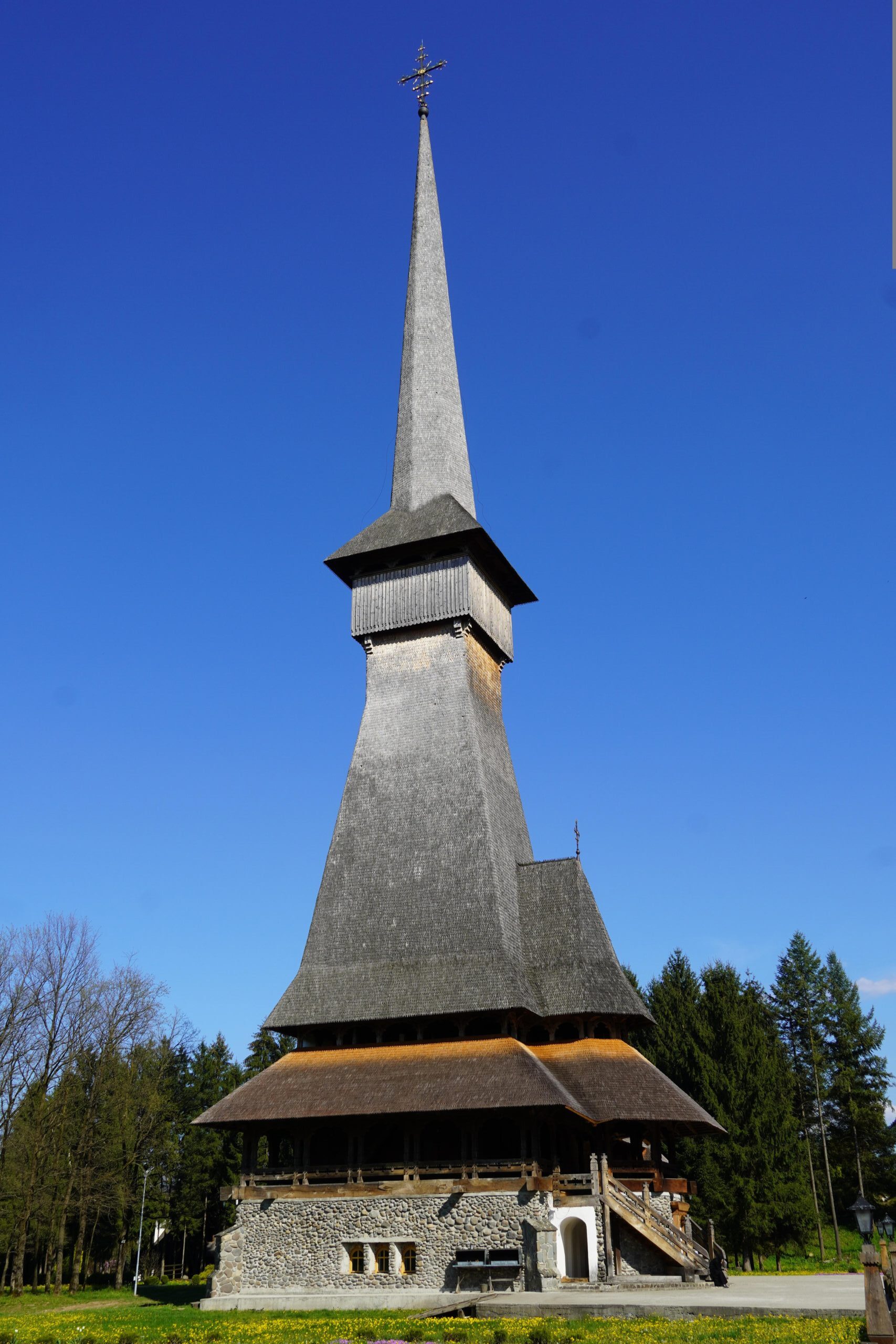
Eight wooden churches in Maramureș are UNESCO World Heritage Sites, and dozens more stand outside the list. They were built mostly in the 17th and 18th centuries, after Austrian rule forbade Orthodox communities from building in stone, and the carpenters answered the insult with architecture: Gothic proportions executed entirely in oak, towers that seem too tall to stand, interiors painted floor to ceiling by itinerant artists.
You don’t need all eight. See three well:
Șurdești, whose 54-meter tower made it one of the tallest wooden structures in Europe when it was raised in 1721. Ieud, in a valley that feels like the region’s spiritual core, where locals will tell you their hill church is the oldest in Maramureș and the argument itself is part of the visit. Bârsana, technically a cheat: the UNESCO church from 1720 stands in the village, while the famous monastery complex on the hill is new, built from the 1990s onward in flawless traditional carpentry. Purists sniff at it. I think watching a 300-year-old craft tradition still operating at full strength is exactly the point of coming here.
Churches are often locked; a phone number on the gate or a neighbor with a key is the normal protocol. This is not an inconvenience. It’s how you end up drinking horincă (the local double-distilled plum brandy) with a churchwarden at 11 in the
Breb and the Living Villages
If you stay one night anywhere in Maramureș, stay in Breb, under the Gutâi mountains. The village has become quietly known among travelers who want the real thing: wooden houses, working farms, guesthouses run by families who’ll feed you their own cheese and vegetables. Walk the lanes in the evening when the cows come home on their own, each one peeling off at its own gate. Nobody choreographs this.
The traditions here aren’t performances either. Hay is cut with scythes because the slopes are too steep for machines. Older women wear the layered skirts and headscarves daily, not for festivals. If you’re nearby in late December, the Marmația winter customs festival in Sighet brings out masks, bells, and rituals that predate Christianity by a comfortable margin.
Borșa and the Rodna Mountains
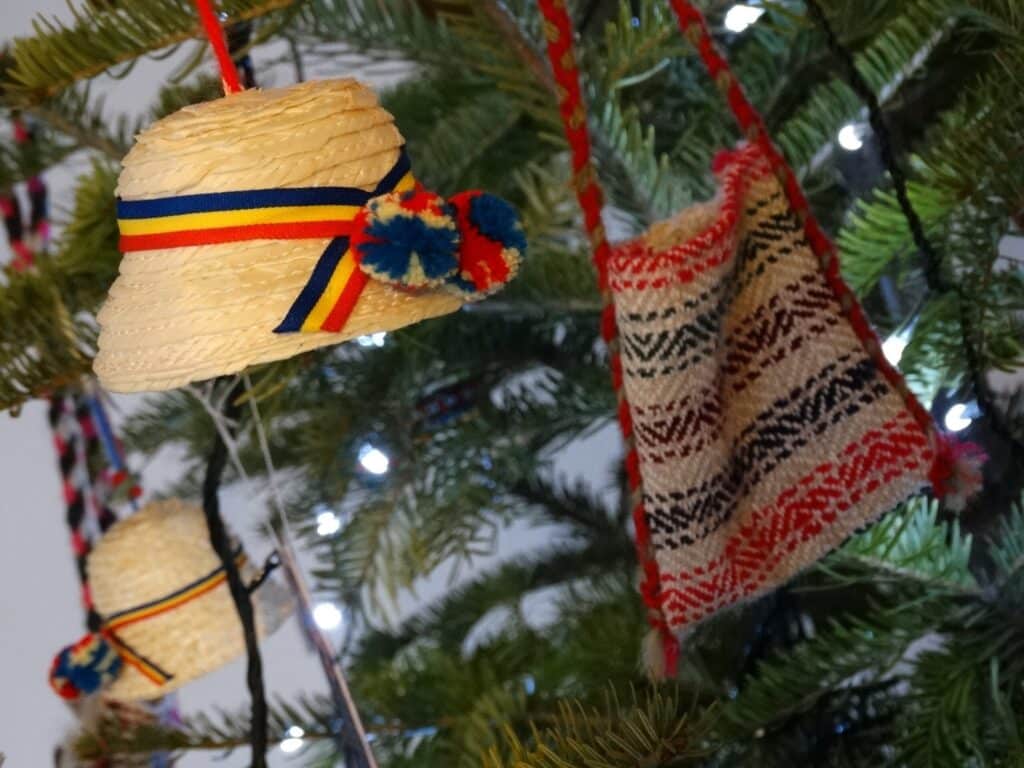
The eastern end of Maramureș rises into the Rodna Mountains, the highest range of Romania’s Eastern Carpathians, and Borșa is the base for getting into them. Pietrosul Rodnei, the summit, stands at 2,303 meters; the full ascent from Borșa is a serious day hike through a national park where chamois sightings are routine.
The accessible classic is the Horses Waterfall (Cascada Cailor), about 90 meters of stepped cascade reachable by chairlift from Borșa’s small resort area plus a 30-minute walk. Legend says a herd of horses sheltering from a bear was driven over the cliff here, which is the kind of cheerful origin story this region specializes in.
From Borșa you have a decision to make, and it shapes the rest of the trip.
The Mocanita: Steam Up the Vaser Valley
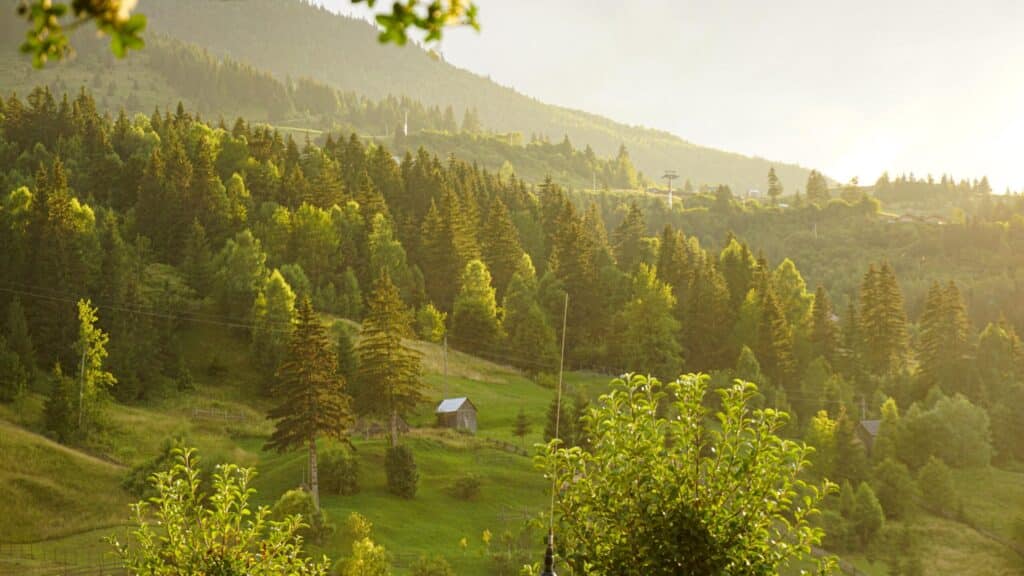
Before leaving Maramureș, one detour I’d argue is non-negotiable: the Mocănița, Europe’s last working forestry steam railway, running from Vișeu de Sus up the wild Vaser Valley. The line was built in the 1930s to haul timber and it still does, but morning passenger trains carry visitors deep into a roadless valley along the Ukrainian border, all steam, creaking wood, and river gorge. Book ahead in summer, take the earliest departure, and bring layers; the valley stays cold.
The Road Between: Colibița and the Tihuța Pass
Most travelers connect Maramureș and Bucovina over the Prislop Pass, the direct road east from Borșa at 1,416 meters. It’s beautiful and it works. But there’s a longer southern arc that I think makes the better trip, dropping through the Salva valley toward Bistrița and climbing back northeast, and it holds two stops most itineraries miss entirely.
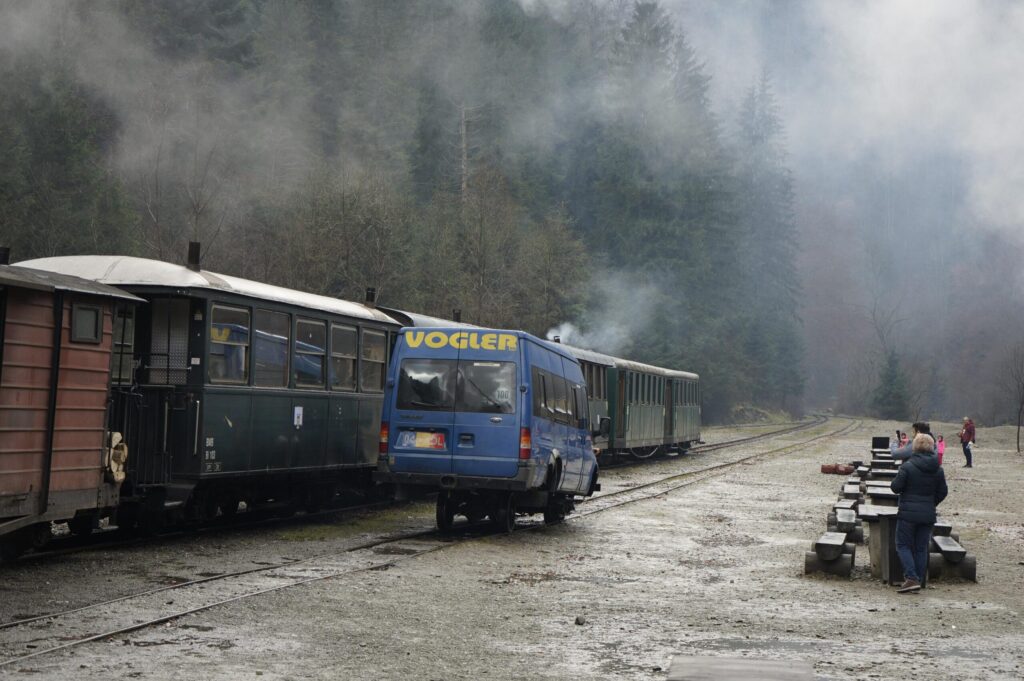
Colibița is a mountain reservoir at around 800 meters in the Bârgău Mountains, created in the 1980s when the Bistrița Ardeleană river was dammed. Locals call it the sea in the mountains, and on a still morning, with the Călimani range doubled in the water, the nickname stops sounding like marketing. It’s a place Romanians keep for themselves: a night here means pine air, grilled trout, and almost no foreign voices. As a halfway camp between the two regions, nothing else comes close.
The Tihuța Pass (1,201 meters) carries the old road from Bistrița over into Bucovina, and it has a strange literary afterlife. This is Bram Stoker’s Borgo Pass, the road Jonathan Harker travels by night coach in the opening of Dracula, written by a man who never set foot in Transylvania. Stoker picked well from his armchair. The pass rolls through dark spruce forest and high meadow, fog is practically resident, and yes, there’s a Hotel Castel Dracula at the top, built in 1983, which is either a charming piece of kitsch or a crime against the landscape depending on your mood. Stop for the view either way. The descent drops you into Bucovina at Vatra Dornei, a faded Habsburg spa town that makes a practical overnight.
If you take this southern arc one way, you can return over Prislop on the way back and see both passes. That’s the loop I’d design.
Bucovina, Romania: The Painted Monasteries
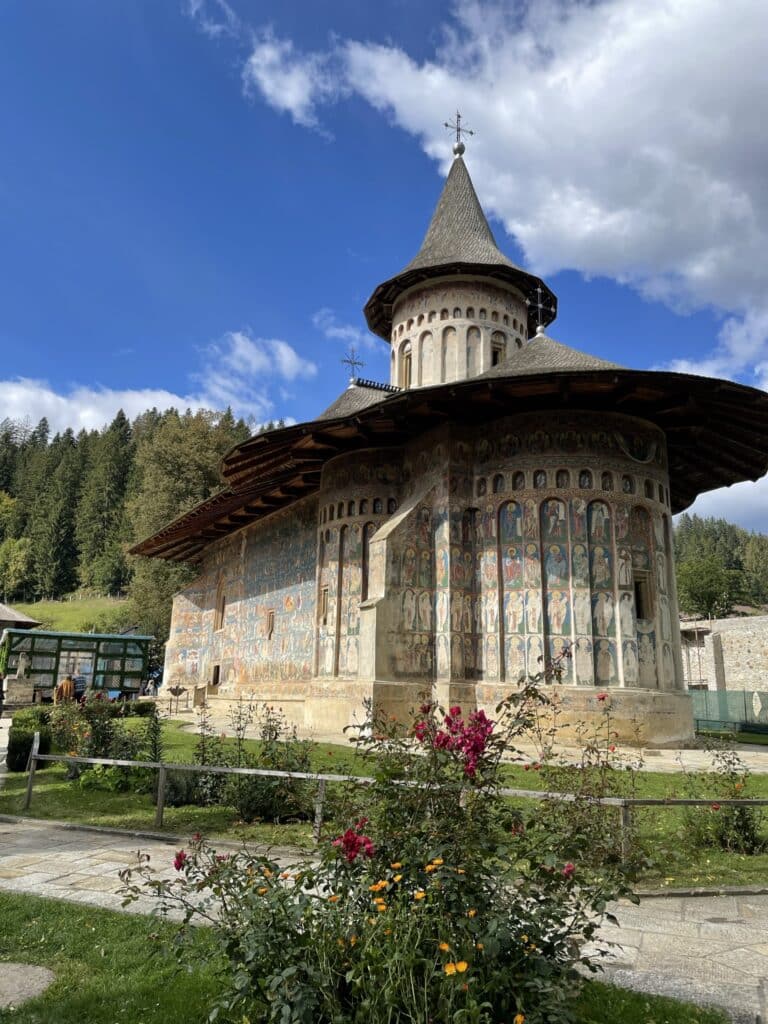
Bucovina means land of beech trees, a name the Habsburgs gave the region when they annexed it in 1775, and the Austrian century left its mark in the orderly towns and the pastel railway stations. But the reason you’re here is older: a cluster of fortified monasteries built in the late 1400s and 1500s whose churches are painted on the outside, every external wall covered in frescoes, and the frescoes have survived 500 years of Carpathian winters in the open air.
There’s nothing else like them in Europe. Eight of these churches form the UNESCO Churches of Moldavia listing, and they exist because of one man’s victories.
A Two-Minute History
Stephen the Great ruled the principality of Moldavia from 1457 to 1504 and spent most of that reign fighting the Ottoman Empire, with a success rate that made him a legend across Christian Europe. His habit, and later his son Petru Rareș’s, was to raise a church or monastery after a victory. The exterior painting came slightly later, in the early 1500s: an illiterate population needed the Bible, the saints, and current politics explained, so the walls became billboards. Theology, propaganda, and folk art fused into a single medium, and the pigment recipes were so good that conservators still argue about how some of them were made.
Sucevita and Moldovita
Sucevița is the largest and the last, painted around 1600, ringed by genuine fortress walls with towers at the corners. Its signature fresco is the Ladder of Virtue on the north wall: 32 rungs to paradise, angels in formation on one side, a chaos of falling sinners and gleeful demons on the other. The dominant green of its palette gives the whole complex a submerged, forest light.
Moldovița, raised by Petru Rareș in 1532, glows yellow and gold, and its famous panel is the Siege of Constantinople, ostensibly depicting a 7th-century Persian attack but painted with unmistakably Ottoman besiegers. Sixteenth-century Moldavians knew exactly what they were looking at.
Voroneț: The Sistine Chapel of the East
Start here. Voroneț was built by Stephen the Great in 1488 in less than four months, which is its own kind of flex, and its west wall carries the most famous image in Romanian art: a full-wall Last Judgment where the saved file upward, the damned tumble into a river of fire, and the surrounding sky is painted in a blue so distinctive it has its own name. Voroneț blue holds its intensity outdoors after five centuries, and nobody has conclusively reproduced it.
Look closely at the Last Judgment and you’ll find the politics: the crowd of the damned includes figures in Ottoman dress. The walls were preaching resistance.
Putna, Marginea, and the Crafts of the North
Putna Monastery, near the Ukrainian border, holds Stephen the Great’s tomb and functions as something close to a national shrine. The church was rebuilt over the centuries so the painting is gone, but the weight of the place is intact, and the museum holds medieval embroidery that belongs in any conversation about European textile art.
On the road to Sucevița, stop in Marginea, where workshops still produce the region’s black ceramics, smoke-fired in a technique that predates written records here. You can watch a pot thrown and buy it for the price of a sandwich in Paris.
Bucovina’s other living art is the painted egg. Decorated with wax-resist geometry in patterns specific to individual villages, they’re a serious craft tradition with museums dedicated to them in Vama and Moldovița. If you travel before Orthodox Easter, the villages produce them in volume and you can sit in on the work.
Rarău and Ciocănești: The Quiet Additions
Two stops most Bucovina itineraries skip. The Transrarău road climbs over the Rarău massif past Pietrele Doamnei, a set of limestone towers above the treeline, and it’s a 90-minute detour that delivers the best mountain views in the region. And Ciocănești, on the upper Bistrița river near Vatra Dornei, paints its houses the way other villages paint eggs: traditional motifs in black and white wrap every façade. It calls itself a museum-village and for once the label is earned.
A 7-Day Northern Romania Itinerary
This is the loop in its full form, starting and ending at Cluj-Napoca, the most practical airport. Baia Mare or Suceava work as alternatives if your flights cooperate.
Day 1: Cluj to Breb. Drive north (about 3 hours), settle into a village guesthouse, evening walk as the animals come home. Dinner at the guesthouse, always. Do not neglect the city of Cluj Napoca. There are plenty of things to do in Cluj.
Day 2: Săpânța and Sighet. Merry Cemetery early, Sighet Memorial before lunch, Elie Wiesel house after. Back to Breb or sleep in Vadu Izei.
Day 3: Wooden churches and the Iza valley. Șurdești or Desești, Bârsana village church and the monastery hill, Ieud. Sleep in Vișeu de Sus.
Day 4: The Mocănița. Earliest steam departure up the Vaser Valley, back by mid-afternoon. Drive to Borșa, chairlift and walk to the Horses Waterfall if light allows.
Day 5: South to Colibița. The Salva road to Bistrița, then up to the lake. Slow afternoon, trout, water, mountains. This is the rest day the trip needs.
Day 6: Tihuța Pass into Bucovina. Over the Borgo Pass, coffee stop for the view and the Dracula kitsch, descend to Vatra Dornei, detour through Ciocănești, optionally the Transrarău. Sleep around Vama or Gura Humorului.
Day 7: The painted monasteries. Voroneț at opening, Humor, Moldovița, Marginea pottery, Sucevița. Return west over the Prislop Pass for symmetry, or overnight near Suceava and depart from there.
Hikers should add a day at Borșa for Pietrosul. Travelers who hate moving nightly can base three nights in Breb and three around Vama and still see almost everything.
Practical Notes: When, How, and What It Costs
When to go. May, June, and September are the sweet spots: green or golden, warm days, no crowds worth mentioning. July and August are fine outside the late-morning bus window at Voroneț and Săpânța. Late December is its own category, for the winter customs, if you’re comfortable with mountain driving. The passes can close briefly in heavy snow.
Getting around. Rent a car. Public transport exists but turns a 7-day loop into a 12-day exercise in patience. Roads are better than Romania’s reputation suggests, and the driving itself, especially the two passes, is a reason to come. If you’d rather not drive, this is exactly the kind of trip where a designed itinerary with arranged drivers earns its keep.
What it costs. Here’s the part that surprises people. Northern Romania delivers one of the best value-to-depth ratios in Europe. As of 2026, expect roughly 35 to 60 EUR per night for a double room in an excellent village guesthouse with breakfast, 8 to 12 EUR for a generous dinner with local wine or horincă, and entry fees to monasteries and museums that rarely pass 2 to 3 EUR. A couple traveling comfortably, car included, lands around 100 to 140 EUR per day total. The same texture of trip in Tuscany or Provence runs triple. I won’t pretend Romania is the “cheapest” destination in Europe, because chasing cheapest gets you a hostel in a city you didn’t want. But for travelers who measure cost against what they actually experience, the north of Romania is hard to argue with.
Food. Guesthouse dinners beat restaurants almost everywhere on this route. Expect soups (the sour ciorbă tradition), polenta with sheep cheese and cream, slow-cooked meats, garden vegetables in summer, and homemade everything. Vegetarians manage well in summer, less effortlessly in winter.
Language. English is solid among younger people and guesthouse owners, thinner in villages. Romanian is a Romance language; if you have French, Italian, or Spanish, written signs start making sense within days.
Why I Send Certain Travelers North First
When someone takes my free personality assessment and scores high on Openness with moderate or low Extraversion, Maramureș and Bucovina are often the first thing I sketch, before Spain, before anywhere glamorous. Not because the north is obscure and obscurity is cool, but because this specific combination of traits predicts that depth, authenticity, and quiet will register as luxury, and this region concentrates all three at a price that lets you stay longer.
That’s the entire premise of The Verse Voyager: the best destination isn’t the best-reviewed one, it’s the one matched to how you process the world. Take the assessment, and if northern Romania is your shape of trip, I’ll design the version of this loop that fits your pace, your season, and your non-negotiables through my custom travel design services. If you’d rather just talk it through first, get in touch and book a discovery call.
Not just where you go. How it changes you.
FAQ
Is Maramureș worth visiting? Yes, and arguably first. Maramureș is the last region in Europe where pre-industrial village life continues uninterrupted: UNESCO wooden churches, the Merry Cemetery at Săpânța, working steam railways, and living craft traditions. It rewards travelers who want culture over spectacle.
How many days do you need for Maramureș and Bucovina? Seven days covers both regions comfortably as a loop from Cluj-Napoca, including the Tihuța Pass and Colibița lake between them. Five days is the workable minimum if you skip the hikes. Maramureș alone needs three full days.
What is the Merry Cemetery in Romania? The Merry Cemetery in Săpânța, Maramureș, is a village cemetery with more than 800 oak crosses painted in a signature blue, each carrying a folk portrait and a humorous first-person epitaph about the deceased’s life. The tradition was started by carver Stan Ioan Pătraș in 1935 and continues today.
Can you visit the painted monasteries of Bucovina without a car? It’s possible using buses and taxis from Gura Humorului or Suceava, but connections are slow and you’ll see fewer monasteries per day. A rental car or a designed itinerary with a driver makes the five main painted monasteries achievable in a single day.
When is the best time to visit northern Romania? May, June, and September offer the best balance of weather and quiet. Before Orthodox Easter adds the painted egg traditions in Bucovina; late December brings the winter customs festivals of Maramureș. Mountain passes can briefly close in heavy snow.
Is northern Romania expensive to travel? No. Expect around 35 to 60 EUR per night for quality village guesthouses with breakfast, 8 to 12 EUR for dinner, and monastery entries under 3 EUR. A couple traveling by rental car spends roughly 100 to 140 EUR per day in total, a fraction of comparable rural trips in Western Europe.
Leave a Reply
You must be logged in to post a comment.