
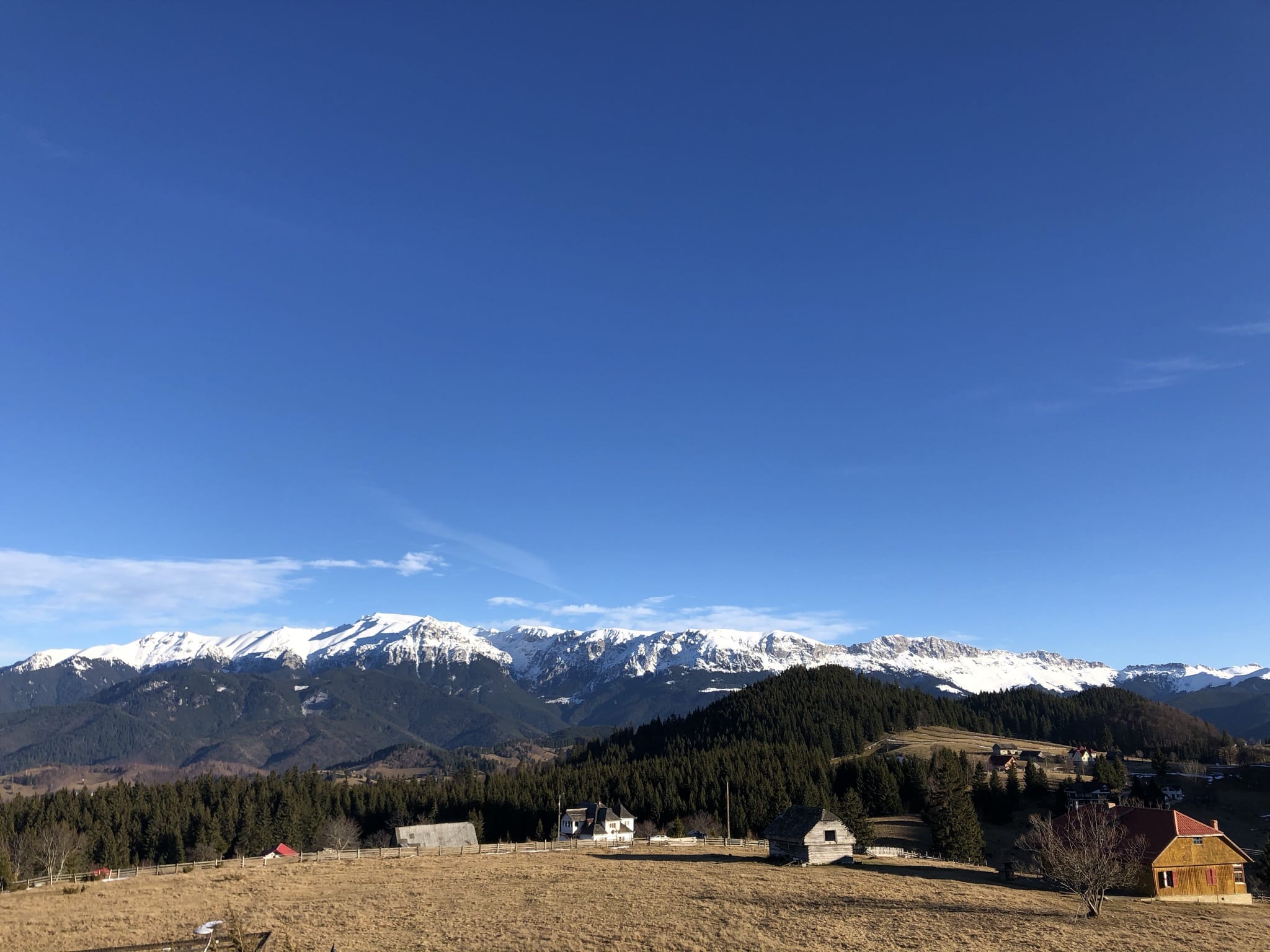
Table of Contents
The Short Version
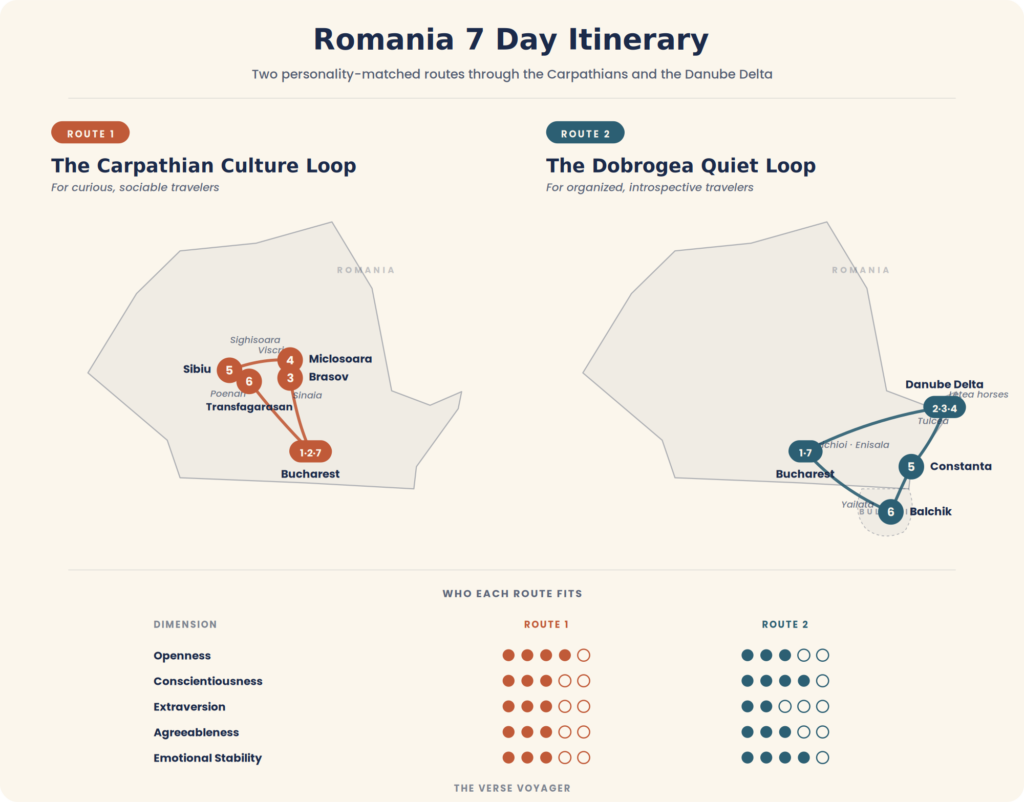
If you only read one paragraph: this Romania 7 day itinerary gives you two completely different one-week trips, one for travelers drawn to culture, movement and variety, and one for travelers drawn to quiet nature and structure. Route 1, the Carpathian Culture Loop, runs Bucharest into the mountains, across Transylvania, and back over the Transfagarasan. Route 2, the Dobrogea Quiet Loop, runs Bucharest to the Danube Delta, down the wild coast of Dobrogea, briefly into northern Bulgaria, and home. Both work in spring, summer, and autumn, with small swaps depending on the season. Pick the one that fits the way you actually travel.
- Route 1 is for: curious, sociable travelers who like a packed pace, castles, food, and surprise turns in the road.
- Route 2 is for: organized, introspective travelers who want birdsong, water, and slow days with a clear plan.
- Best months: late April through mid October, with a few seasonal swaps noted below.
- How to get around: rent a car. A 7 day trip to Romania without one is a 7 day trip you only half do.
How This Romania Itinerary Works
Most “things to do in Romania” lists assume every traveler wants the same trip. They don’t. The exact same week in Romania can be the best holiday of someone’s life and a slow seven-day grind for the person next to them, and the difference comes down to personality, not destinations.
At The Verse Voyager we design every trip around five personality dimensions, the same ones the science of personality has been built on for decades. Two of those dimensions, Openness and Extraversion, change pace and stimulation. The other three (Conscientiousness, Agreeableness, Emotional Stability) shape how much structure, social warmth, and predictability you want. Two travelers with very different scores will love Romania in very different ways. That is exactly what these two routes do.
If you want the full picture of the country before you choose, our complete guide to the best places to visit in Romania covers every region. If you want to see how the same logic applies to another country, our Spain regions by personality guide is the sister piece. And if you want to know where you actually land on the five dimensions, the free travel personality quiz takes about ten minutes.
When to Visit Romania: Spring, Summer, or Autumn
A 7 day trip to Romania works in any of three seasons, but each one changes the feel and the practicalities. Quick read of the tradeoffs.
Spring (mid April to June)
Romania at its greenest. Hills come alive, the Delta fills with migrating birds, and bears are out of hibernation and active, which is ideal for wildlife. Temperatures sit between mild and warm, prices stay low, and the country is uncrowded.
The one catch: the high mountain roads. The Transfagarasan usually only opens fully around late June, and the Transalpina is similar. If you travel in May or early June, you’ll need the alternative Olt valley route on Route 1 Day 6 (still beautiful, still worth it). The Delta is at its absolute best for birdwatching from late April through May.
Summer (July and August)
The warmest, busiest months. Both high passes are fully open. The Black Sea coast is in full swing, Vama Veche is loud, and the Delta is hot and lush. Bears are still very active in the Carpathians. Bucharest gets warm enough that you’ll plan around midday heat.
Summer is the easiest season logistically because everything is open and accessible. It is also the season where booking a few weeks ahead actually matters, particularly for the Delta and the Kalnoky estate stays.
Autumn (September and October)
Many travelers, including us, think this is the best season for Romania. The Transfagarasan is still open, crowds thin out, the forests turn, and bears are at their hungriest before hibernation, which makes for excellent watching. The Delta light in September is something else. Days are mild and nights start to bite, so pack layers.
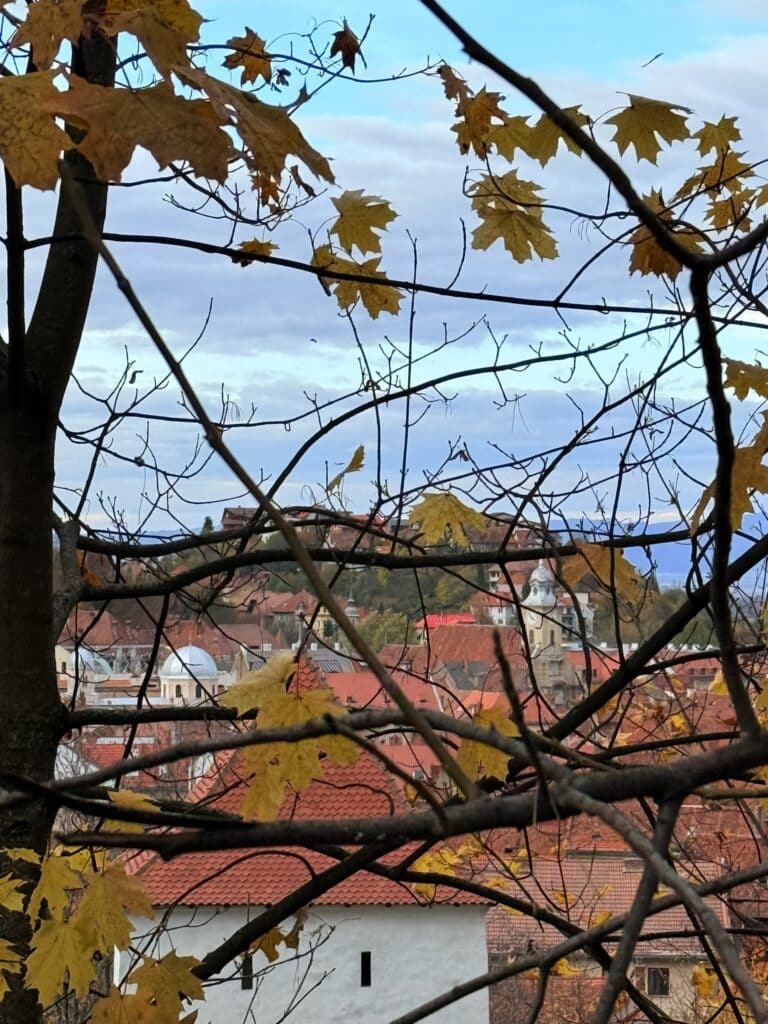
Autumn leaves in Brasov, Romania
Practical Basics for a 7 Day Romania Trip
This is the short version. For deeper logistics see the main Romania travel guide.
- Rent a car. Both routes depend on it. Pick it up at Bucharest airport on arrival, drop it on departure.
- Currency. Romanian leu (RON). Cards work in cities and tourist spots, cash matters in villages and at small Delta restaurants.
- Language. Younger Romanians and anyone in tourism speak English. In Saxon villages and the Szekely Land a few words of German or Hungarian go a long way.
- Safety. Low crime overall. The real outdoor risk is bears in the Carpathians. Don’t feed, don’t approach, don’t stop your car to photograph one.
- Border with Bulgaria. Both countries are in Schengen, so the Route 2 day trip south is a smooth EU crossing now.
What a 7 Day Trip to Romania Actually Costs
Romania is still one of the better-value European destinations, but a few line items genuinely change the budget. Here’s an honest read of where money goes on either route, in per-person terms for two travelers sharing a room during a 7 day itinerary.
- Flights. Bucharest is well connected from across Europe with low-cost carriers. From the US or Asia you’ll usually route through a Western European hub. Budget what you’d budget for any European city.
- Car rental. A small to mid-size car for seven days runs roughly 250 to 450 EUR depending on season, plus fuel. Book through a known international agency at Bucharest airport. Don’t take the smallest car for Route 1; you’ll be on mountain roads.
- Accommodation. Bucharest, Brasov and Sibiu boutique stays sit in the 70 to 130 EUR per night range outside high summer. Delta lodges run 80 to 150 EUR per person per night, often with meals included, which is where Route 2’s value actually shows. The Kalnoky estate guesthouses are a step up (rightfully so) and book out months ahead.
- Food. Dinner at a real restaurant rarely tops 25 to 35 EUR per person with wine. Village meals on Route 2 are usually included in your lodge. Saxon village home lunches on Route 1 sit around 15 to 25 EUR a head.
- Entry tickets and tours. Peles, Bran, the Palace of the Parliament, fortified churches, the Delta boat days, bear watching, Balchik palace and garden. Budget around 200 to 350 EUR per person across the week for entries and guided activities, more if you do every premium tour on Route 1.
- Extras. Tips for guides (10 to 15 percent at most), a small budget for craft buys in Maramures and Horezu if you wander into them, and a comfortable cushion for fuel detours.
A realistic all-in Romania 7 day itinerary for two travelers, excluding international flights, lands between roughly 1,500 and 2,800 EUR depending on accommodation choices and season. That covers a proper version of either route, not a backpacker version and not a luxury one.
What to Pack for Romania in One Week
Both routes share most of a packing list, with a few small differences.
- Layers, always. Romanian weather changes fast, especially in spring and autumn. A light fleece and a packable rain shell live in your day bag.
- Real walking shoes. Cobblestones in Sibiu, gravel at Viscri, sand at Letea, climbing steps at Poenari. A single comfortable closed shoe handles all of it.
- A swimsuit. For the Szekely spa on Route 1 and the Delta swimming and Black Sea on Route 2.
- Binoculars and a zoom lens. Worth their weight on Route 2 (Delta birds, Letea horses). On Route 1, useful for bear watching from the hides.
- A power adapter (Type F, European two-pin). Same as most of mainland Europe.
- Cash in small denominations. For tips, small village shops, and Delta restaurants.
- A printed copy of your booking confirmations. Particularly useful for the Kalnoky estate on Route 1 and the Delta lodge on Route 2, where mobile signal is patchy.
Route 1: The Carpathian Culture Loop
A high-variety, high-stimulation week. You sleep in five different beds, drive one of the most famous mountain roads in Europe, sit down with shepherds and counts in the same trip, and watch wild brown bears at dusk. There is no wasted day.
Who this route is for
This is a Romania itinerary for travelers who score:
- High Openness. You want novelty, art, ideas, layers of history, food you haven’t tried, and you will happily reroute for something interesting.
- Mid Extraversion. You enjoy company and a busy day, but you don’t need crowds. You like a good dinner conversation, not a packed club.
- Mid Agreeableness. You’re warm with hosts and travel companions, but you have your own opinions and you’ll voice them.
- Mid Emotional Stability (mid Neuroticism). You can roll with a delayed lunch, a closed road, or an unplanned bear. You don’t need everything controlled.
In plain English, you are the kind of traveler who wakes up curious and goes to bed happy that the day was long. Not sure if that’s you? Take the free personality quiz and find out before you book anything.
How this loop changes by season
- Spring (May, early June): Transfagarasan likely closed. Day 6 runs Sibiu to Bucharest via the Olt valley instead, which is genuinely lovely (Cozia monastery, Calimanesti spa town). Bears at the Kalnoky hides are very active.
- Summer (July, August): Full Transfagarasan day on Day 6. Book Viscri lunch and bear watching well ahead.
- Autumn (September, October): The best version of this loop. Transfagarasan still open. Colors. Quiet. Bears at peak watching intensity. Book Kalnoky stays a month or more in advance, the property fills up.
Day 1: Bucharest, Settling In
You’ll likely land in the morning or early afternoon, pick up the rental, and check into a hotel in the old town. Resist the urge to over-plan day one. A high-openness traveler is going to want to walk, and Bucharest rewards walking.
Spend the afternoon in the Old Town (Lipscani): the ruins of the Old Princely Court, the photogenic Stavropoleos church, and the much-photographed Carturesti Carusel bookshop. Drift into the Romanian Athenaeum if there’s a free moment (the building alone is worth the stop). Have your first dinner at one of the city’s modern bistros. Save the heavy classics for tomorrow.
Day 2: A Deeper Day in Bucharest
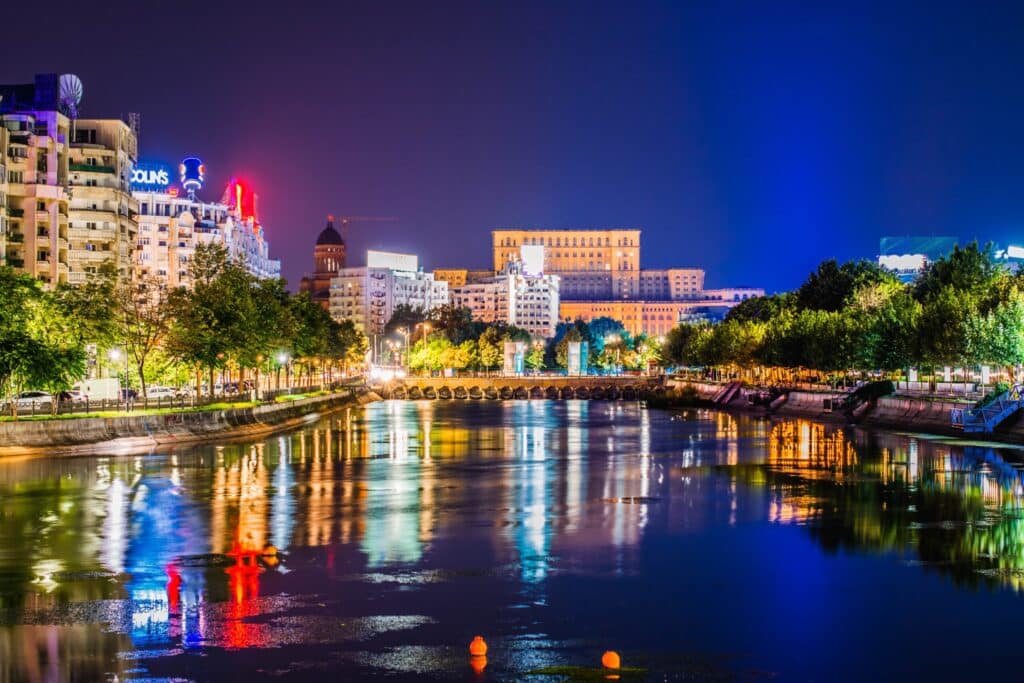
This is the day to do the heavyweight sight. Book a morning guided tour of the Palace of the Parliament, one of the largest and heaviest buildings on the planet (book ahead, especially in summer). Walk down the giant Unirii boulevard afterward to feel the deliberate scale of it.
Afternoon: contrast it with somewhere green and human. Cismigiu Gardens in the center, or the open-air Village Museum by Lake Herastrau, where traditional houses from across the country sit side by side. Dinner at a proper old beer hall like Caru’ cu Bere for one classic Romanian meal under stained glass, then a drink in one of the rooftop bars off Calea Victoriei. If you want a deeper read on the capital, the Bucharest section of our main guide covers what else is worth your time. For more details about things to do in Bucharest you can check out this website.
Day 3: Bucharest to Sinaia to Bran to Brasov
A driving day, and a beautiful one. Roughly two and a half hours of total driving spread over a day full of stops.
Leave Bucharest by 8 AM. First stop, Sinaia in the Prahova Valley. Spend two hours at Peles Castle, the neo-Renaissance former royal summer residence. Carved wood, painted ceilings, the lot. It is probably the most beautiful castle in Romania and it earns the visit. Coffee in town afterward.
Continue to Bran Castle. Here’s the honest version: Bran is mainstream and overrated, the Dracula link is thin, and the crowds are real. We tell every client this. If you must see it, treat it as a 45-minute photo stop from the outside, then move on. Don’t waste a half day there. Also, be careful from which website you are buying the tickets. You can buy your ticket directly at the castle or from the official website.
Push through to Brasov by late afternoon. Walk the medieval Council Square, see the soaring Gothic Black Church, take the cable car up Mount Tampa for sunset over the rooftops. Dinner at Bistro de l’Arte, a small artisan bistro hidden in the old town that does excellent modern Romanian cooking. Sleep in Brasov.
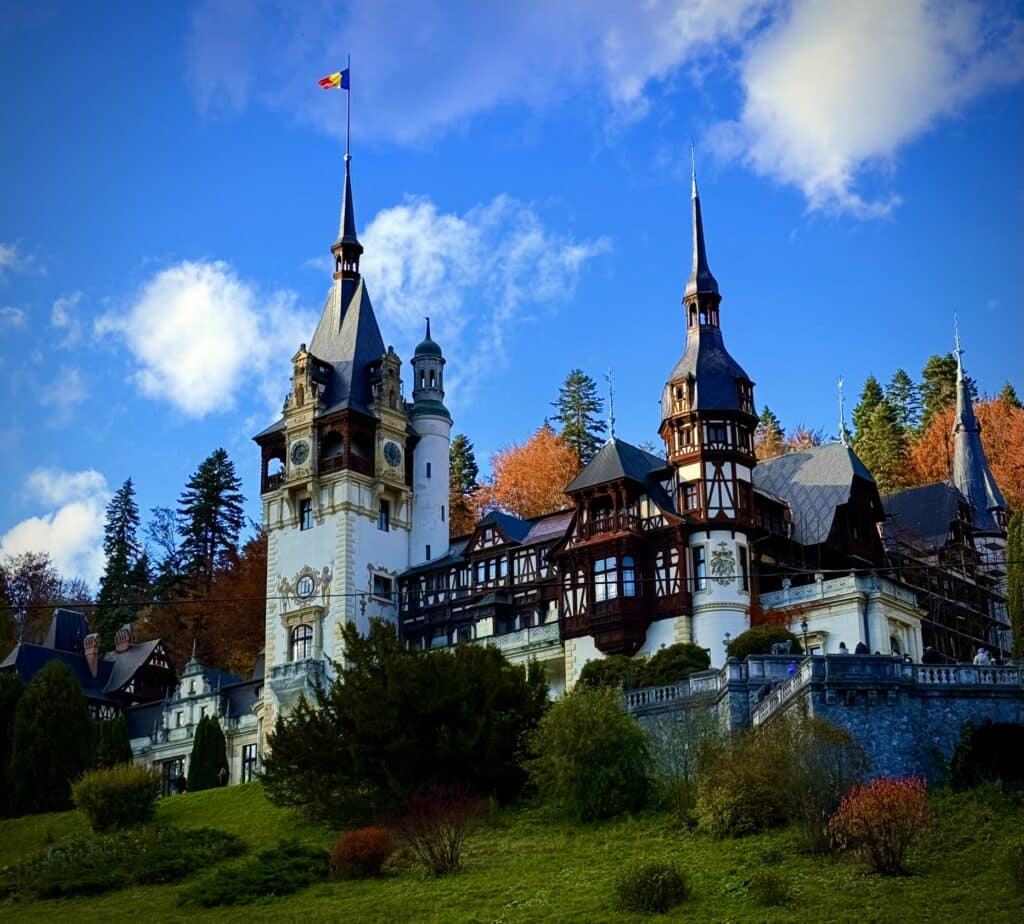
Peles Castle, Sinaia
Day 4: Miclosoara, Bear Watching, Daniel Castle, Szekely Spa
Today is the heart of this route, and the day most travelers remember years later. Drive about an hour and a half east into the Szekely Land, the Hungarian-speaking part of Transylvania.
Base yourself at one of the restored noble estates run by Count Tibor Kalnoky in Miclosoara (Miklosvar), a tiny village rebuilt around the family’s old manor houses. You’ll be eating from the estate’s own kitchen and garden and sleeping in rooms that were furnished by the count himself. It is one of the singular places to stay in Romania.
Mid-afternoon, head out to the bear-watching hide the estate operates in the forest nearby. You sit, you stay quiet, you wait, and the bears come. In good autumn weeks the sightings are reliable. This is one of the few places in Europe where you can do this responsibly, from a permanent hide, with no baiting that turns wildlife dangerous.
After bear watching, drive a short way to Tálișoara to see Castelul Daniel (Daniel Castle), a 17th century manor restored as a guesthouse and a stop in its own right. End the day with a traditional Szekely thermal bath, wood-heated, deeply restorative, the local cure for a hard week. Sleep back at Miclosoara.
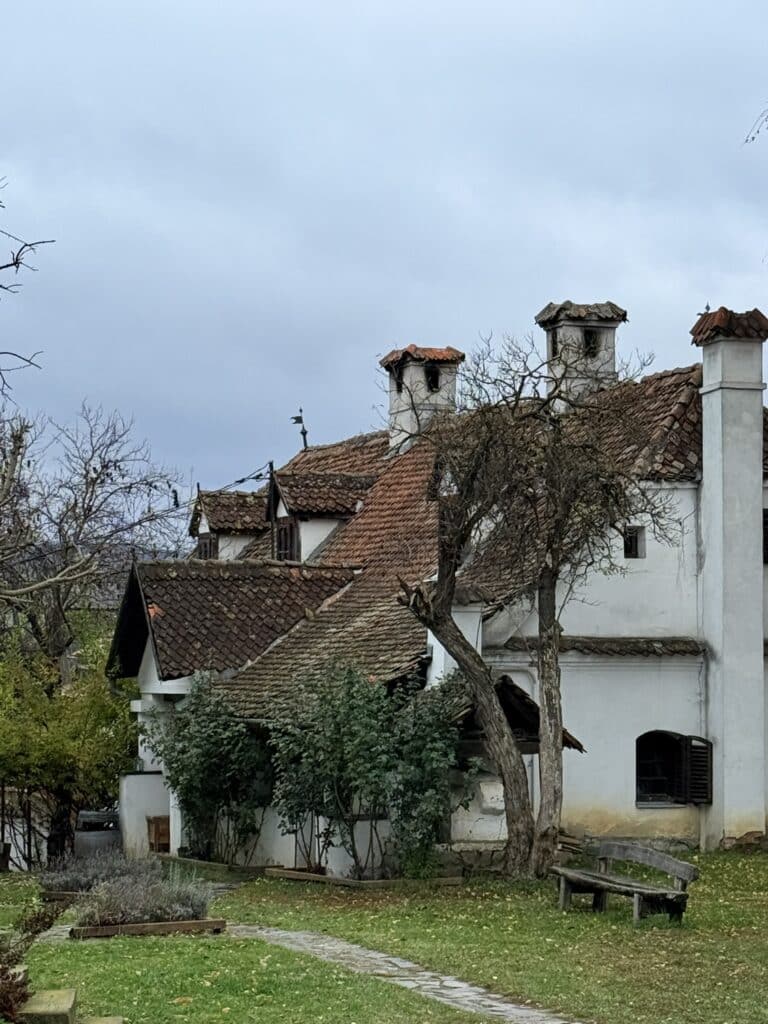
Kalnoky Estate, Miclosoara
Day 5: Viscri, Sighisoara, Biertan, Sibiu
Saxon Transylvania day. Drive west to Viscri, the small village made internationally famous by King Charles III, who fell for the place and bought property here. Visit the UNESCO-listed fortified church. The right way to do Viscri is to arrange lunch in a local family’s home (a few houses in the village offer this) and eat what they cooked that morning. You will remember it longer than any restaurant meal.
From Viscri, drive to Sighisoara, the perfectly preserved citadel where Vlad the Impaler was born. An hour or two is enough: walk the upper town, climb the Clock Tower, see the birth house. Push on through to Biertan, one of the great fortified Saxon churches, with its famous multi-bolt door.
Sleep in Sibiu. Pastel facades, cobbled squares, the Bridge of Lies, the rooftops with their half-shut “eyes.” Dinner in the lower town. For more on the Saxon citadels and villages, see the Transylvania section of the main guide.
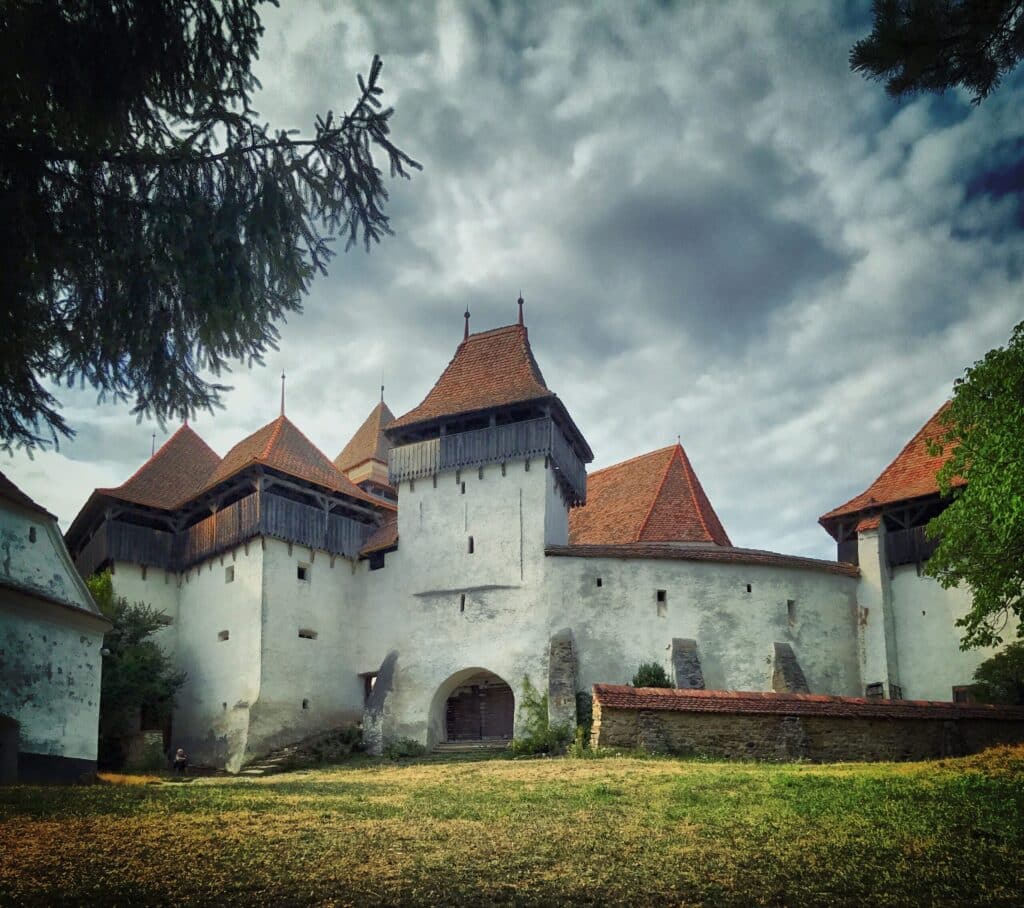
Viscri fortified church
Day 6: Sibiu Back to Bucharest via the Transfagarasan
The driver’s day. From Sibiu, one of the most beautiful cities in Romania, head south and climb the Transfagarasan, one of the great mountain roads in the world. Hairpins, glacial valleys, Balea Lake and its waterfall at the top, then a long descent past Poenari Citadel, Vlad the Impaler’s actual fortress (a steep climb up steps if you have the legs for it). Arrive in Bucharest in the evening. Roughly five to six hours of driving, but you’ll want all day for stops.
Spring alternative: if the Transfagarasan is still closed, drop south through the Olt valley instead. Stop at Cozia Monastery (one of the oldest in the country, burial place of Mircea the Elder) and the spa towns of Calimanesti-Caciulata. Slower, gentler, and very beautiful in spring green.
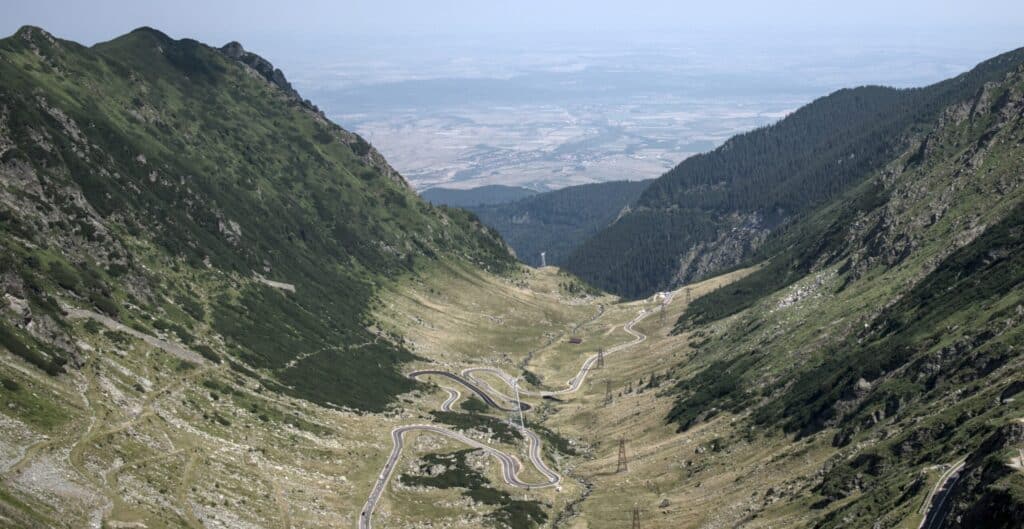
Transfagarasan road, Romania
Day 7: Bucharest, Departure
Late breakfast in Bucharest, last walk through Lipscani, drop the car at the airport. If your flight is in the afternoon, you can fit one more thing in: the Romanian Athenaeum if you missed it, the Museum of the Romanian Peasant, or the Therme spa complex outside the city for a long unwinding morning. Be aware that the experience at the Therme spa complex can be totally different depending on how crowded it is. I would recommend calling in advance in the same day to ask for capacity. Then home.
Route 2: The Dobrogea Quiet Loop
A slower, quieter week. You’ll spend more time on water than in cars, eat freshwater fish you’ve never had before, watch pelicans drift past at sunrise, and end with a small cross-border day into Bulgaria for one of Romania’s lesser-known heritage threads. This tour is focused more on Danube Delta. You can read my article about the 15 underrated places in Europe to understand why this place is a must-see for certain types of people.
Who this route is for
This is a trip to Romania for travelers who score:
- High Conscientiousness. You like a plan. You like knowing what tomorrow looks like. You appreciate trips that respect your time and your structure.
- Mid Openness. You’re not chasing constant novelty. You’d rather go deeper into one place than skim five.
- Low Extraversion. Crowds drain you. You travel to come back to yourself, not to be on stage.
- Mid Agreeableness. Warm, polite, but you don’t need every stranger to be your best friend.
- High Emotional Stability (low Neuroticism). You’re calm, you don’t catastrophize, and you sleep through wind on a Delta houseboat just fine.
In plain English, you’re the kind of traveler who packs lists, books in advance, and finds the best version of a trip in slowness and detail. Not sure that’s you? The free quiz will tell you in ten minutes.
How this loop changes by season
- Spring (late April, May): the absolute best season for the Danube Delta. Bird migration is in full swing, the channels are full of life, and temperatures are mild. Book Delta accommodation early because the operators are still ramping up.
- Summer (July, August): the Delta is hot, the coast is busy. Vama Veche is at peak, which you’ll want to avoid on this route (drive past, don’t stop). The Bulgaria day works well because the sea is warm.
- Autumn (September, October): quiet, golden, the second migration is on. The light in the Delta in September is something experienced birdwatchers travel for. Cheile Dobrogei (the climbing area) is at its best in autumn temperatures.
Day 1: A Slower Day in Bucharest
You land, pick up the rental, and check in centrally. Where Route 1 spends its first day walking, this one spends it sitting and looking. Start at the Museum of the Romanian Peasant, one of the most thoughtfully curated ethnographic museums in Europe. Spend an unhurried afternoon at the open-air Village Museum by Lake Herastrau. Skip the loud old town tonight and have a quiet dinner near the lake or in the embassy district. You will not miss the Palace of Parliament even if you try. This building is BIG.
Tomorrow is an early start, so go to bed early.
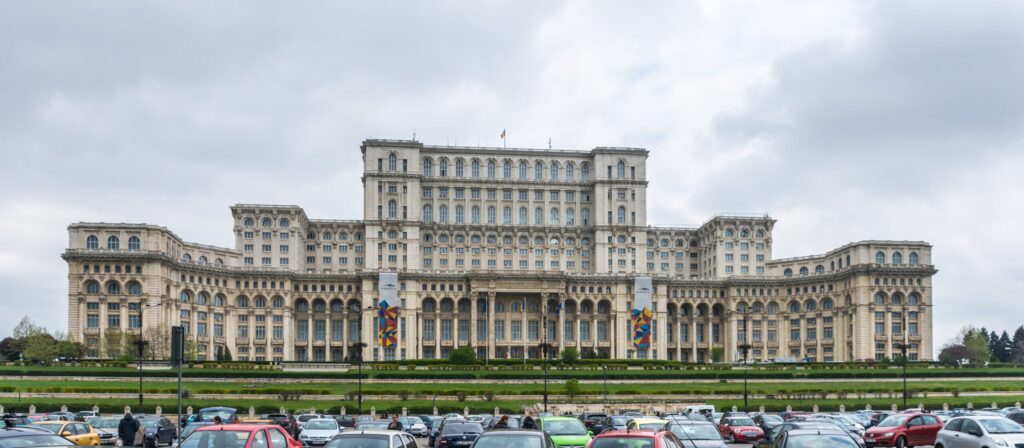
Palace of the Parliament, Bucharest
Day 2: Bucharest to Tulcea, the Danube Delta tour
Four hours of driving northeast to Tulcea, the gateway city to the Delta. You’ll arrive by lunch. Park the car at your accommodation (most Delta lodges have secure parking or shuttle you in from a meeting point) and switch to the boat that takes you into the channels.
The afternoon is the slow read. The Delta announces itself in stages: first the wide arms of the Danube, then narrower side channels lined with reeds three metres high, then the silence. Settle in at your lodge in a village like Crisan, Mila 23, or Sfantu Gheorghe. Dinner is whatever the cook caught that morning, almost certainly carp or pike or sturgeon, with cold mamaliga (polenta). Sleep with the windows open.
For more context on the Danube Delta itself, see the Dobrogea section of our main Romania guide
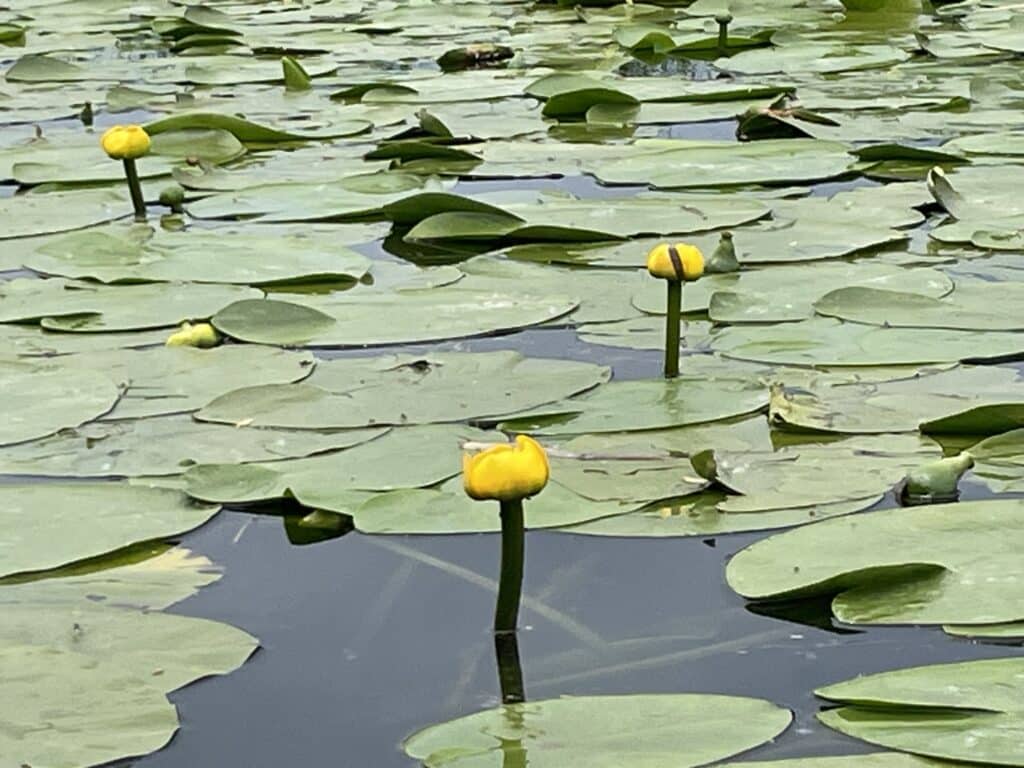
Lotus flower in the Danube Delta, Romania
Day 3: Deeper into the Danube Delta
The biggest day of this route. You go out with your guide before sunrise, when the Delta is at its quietest and the birds are most active. Pelicans, herons, kingfishers, cormorants. Over 300 species live or pass through here, which is why this is one of the most serious Danube Delta birdwatching destinations in Europe.
Mid-morning, switch into a smaller kayak (or stay in the motorboat if you prefer) and head into the interior lakes. Late morning, try a guided fishing session with a local. Lunch is back at the lodge or out on a sandbank with the boatman cooking the catch over a fire. Afternoon, a long unscheduled rest. Evening: a slow sunset cruise. The Delta has a habit of giving you exactly what you came for if you stop trying to fill the time.
Day 4: The Delta Villages and Letea Forest
Today is about the human side of the Delta. Spend the morning visiting one of the more remote villages, ideally Sfantu Gheorghe or Mila 23, where you can sit in a fisherman’s house and see how a community shaped entirely by water actually lives. Lunch on the boat or back at the lodge.
In the afternoon, take the trip to the Letea Forest, a strange sub-tropical sand-dune forest at the north of the Delta, and the famous wild horses that roam it. A Letea outing is half boat, half cart pulled by hardy local horses through deep sand. It is one of the most photographed and least understood corners of Romania. Be respectful: the wild herd is wild, watch from distance. You can also have an authentic experience by having lunch at a gastronomical spot, in a local’s house.
Last night in the Delta. If you’ve ever wondered what truly dark skies look like, walk out late.
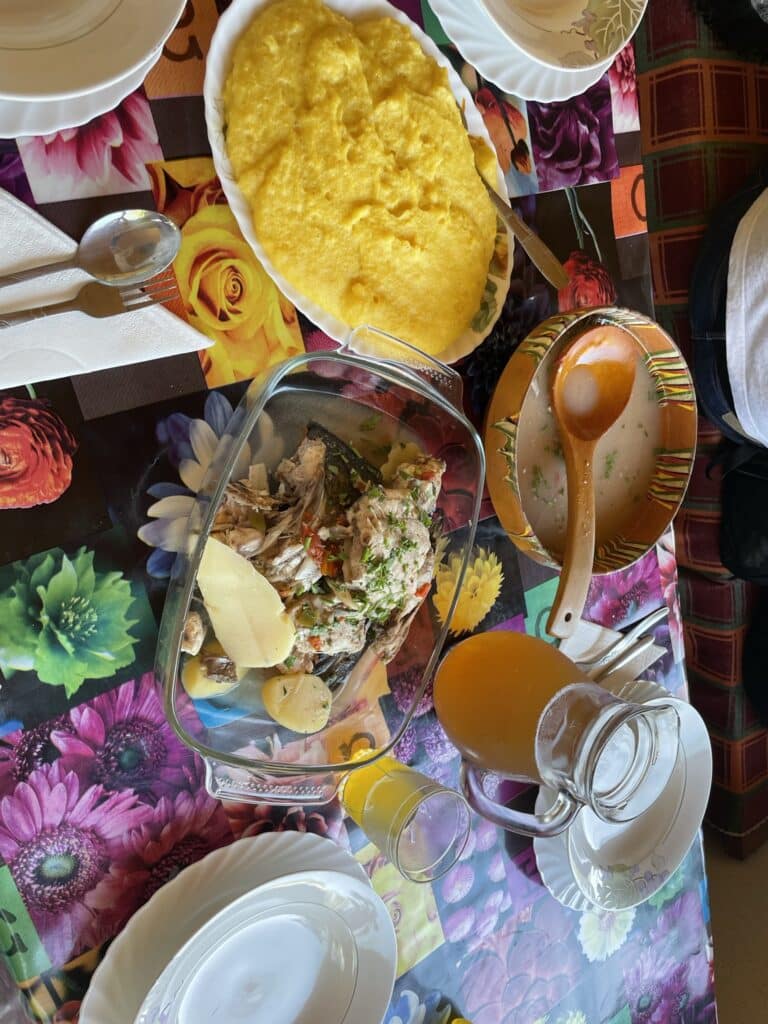
Traditional Danube Delta food at a local’s house: fish soup and polenta
Day 5: Sarichioi, Cheile Dobrogei, Enisala, on to the Coast
A long, varied day on the road back toward the sea. Drive south from the Delta to Sarichioi, a village on Lake Razelm with deep Lipovan roots (Russian Old Believers who settled here generations ago). Visit the small wooden Lipovan church and stop for lunch at LeGa Fish, a local fish restaurant known for fresh turbot from the Black Sea. If you’ve only ever had farmed turbot, this will reset your standards.
After lunch, drive inland into central Dobrogea to Cheile Dobrogei (the Dobrogea Gorges). Small, rarely visited, and oddly underrated. There’s beginner-friendly rock climbing here if you’ve booked a local guide in advance (this fits a structured traveler: arrange it ahead, don’t show up cold), or simply walk the gorges and read the limestone like a quiet geology lesson.
Late afternoon, climb up to Enisala Fortress, a 14th-century stone fortress on a hill above Lake Razim, with one of the great views in Dobrogea. Sleep just outside Constanta, ideally in a quiet hotel away from the Mamaia beach strip.
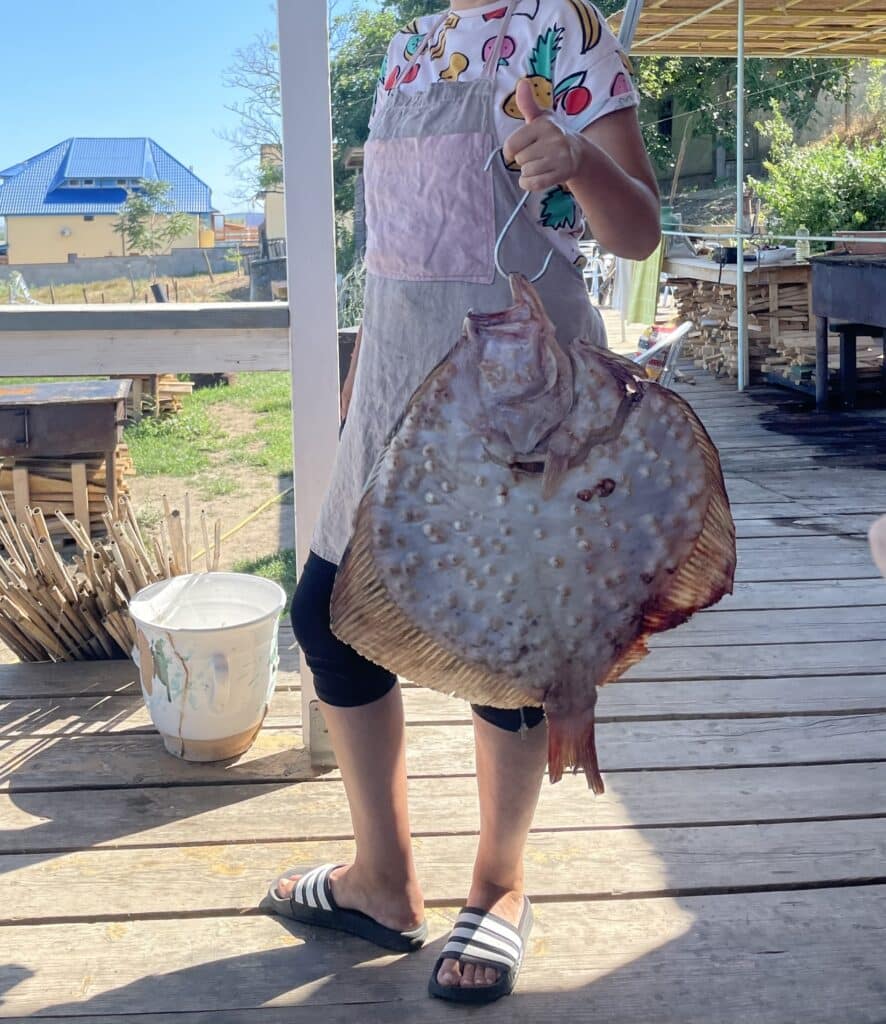
Turbot in Sarichioi, Dobrogea
Day 6: Across to Northern Bulgaria, Yailata and Balchik
A surprising, delightful day that most tourists skip entirely. Both countries are in Schengen now, so the border crossing south of Constanta is smooth. The drive to your first stop is under two hours.
Lead with Balchik, a small Bulgarian coastal town that’s quietly part of Romanian history: in the 1920s and 30s it was the favorite summer place of Queen Marie of Romania, who built the Quiet Nest Palace (Tenha Nuvar) and the magnificent Botanical Garden that climb up the seafront. Spend the morning walking the palace, the garden, and the seafront. It is one of those places where heritage and quiet just fit, exactly what a high-conscientiousness traveler comes to find.
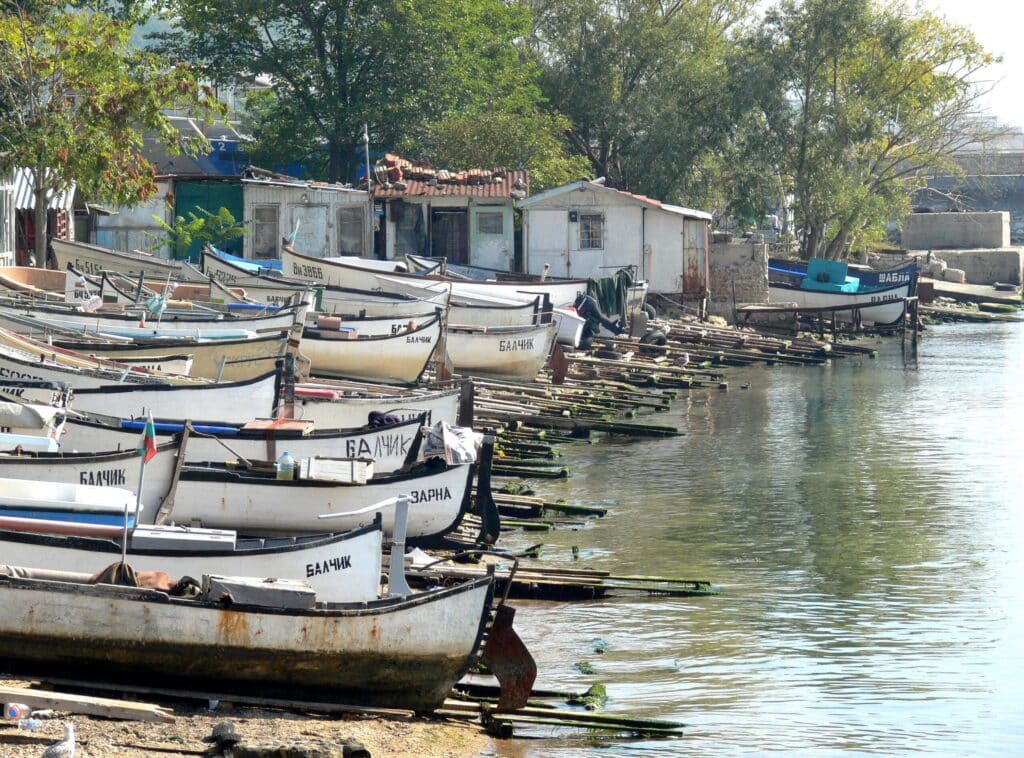
Balchik boats
After lunch, drive north to Yailata, an archaeological reserve on a wild Black Sea cliff plateau full of rock-cut tombs, a small Byzantine fortress, and almost no other people. This is the quiet, structured, deeply atmospheric stop most travelers never hear about.
Optional stretch: if you’ve got an adventurous streak and the weather is right, the cliffs at Tyulenovo a little further on are known among climbers for deep water solo (free climbing above the sea with the water as your only landing). It is a beautiful site even just to stand on. If your week has been calm and structured, only consider this if you have the experience and an instructor. We mention it for completeness; for most travelers on this route, leave it out.
Drive back to Romania, sleep near Constanta one more night (or push back to Bucharest if you prefer to be near the airport).
Day 7: Back to Bucharest, Departure
A relaxed last drive, roughly three and a half hours back to Bucharest. Drop the car at the airport. If you have spare hours, the Therme complex on the way is the best transition between a quiet trip and a long flight: hours of thermal pools, palms, and nothing to do.
Where to stay on Route 2
- Bucharest (nights 1, 6 optional, 7): stay near the Athenaeum or the embassy district for quiet, not the loud old town.
- Danube Delta (nights 2, 3, 4): a single lodge in Crisan, Mila 23, or Sfantu Gheorghe, booked at least a month ahead in spring and autumn. Pick one and stay put rather than hopping; this is a slow-travel route.
- Near Constanta (night 5, possibly 6): a quiet hotel outside the main Mamaia strip. The boutique stays inland from the coast are calmer than the seafront blocks.
Which Route Fits You?
If you’ve gotten this far you’re probably already leaning one way. A quick decision shortcut:
| If this sounds like you… | Pick |
|---|---|
| Curious, sociable, packs the day, loves castles and surprises | Route 1, the Carpathian Culture Loop |
| Organized, quiet, plans ahead, drawn to water, birds and detail | Route 2, the Dobrogea Quiet Loop |
| Both, depending on the year | Do one this trip, the other next year (they fit together beautifully back to back) |
| Honestly not sure | Take the free travel personality quiz before you book anything |
We’ve designed both routes so they can be lifted, customized and booked. If you want either of them tailored to your exact personality scores, with the bookings made for you, that’s what our custom itinerary service does. We’ve built the same logic for other countries too (the Spain by personality guide is the closest sibling to this one).
Common Mistakes to Avoid on a 7 Day Romania Itinerary
We’ve watched a lot of well-intentioned Romania itineraries fall apart for the same handful of reasons. None of these are fatal, but each one quietly steals time, money, or a memory from your week.
Trying to fit both routes into one week. This is the single biggest mistake. The Carpathian loop and the Dobrogea loop are deliberately opposite, and trying to combine them turns seven days into a thirteen-hour-a-day driving competition with no rest. Pick one, do it properly, come back for the other.
Spending half a day at Bran Castle. We’ve said it twice already, we’ll say it again: Bran is overrated and crowded. Forty-five minutes from the outside, then drive on. The rest of Transylvania is the reward.
Booking the Kalnoky estate or a Delta lodge “when you arrive.” The two single best stays on either route both book out weeks or months ahead in summer and autumn. If you want them, plan early. If you leave it late, you’ll get a generic guesthouse and feel like the trip lost a tier.
Underestimating Carpathian driving times. Roads look short on a map. Mountain switchbacks, slow trucks, road works, and the occasional bear roadside stop add real time. Always add 30 to 45 minutes to whatever your map says, and never plan an arrival after dark in the Carpathians if you can help it.
Driving the Transfagarasan in May. The road usually only opens fully around late June. Locals will tell you “they cleared the snow already” and they sometimes have, but reliable opening is later. Plan the spring alternative (the Olt valley route) and treat any earlier opening as a bonus.
Treating the Danube Delta as a day trip. People drive from Bucharest, take a one-hour boat from Tulcea, see reeds, leave. They miss the whole point. The Delta opens up over two or three nights, when you start to read the channels and the light shifts. Day-tripping it is the worst version of the experience.
Eating in Mamaia rather than near it. The main Mamaia strip is loud, touristy, and overpriced. The best fish on the Romanian coast is in the small Lipovan villages around Lake Razelm or further down toward Vama Veche, not on the boardwalk.
Skipping Balchik because “it’s in Bulgaria.” The Queen Marie palace and gardens at Balchik are one of the most quietly Romanian places you’ll see all week, even though the border is now drawn the other way. It is a 90 minute drive, not a separate trip.
Renting the cheapest car. A subcompact on the Transfagarasan is a long, slow, slightly unhappy day. Spend the small upgrade.
Trying to wing the bear watching. Walking into the Carpathian woods at dusk to “look for bears” without a guide or a licensed hide is the wrong kind of memorable. The proper hide experience is structured, ethical, and reliable. Book it. <!– Build this section with the “FAQ by Rank Math” block so it emits FAQPage schema –>
Is 7 days enough for Romania? Seven days is enough for a focused, well-designed Romania itinerary covering Bucharest and either the Carpathians and Transylvania or Dobrogea and the Danube Delta. It is not enough to do everything. If you can stretch to 10 to 14 days you can do more in one trip.
What is the best time of year for a Romania 7 day trip? Late April through mid October. Spring is best for greenery, bird migration in the Delta, and active bears. Summer is busiest, with full access to the high mountain roads. Autumn (September and October) is many people’s favorite for color, calm and bear watching.
Which Romania itinerary is better, the mountains or the Delta? Neither, they suit different travelers. The Carpathian and Transylvania loop suits curious, sociable, high-variety travelers. The Dobrogea and Danube Delta loop suits quieter, more organized travelers drawn to nature. The Verse Voyager personality quiz will tell you which fits you.
Do you need a car for a Romania trip? Yes, for both of these routes. Trains link the major Romanian cities but most of the highlights (Saxon villages, Delta lodges, mountain roads, Dobrogea fortresses) are reached by car or by boat from a road head.
Is Bran Castle worth visiting on a 7 day Romania itinerary? Treat it as a brief photo stop, not a half day. The Dracula link is thin and the crowds are real. Sighisoara and Biertan are more rewarding stops in the same region.
How much driving is in each route? Route 1 is roughly 1,000 km spread across seven days, with the longest single day being the Transfagarasan return (five to six hours of driving with stops). Route 2 is closer to 1,200 km, mostly the long out-and-back to the Delta and the short Bulgaria day.
Is the Danube Delta safe and easy to visit? Yes. The Danube Delta is a UNESCO biosphere reserve with established lodges, registered guides, and well-run boat tours. Pre-book a lodge in Crisan, Mila 23, or Sfantu Gheorghe and they handle transfers from Tulcea.
Do I need to book bear watching in advance? Yes. The hides operated by the Kalnoky estate and other licensed operators have limited seats and book weeks ahead in summer and autumn. This is not a walk-up activity.
Can I drive from Romania to Bulgaria on this trip? Yes. Both Romania and Bulgaria are now in Schengen, so the crossing south of Constanta is smooth. Balchik and Yailata are an easy day trip from the Romanian coast.
What does “personality-matched” actually mean? At The Verse Voyager we design itineraries around five core personality dimensions (Openness, Conscientiousness, Extraversion, Agreeableness, Emotional Stability). Two travelers with very different scores will love Romania in very different ways. The two routes here are tuned to two opposite personality patterns; the free quiz tells you which fits you.
Where to Next
If this gave you the shape of your Romania trip but you want the full country in one place, the main guide to the best places to visit in Romania is the place to start. If you’d rather skip the planning and have us build the trip for you, around your exact personality, book a free discovery call or browse the custom itinerary service.
Leave a Reply
You must be logged in to post a comment.