
Discovering the traditions of the mozabites berbers at a M’zab wedding
ⴰⵙⵏⵓⴱⴳ ⵏ ⵢⵉⵎⵣⵔⴰⵢⵏ ⵏ ⵉⵎⵥⴰⴱⵉⵢⵏ ⴳ ⵜⵎⵖⵔⴰ ⵏ ⵎⵣⴰⴱ
February 2019
Table of Contents
I. The M’zab Valley: A World That Kept to Itself for a Thousand Years
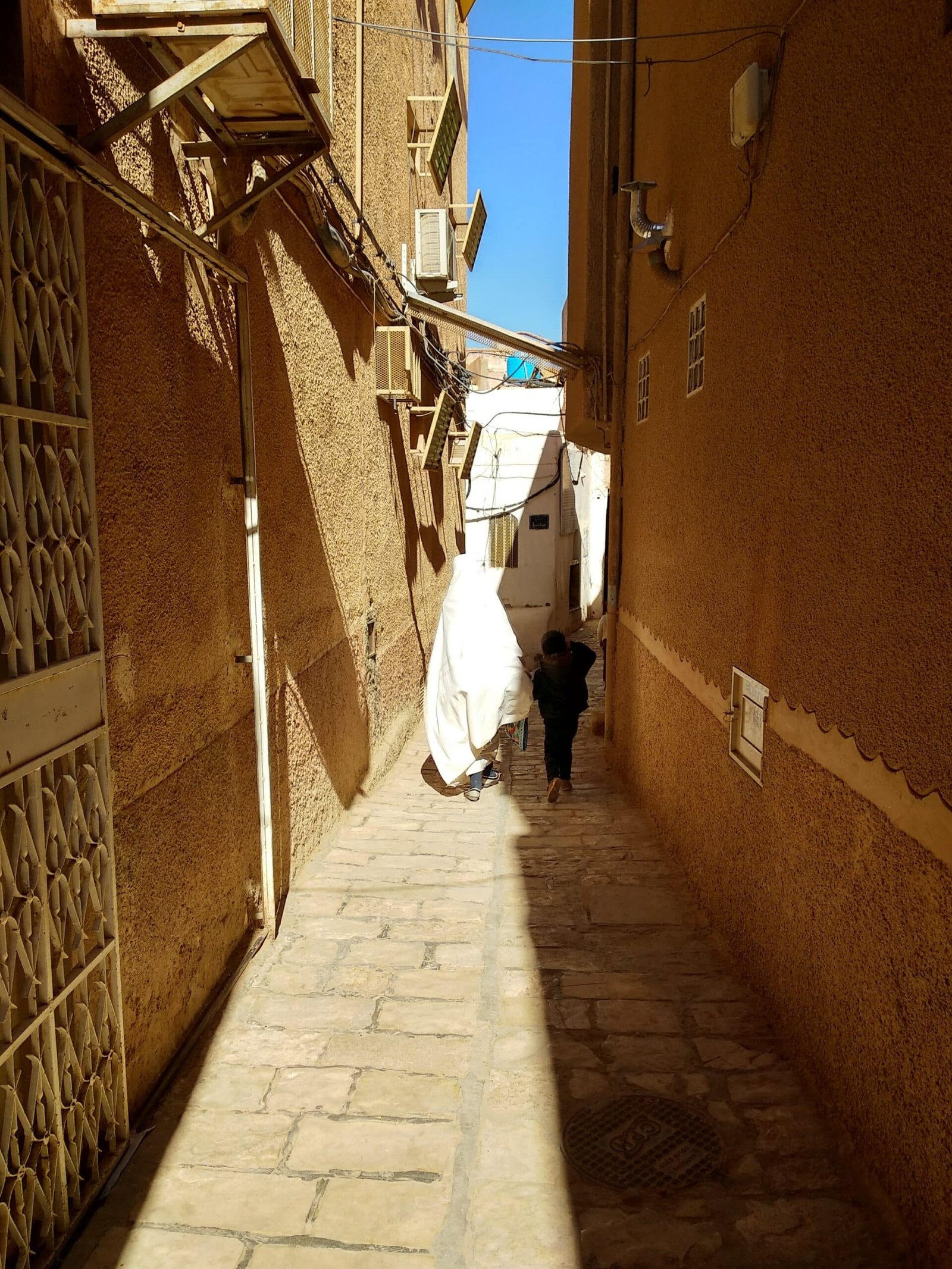
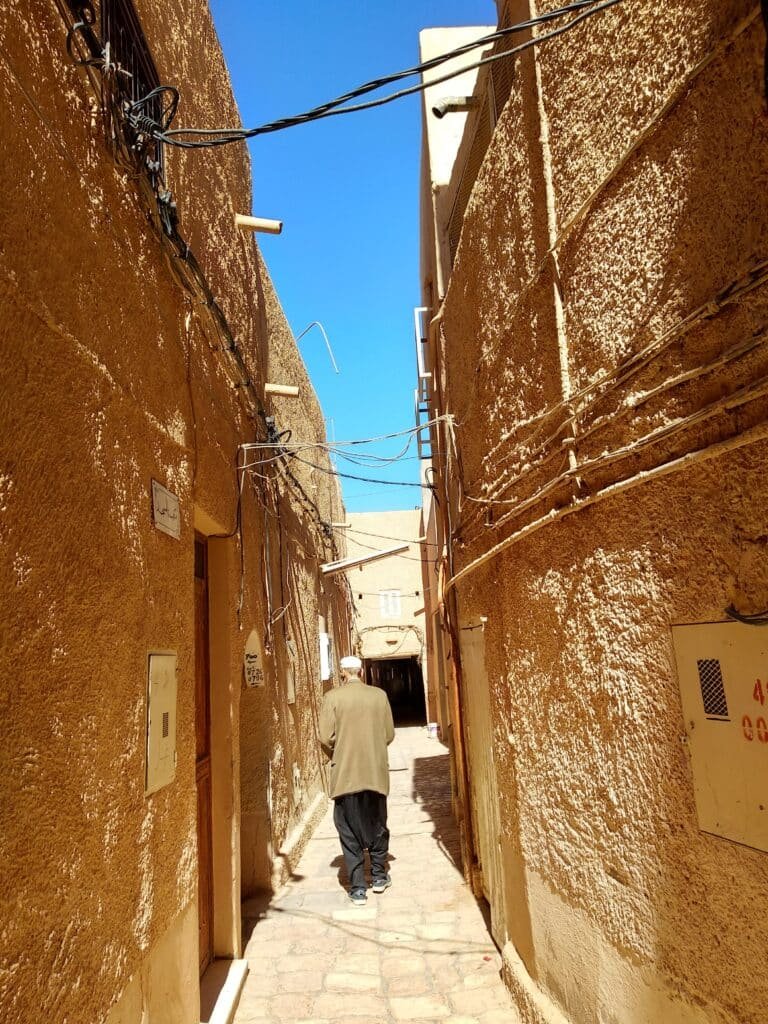
In the narrow streets of Beni Isguen, as in those of the other ksour of the M’zab Valley (UNESCO World Heritage), the women walked wrapped from head to toe in a white cloth, crossed over at face level in such a way that it left only a single eye visible. It wasn’t called a chador but a haik, it wasn’t black but white, I wasn’t in Dasht-e-Lut but, but in the middle of the Sahara (and the social context was probably rather different too). Yet, walking behind their hurried steps they stirred in me the same kind of curiosity. Guilty or not, the immaculate anonymity of Les cyclopes de Ghardaïa fascinated me.
“You know, in fact, the municipality of Ghardaïa is not a single city but a pentapolis made up of five citadels: Ghardaïa, the largest of them, Beni Isguen where we are now, Melika, Bou Noura, and at the head of the valley the oldest of them all, El Atteuf, founded by the Ibadis in the 11th century…”
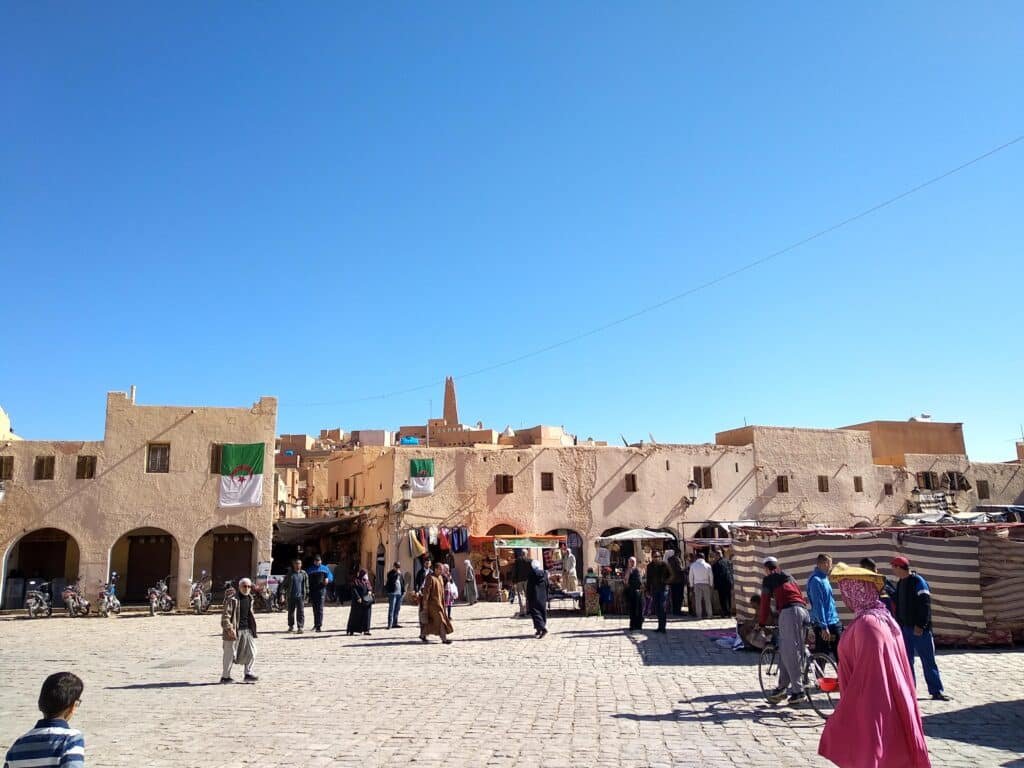
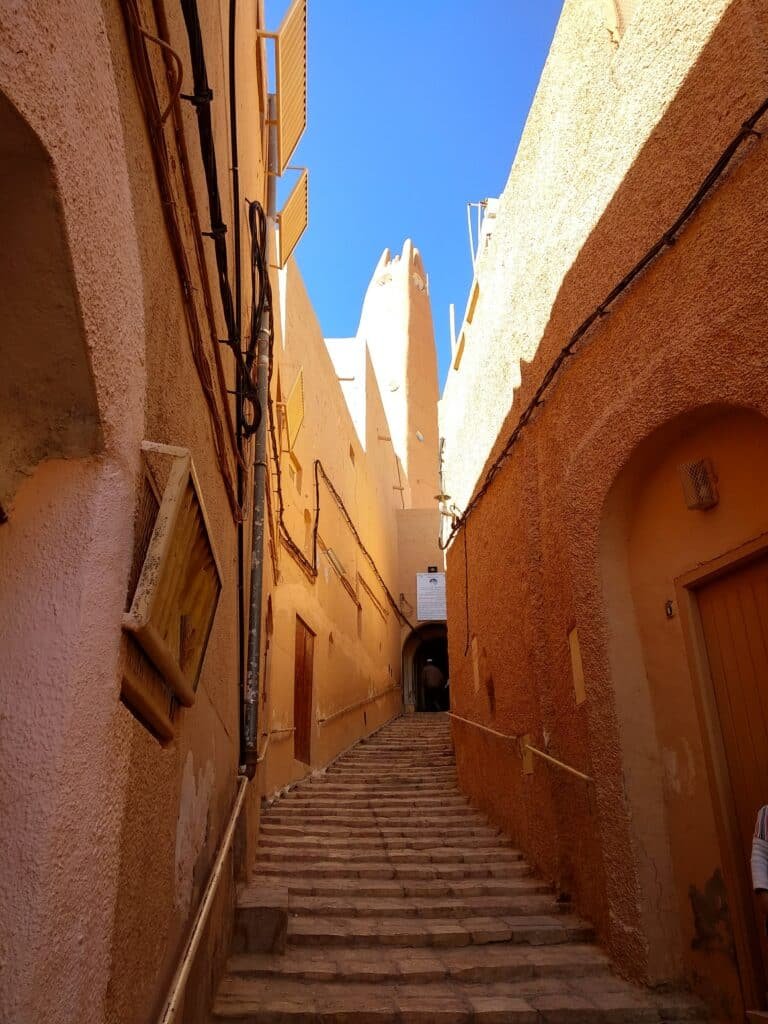
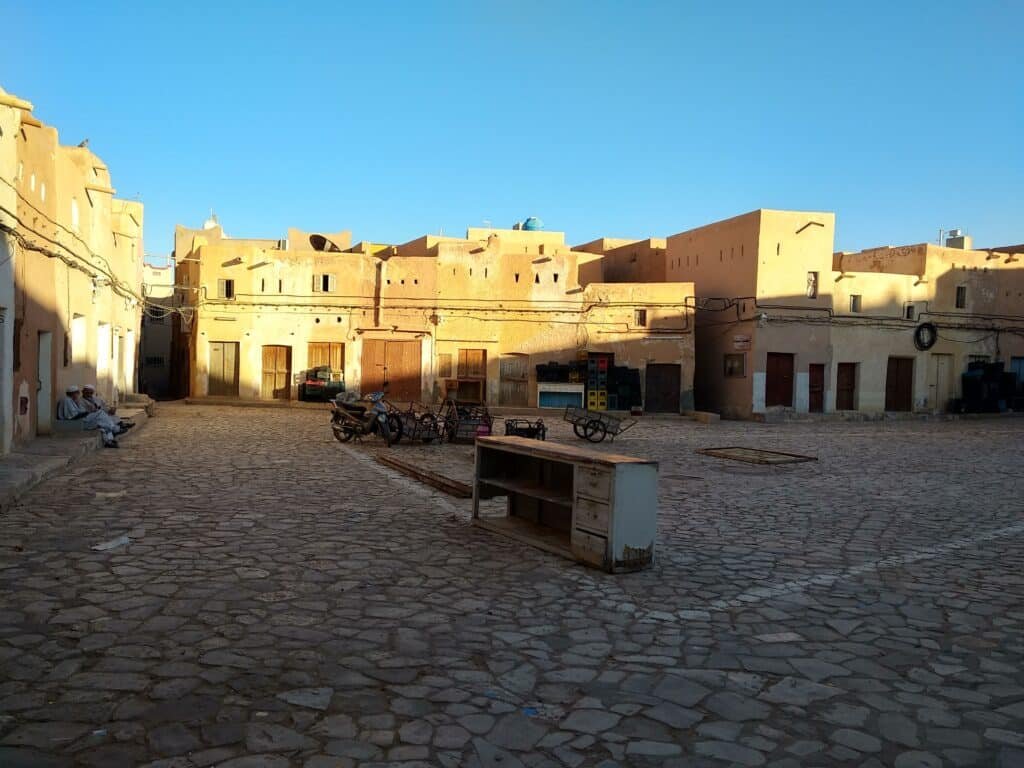
The arcaded ochre buildings ringing this cobbled place du marché are the commercial heart of the ksar and above them, on the hilltop, rises the unmistakable pyramidal minaret of the Ibadi mosque. This is M’zab urban architecture in miniature: each of the five citadels (Ghardaïa, Beni Isguen, Melika, Bou Noura, and El Atteuf) was built on a hill, crowned by its mosque and minaret, with houses spiralling down in tight concentric rings and the market square set at the foot. That form is no accident. Fleeing into the Sahara after the fall of the Rustamid dynasty, the Ibadi Mozabite Berbers designed these fortified towns to be defensible, water-thrifty, and self-contained: a vernacular architecture shaped entirely by the desert and by a community determined to preserve its faith and identity.
Yahia, our volunteer guide, was generously offering us information about the Mozabite Berbers (or M’zabi) and everything their way of life entailed, being one of them himself. I very nearly let myself be caught in the archaic snares of that world. Once you passed through the gate of the citadel it was easy to fall prey to the storybook atmosphere; especially if tourist enthusiasm was prodding you to seek out, deliberately, landscapes from One Thousand and One Nights. Even so, when I sank a little deeper into their lives and got past the charm of appearances, I couldn’t help wondering in what ways the modern world had managed to slip in beneath the walls of the ksour.
But we were still novices in M’zab matters, and we were discovering the place with fresh, impressionable eyes.
That morning we had only just arrived from Ouargla, after 200 km of hitchhiking through the Sahara, and had met our host, Idir. To our surprise, he put at our disposal a small villa at the edge of the oasis: new, but built using careful details from traditional architecture. Inside, the M’zab mentality —which Yahia would explain to us later— was reflected in everything. The practical sense and thrifty spirit of a people who had chosen to stand up to the desert had been transformed, along with the comfort brought by modernity, into aesthetic qualities.
II. M’zab Architecture: How Vernacular Berber Design Is Shaped by the Desert
The M’zabis kept an ancestral respect for all primary natural resources, but first and foremost for water and wood. One could easily understand their carefulness with water; as for wood, it came strictly from the palm plantations, and no one allowed himself to cut down the palms in vain, as they were the primordial link in the local food chain. Consequently, as far as possible, the manufacture of wooden objects was to be avoided or at least optimized; a premise that shaped the interior of the houses in a particular way.
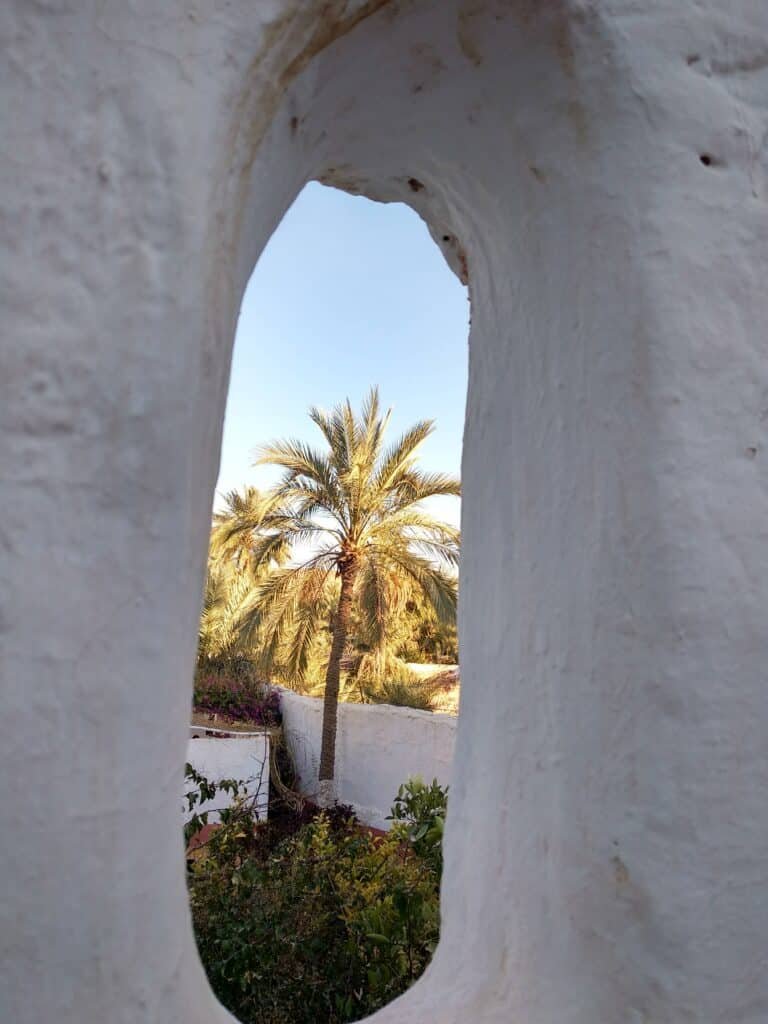
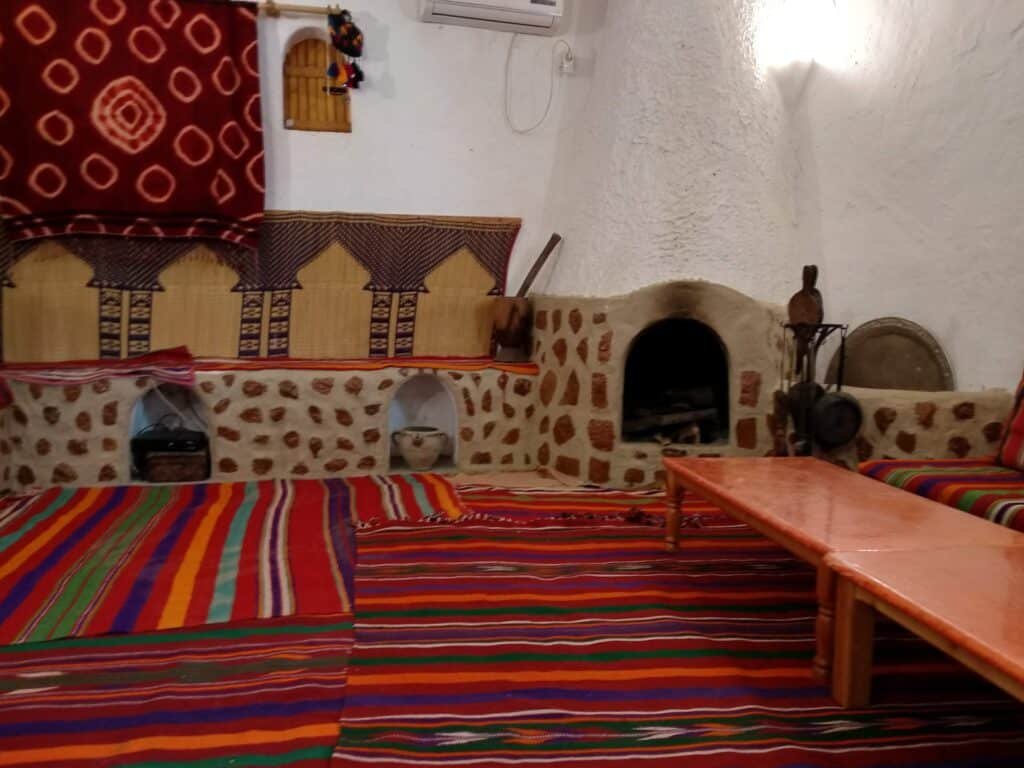
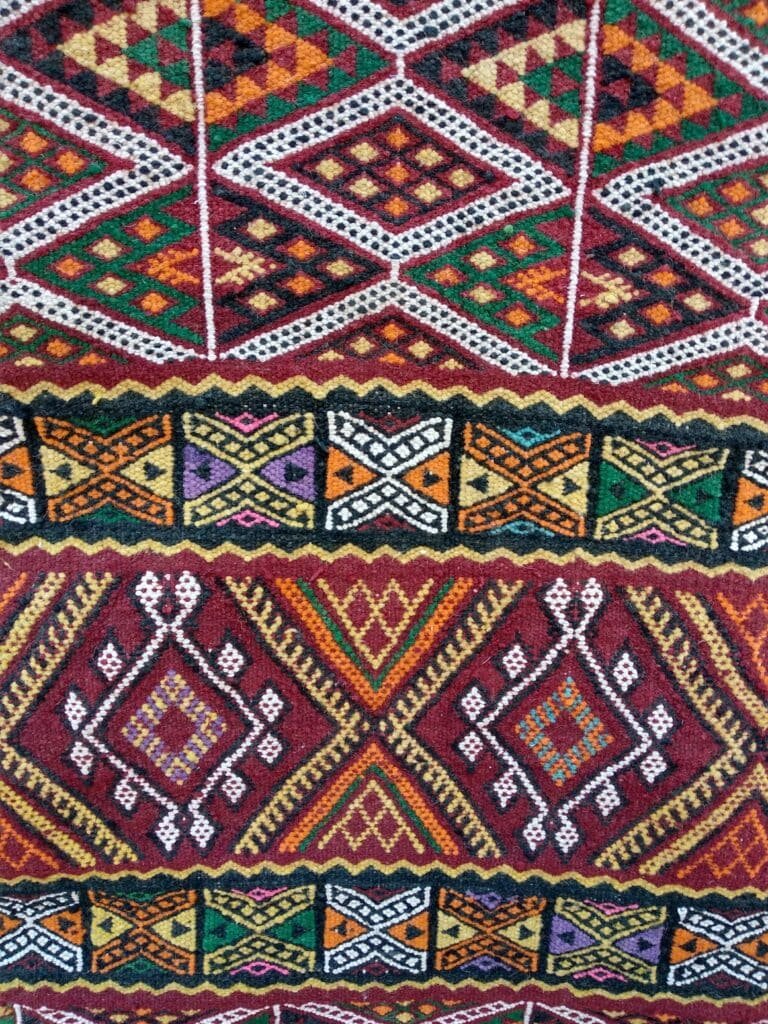
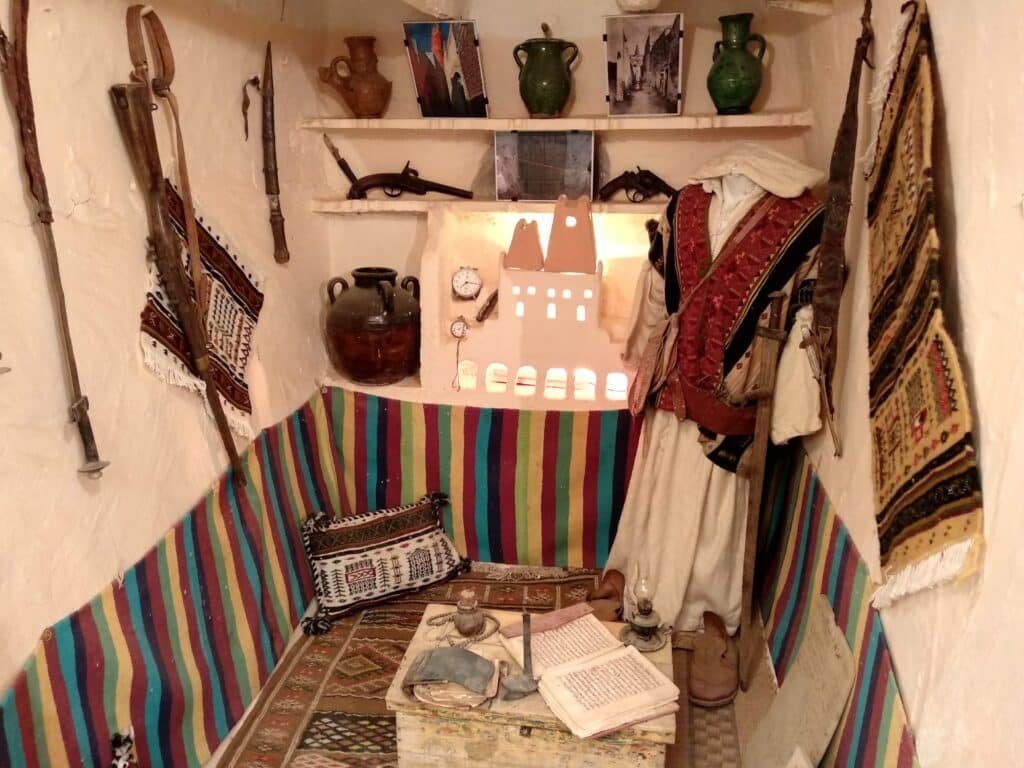
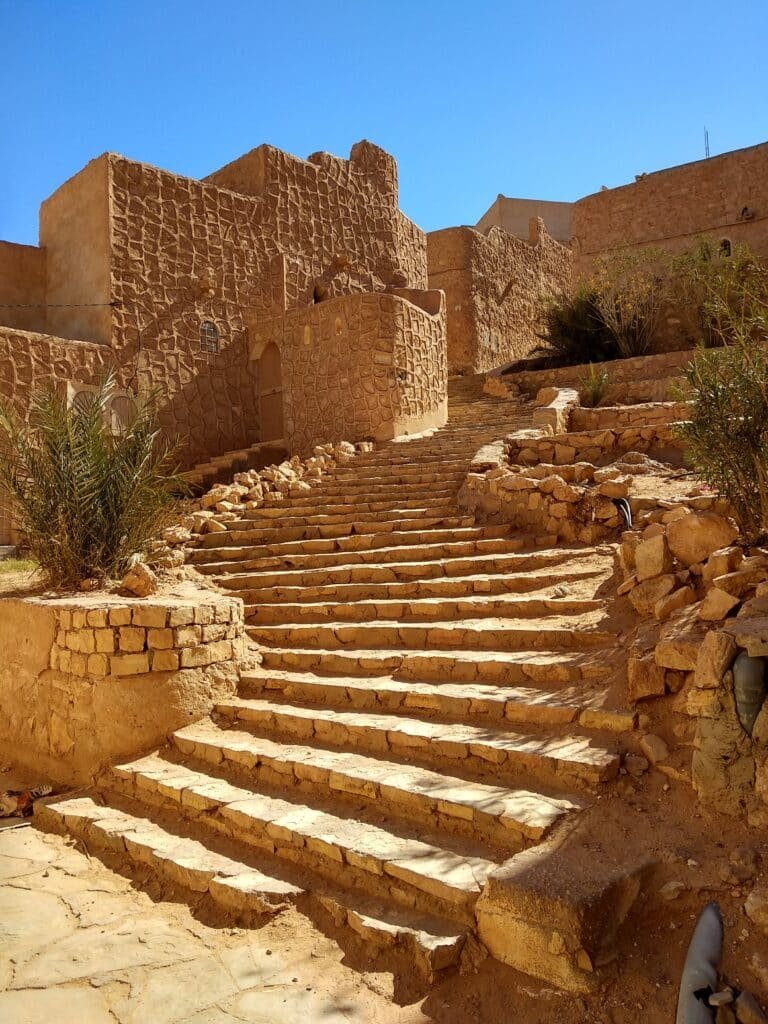
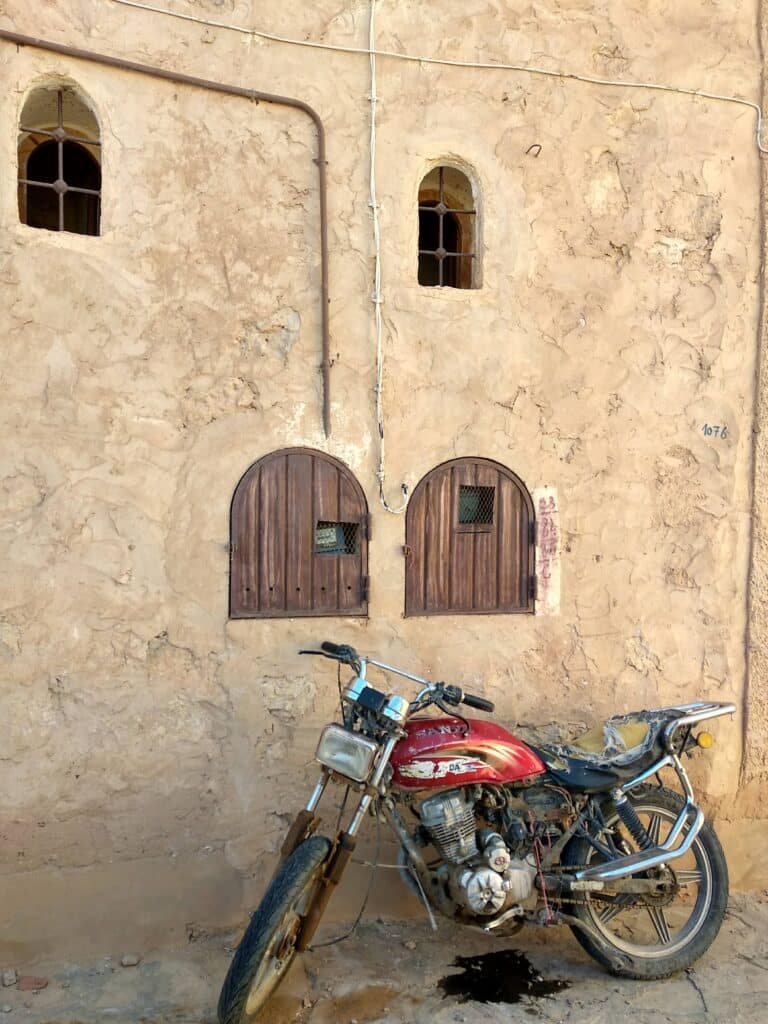
Doors low enough to reach only mid-torso, household objects kept in alcoves in the walls, beds and divans “built” together with the house, lamps set into the base of the wall, whose discreet light came out through a row of holes resembling the spots on a giraffe’s neck: everything gave off the air of a stylish burrow. The bedspreads, the rugs on the floor and the cushions embroidered in traditional style turned the house into a colourful universe. There were no windows, and during the day, light came in through the central skylight. You could also get out onto the roof that way, climbing a solid staircase with clay steps stuck to the wall. On the roof, a small tower rose the height of another storey. With only four merlons, one at each corner, it imitated in miniature the distinctive shape of the M’zab minarets. It didn’t seem to serve any purpose other than watching the sunset in twos, since that was all it had room for.
It was by far the best place I had ever stayed through Couchsurfing and most likely will remain so.
In the inner courtyard, in the shade of orange trees caught in every stage of flowering, we even had a swimming pool! I couldn’t believe there is a place in this world where two dusty wanderers are handed such a house, without paying anything and simply because they happened to turn up in the area.
Idir explained to us that in fact he wasn’t the owner of that house: it belonged to the community, and every time someone had guests, they put them up there.
Idir was going to be the photographer at a wedding, so he left us in the care of Yahia, whom he introduced to us as a friend with free time that day. The choice wasn’t bad at all. Yahia was in his 20s at the time and, unlike Idir (already a head of family), he was closer to our own mentality.
Interior design in desert Berber architecture
Step through the low arched doorway and the M’zab house reveals its quiet genius. This whitewashed interior, with its rows of red-ochre niches carved directly into the wall, is a masterclass in vernacular Berber architecture shaped entirely by the desert. Among the Mozabites, wood was too precious to waste. It came only from the palm plantations that also heated the community. So shelves, cupboards, and storage were not built from timber but hollowed out of the earthen walls themselves. These arched alcoves held lamps, vessels, and household objects, turning necessity into a distinctive aesthetic.
Meeting the M’zabis
At first I was struck by the fact that despite the nearly 30°C he was wearing a black padded jacket, but then again it was February after all, even in the Sahara. I noticed he wore the same sort of trousers as Idir (a kind of navy-blue sirwal, tight at the calf but wide at the top, which resembled a pleated skirt in that the two legs joined below knee level) and I asked him whether it had anything to do with the wedding. He told me they were M’zab trousers and that he wore them every time he was home. If he left Ghardaïa he put on jeans “like everyone else.” Otherwise he had a cheerful face, as was the attitude he took, with a naturally high forehead, but seemingly made even longer by his white ⵜⵛⴰⵛⵉⵜ (chéchia).
Continuing with my questions, I learned that he worked as a receptionist in a hotel, which was why his English had fluency. He spoke four languages, in fact, from three distinct language families (berber, semitic and latin); but African polyglotism was already beginning to stop impressing me. My own friend had set about learning his 6th. And then, from what he told me, education was important to the M’zabis.
III. An Oasis of Ibadism: Understanding the M’zab’s Dual-System Society
Since schooling had become compulsory in Algeria, the M’zabis attended two schools: in the morning the state one, where they study in Arabic, and in the afternoon the one organized within the communities, by the Azzaba majlis (the local council). Most of the latter’s roles had been taken over by the state school, leaving it at present only to teach Tumẓabt, the local Berber dialect, and the Ibadi vision of Islam.
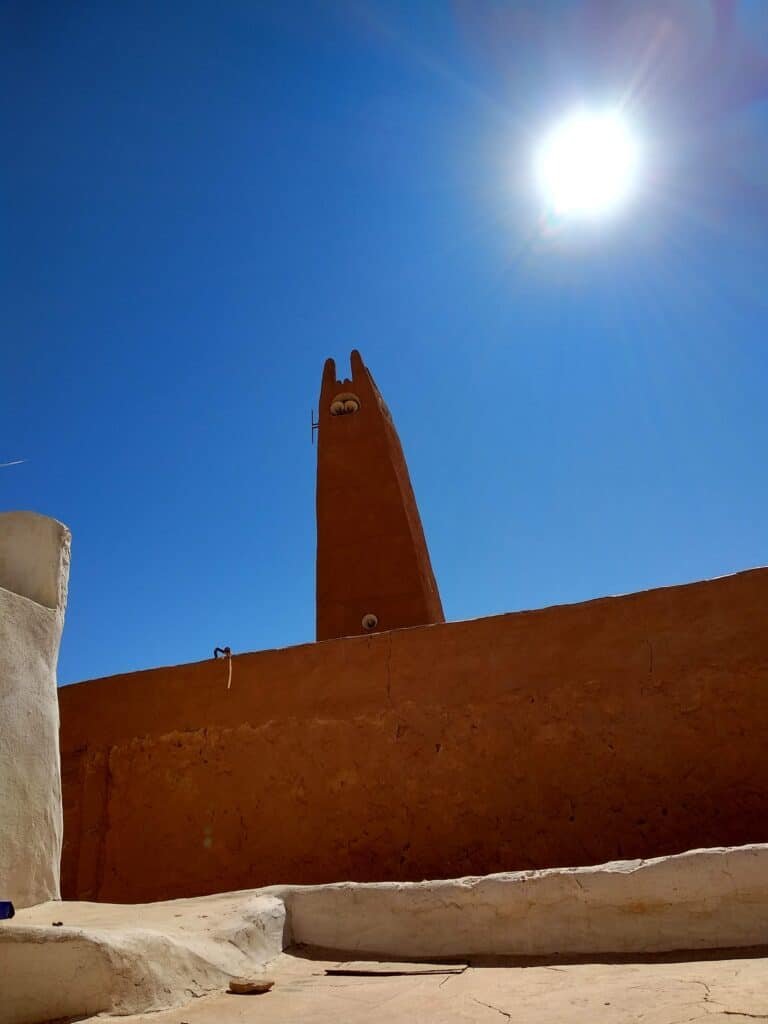
The M’zab Minaret: Highest Point of the Ksour, Seat of the Azzaba Council
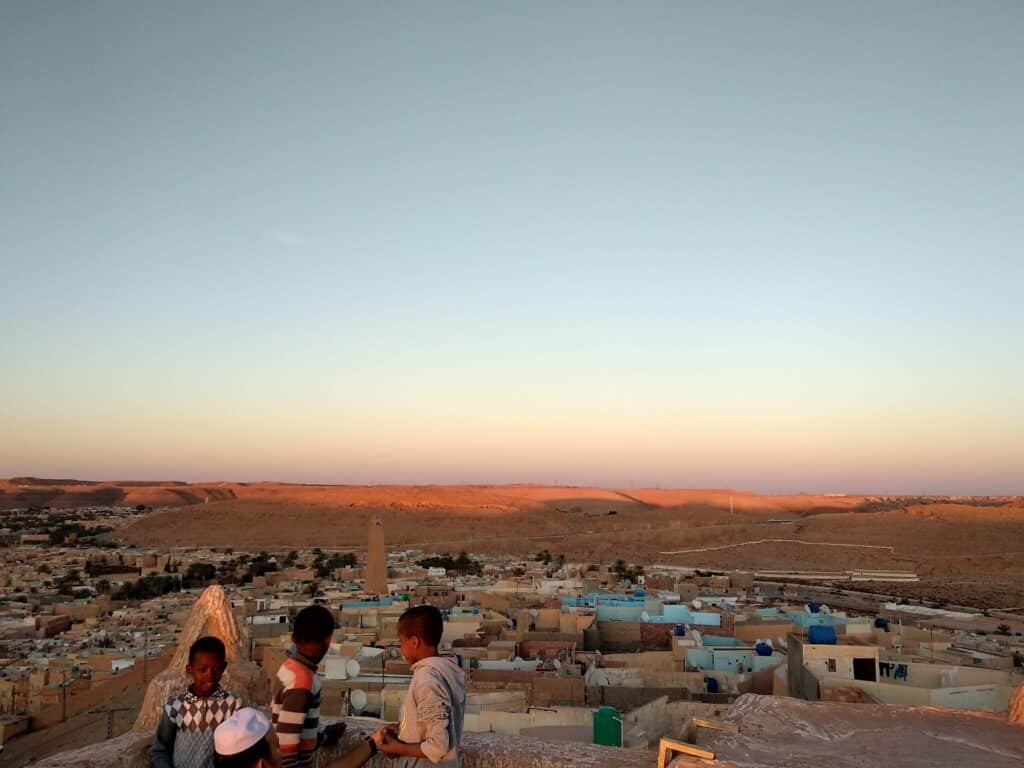
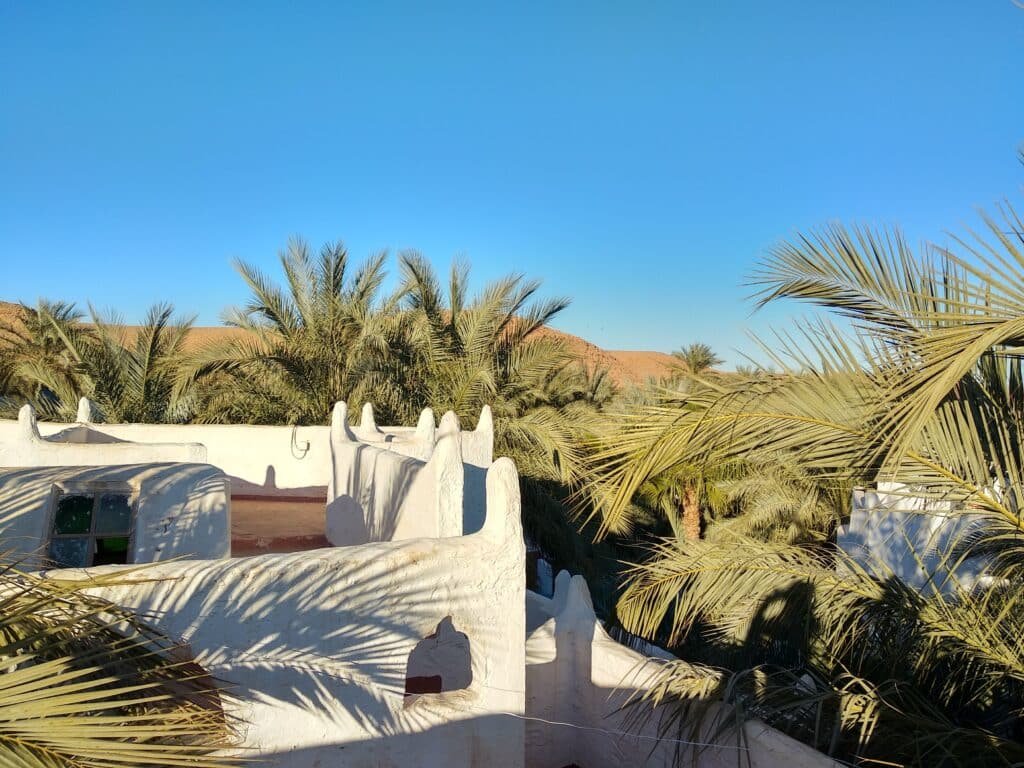
Seen from the rooftops, the tapering ochre minaret of Beni Isguen rises over the mosque that houses the Azzaba majlis: the council of religious scholars that has governed the spiritual and civic life of the M’zab for a thousand years. Its finger-like merlons and unadorned earthen mass are the signature of Mozabite Berber architecture: austere, defensive, shaped by the same desert thrift that governs every wall in the valley. But this minaret marks more than a place of prayer; it is the seat of an authority at the heart of one of Islam’s most singular communities.
Unable to refuse the powers of the region, M’zab society had stubbornly insisted for centuries on maintaining its own authority at the local level while accepting the regional one at the same time; a fact which gave rise to a dualism in: education, social norms, legal systems and authority. The voice of the local community has always been heard distinctly. And, although they amounted to no more than one larger town, at the moment when France took Algeria from the Ottoman Empire they negotiated their own autonomy in exchange for an annual tax (for a while, at least).
The effort put into keeping their culture alive was visible. At the gate of the ksar, a small sign warned us about three forbidden things: failing to observe Islamic dress, photography, and littering. And yet, outside the walls there were no wastelands but other neighbourhoods. The urban area had expanded in the ’60s along with the development of the oil industry. But the Arab population did not mix with the Berber one: the M’zabis saw to that. And even though they too no longer had room to build within the former walls, they were putting up new neighbourhoods. Admittedly with paved, wide streets you could drive right up to your house on, unlike the old alleys, narrow and twisting steeply uphill. But in essence they were the same: secure, spotlessly clean (and that really was something novel), shunting away any temptation: no shop sold cigarettes, semi-prepared food or snacks, in a completely atypical way there were no fast-food places and people cooked and ate at home, with the family, alcohol was out of the question, and only M’zab “citizens” were granted permission to acquire property there.
Well organized, serious and with commerce in their blood, they owned almost exclusively the smaller and larger businesses in the area, ending up rather as business owners, with the Arabs tending to be the employees. Adding to this their exclusivism, manifested for example in unwritten social rules that banned the Arabs from marrying M’zab women (the reverse not being valid), we had the premises of the ethnic conflict that had begun to smoulder in recent years and had been exacerbated by a few bloody street fights.
But even so, the tensions astonished me. Or rather, what astonished me was that there still exists such a clear demarcation between the Arab and the Berber population as to give rise to such divergences. After more than a millennium of living together I was inclined to think that they would have blended almost completely. Especially since the Berber population had converted to Islam.
The Ibadis in the Bigger Picture: Between Sect, Colonialism, Nationalism and Pan-Islamism
To understand the people whose hospitality I was enjoying, it helps to know something of the intellectual currents that shaped the M’zab. The Ibadis of the valley are Berbers who settled here after the fall of the Rustamid dynasty in 909, and for most of Islamic history they were regarded by the Sunni majority as heterodox outsiders, Kharijis blamed for the community’s early divisions. Yet by the late nineteenth century, as European colonialism pressed in, the M’zab’s leading scholars began to reach across those old sectarian lines. Figures like Muhammad Atfiyyash argued that the colonial threat demanded the unity of all Muslims above their doctrinal differences, and a later generation—Ibrahim Atfiyyash, Ibrahim Abu al-Yaqzan—carried that conviction into the vibrant Tunisian and Algerian press, defending modern sciences and calling for reconciliation between Ibadi and Sunni, Berber and Arab. Abu al-Yaqzan’s slogan captured the aspiration with lapidary force: “Islam is your father and Algeria is your mother.” What these reformers imagined was a single Algerian watan, a homeland walled by Islam and bound together by the Arabic language, in which the region’s many identities (Maliki, Ibadi, Tijani, Arab, Kabyle) would dissolve into one.
Ghazal, A. N. (2010). The Other Frontiers of Arab Nationalism: Ibadis, Berbers, and the Arabist-Salafi Press in the Interwar Period. International Journal of Middle East Studies, 42(1), 105–122. http://www.jstor.org/stable/40389587
Yahia told me that in fact they are not exclusivists: they are willing to receive anyone who wishes to join them, as long as that person adopts their traditions. Some M’zab families are of sub-Saharan origin. At one point some Jewish families from the island of Djerba joined them as well. Nor are they resistant to change, but everything new is discussed within the Azzaba councils, which decide whether it is to be adopted or not.
I was curious whether the individuals’ such close adherence to society was their prerogative as an ethnic group or had appeared along with the adoption of Islam. But since Yahia couldn’t satisfy this curiosity of mine, I shifted the topic of conversation to their origins.
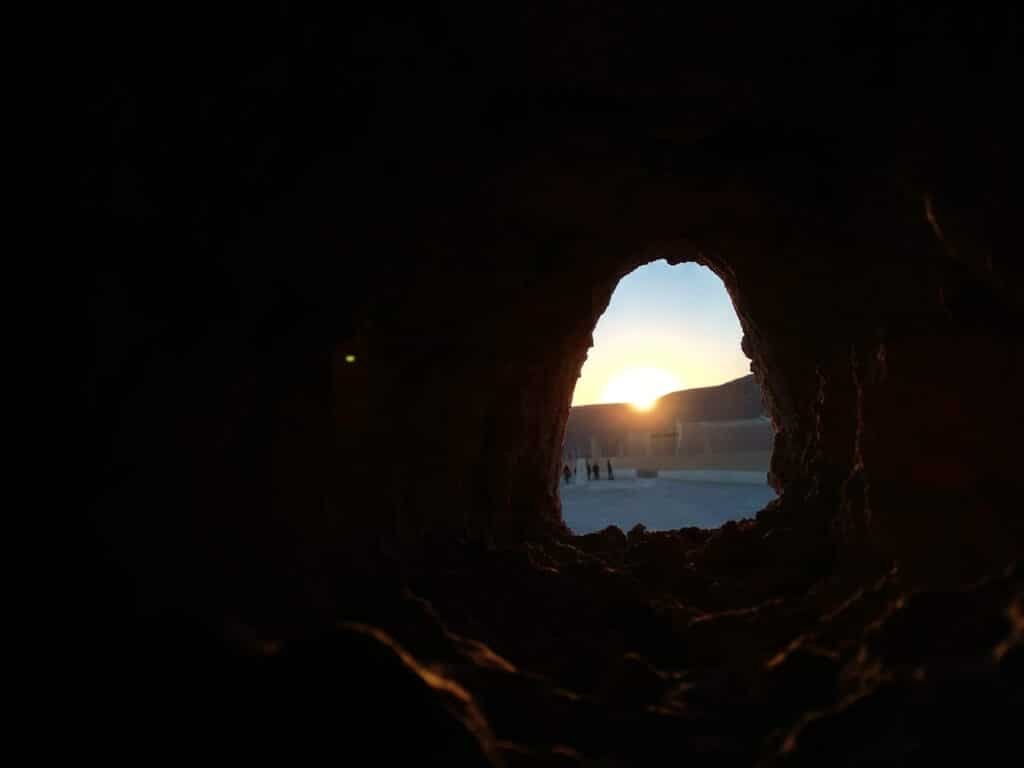
In a nearby cave one of those rock paintings had been discovered that remain in various corners of the Sahara as testimony to its age as a savannah. Not as elaborate as those in Tassili n’Ajjer, but enough to say that the valley has been inhabited since prehistoric times. In part their ancestors are those who stayed put (or in the area, being semi-nomadic tribes) and adapted to the process of desertification. The settlements and the present form of organization, however, are owed to those who fled into the desert after the fall of the Rustamid dynasty, in the hope that they would be left in peace. It is from them that the M’zabis inherited their way of life.
I wasn’t familiar with any of the Islamic sects or schools of thought, but as luck would have it, my traveling companion knew how to ask the right questions. Ibadism was a mystery, even to those born in the Muslim world.
I learned that in Islam, sectarianism had a political rather than a doctrinal substratum, originating in the civil wars sparked after the death of the Prophet. The first politico-religious sect appeared during the Battle of Siffin.
The Kharijites broke away from the troops of Caliph Ali when he agreed to end the fighting and leave the leadership of the Caliphate to arbitration. They opposed the choosing of a new leader by that route on the grounds that “judgement belongs to God alone” and that carrying the battle through to the end would have revealed His will. They would become a constant source of insurrections throughout the caliphates and the origin of other radical sects.
As for Ibadism, it seems to have been one of the earliest sects to break away from Kharijism and probably the only one preserved to this day. Although they took over the inclination towards puritanism, they were formed from the more moderate side of the Kharijites, and many of today’s Ibadis no longer acknowledge the connection with them.
Unfortunately the amalgam of medieval stories and narrow streets came to an end once we reached the top of the hill next to the Azzaba mosque. Against a strip of sky caught between two buildings stood the rudimentary but unmistakable M’zab minaret.
IV. Entering a divided world: The men’s side of a M’zab wedding
In the afternoon, meeting up again with Idir, we too were invited to the wedding. That was all we’d been waiting for! Dressed as we were and shod in the same dusty boots, we turned up at the party. It didn’t matter. I would have stood out anyway: I was the only woman present… among 300 men.
Pairs of curious eyes followed us until we found a more sheltered spot to one side of the dance floor. My travelling companion joined the dancers, while I decided to make myself as invisible as possible and enjoy the role of the observer. After a while, apart from a few stolen glances, they too started to treat me as invisible. A western woman: not quite a woman, but undeniably a woman.
The courtyard was spacious and paved. At one end, on a blanket with an electric yellow-and-blue pattern, sat the musicians: four percussion instruments and something resembling a clarinet. Except for a few old men resting on the chairs along the edge, everyone was dancing. From the musicians’ blanket came more rhythm than music, and their bodies weren’t shy about surrendering to it.
At first it seemed strange to me to see men dancing with other men, but then I got used to following the vertical zigzag of the white ⵜⵛⴰⵛⵉⵜ and the rapid movements of ankles leaving the pleated fabric slightly behind.
After a prolonged roll of drums, everyone cleared the dance floor. Ten more experienced dancers each took a rifle in hand and began to whirl in a circle, firing into the sky. As luck would have it, they were blanks, but they still managed to make a tremendous racket. When things had calmed down a bit, the others joined them on the dance floor as well.
One of the dancers pressed a rifle into another’s hands and, for a moment, through my eyes the tableau assembled itself the way prejudice usually does: the untended week-old beards, the rifles held aloft against the strip of Saharan sky. Had I left unchecked cultural bias to pass by, I could have ended up believing that I was watching a wild party of terrorists.
I was educated to keep an open mind, yet how open should one be with the things one does not quite understand. Algeria had a social fabric, in so many ways different from what was familiar to me. It was an exercise not to give space in my mind to the fear of alterity. I was able to push away the fear from my mind, yet how far should one go with these exercises?
The image was right there, waiting to be swallowed undigested. The blanks they were firing made a tremendous racket, and it would have been tempting to let the image of Arabs with guns slip right from my cultural background to the way I was perceiving them at that moment.
But that is precisely these deforming lenses that being in one place and taking part of the bits of life lived there, is meant to dismantle. You can always choose to analyse the perspective through which you see the world or the frame you were, maybe unknowingly, part of. Alterity provides a good opportunity to realise the particularities of and to detach from one’s known subspace of the world.
So I was there, at a wedding I had been invited to by them, thinking about one of the painful subjects that make the rest of the world prejudiced against them—and thinking, at the same time, that they had treated me with kindness and impeccable hospitality. Had I discussed manly affairs with them? Not really. Not a word of business or politics was addressed to me. Nor had I tried to enquire. In retrospect, what inhibited me was the fear of touching some hidden nerve. And yet we did discuss subjects closer to home: family, marriage, children, the schooling system.
That was a good moment to remember that one needs to judge every person and every group of people for oneself, free of prejudice. It is an exercise that is necessary in order to see how the world actually is, but might as well just lead to the same old conclusions.
Could I have decided to see terrorists at a wedding? Of course I could. But to see the world through some arbitrary lens, deformed by one prejudgement or another, was not the attitude I had chosen. One of the main purposes of travelling is to make up your own mind about what you see and experience, about the people you meet. Was I in the right frame of mind? Detachment and relativism can also be damaging to our understanding.
In a society that has not parted very far away from its tribal roots, weapons at a wedding symbolise the fact that the members are willing and have the means to defend what they love. A show of strength makes one feel powerful, and consequently unafraid of losing what he values and loves. They are yet far from knowing that fear and violence can be abolished completely.
V. In between wedding parties: Weighing Tassili n’Ajjer Against Algeria’s Northern Coast
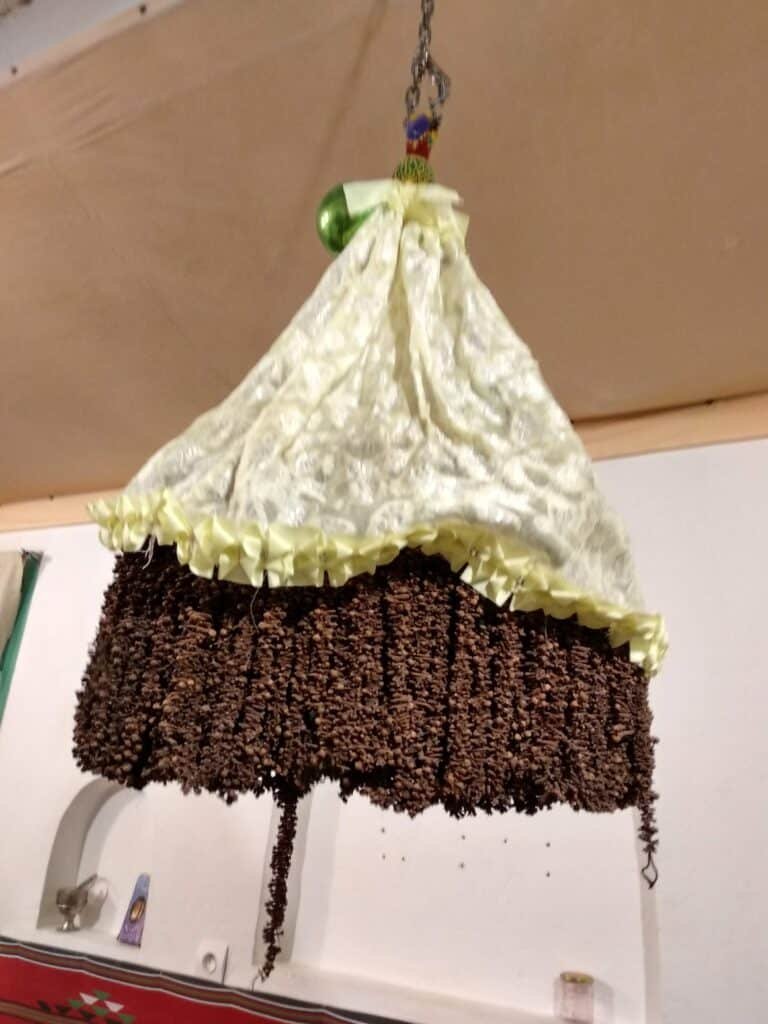
When evening fell and the party broke up, we gathered inside in a smaller group. Someone set fire in the stove to some thick, dry stalks of palm leaves. Then they made a clove tea. Yahia was in a mischievous mood and, to make us feel like one of them, in a moment of inspiration he decided to give us the most Berber names he could think of. ⴼⴻⴼⴰ and ⴱⴰⴽⵉⵔ. So I became Fefa and my companion Bakir.
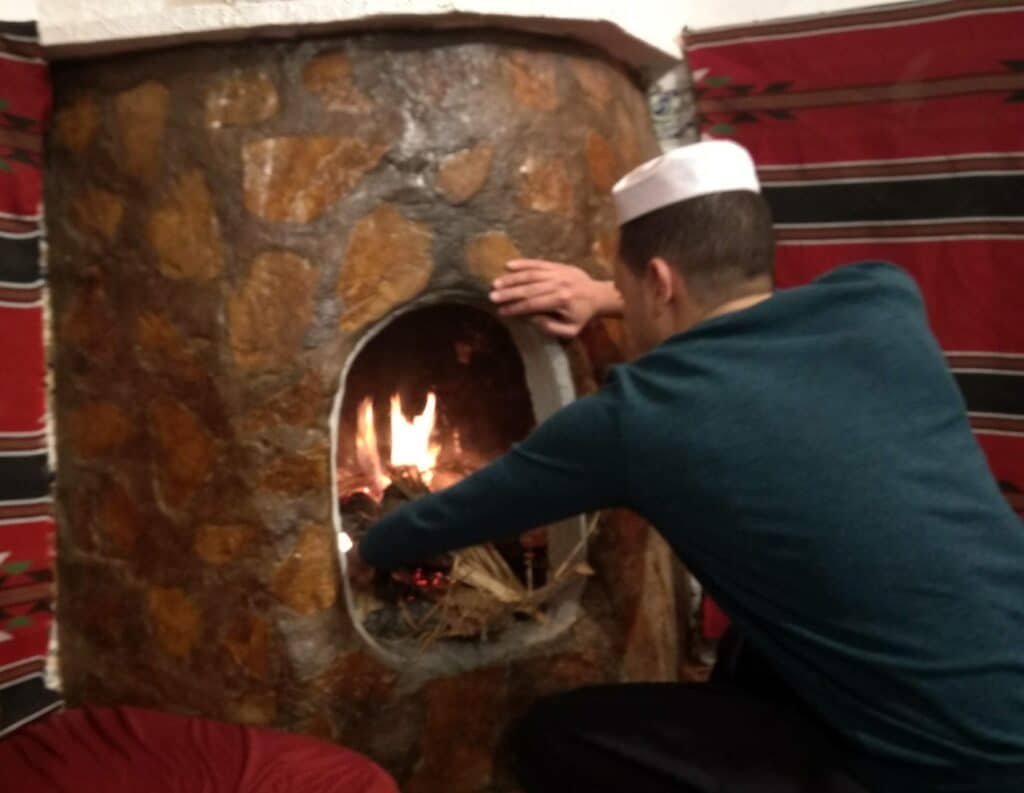
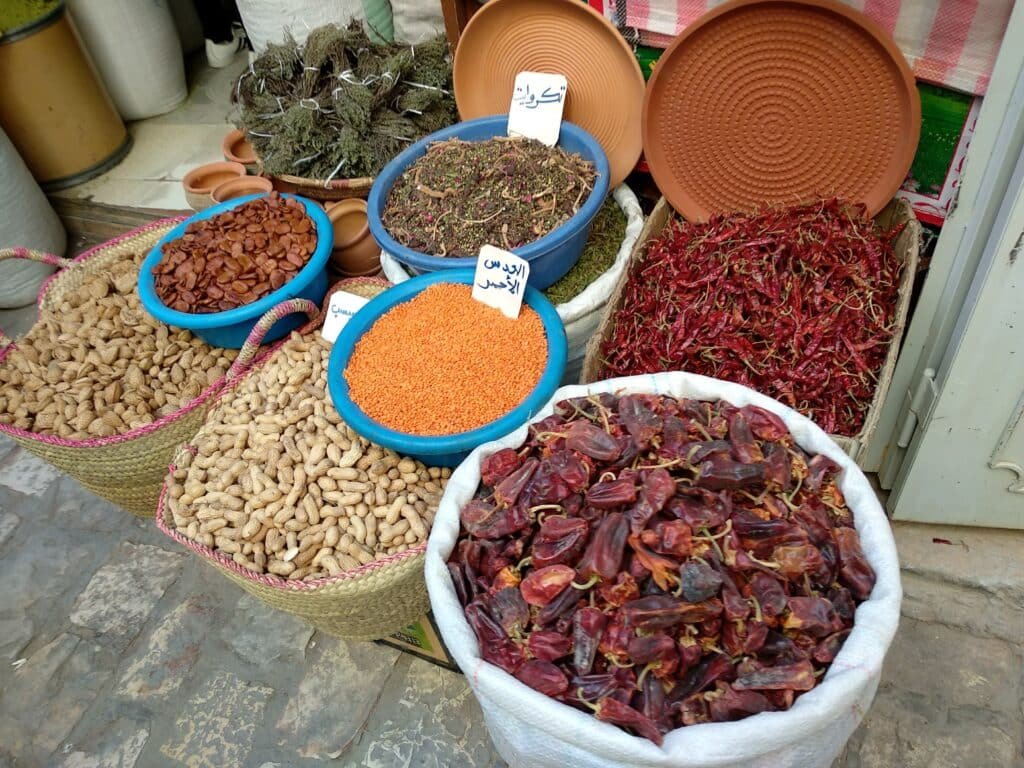
We could be Fefa and Bakir if need be. Every day seemed to weigh as much as a whole month anyway. Given the diversity of situations we had to face, we got along surprisingly well. We discovered in ourselves the same flexibility, the same ease in adapting the itinerary and plan, nothing was set in stone, we simply gave ourselves over to the desire to meet people, places; we yielded as often as possible to the irresistible impulse to sniff out les coins cachés…
That very day, catching a moment’s pause from M’zab hospitality, we had raised the question of which way to go after Ghardaïa. Broadly speaking, we had two possibilities: straight south, sinking further and further into the Sahara, or northwest, so as to then do the entire Algerian coast. In the south we were aiming for Tassili n’Ajjer.
I had a mad plan to cross the whole national park along an old Tuareg trail. I wouldn’t have had the courage to cross the open space of an erg on foot, but following a canyon 250 km long, I would have dared. I had calculated all the technical details, how much water, how much food, roughly how many days, we even had a filter and antibiotic tablets for sterilizing water.
At the time I didn’t know about the former nuclear tests and the radioactive waste in the Sahara, and only considered the flora; the particular area that was radioactively contaminated was around Reggane and In-Eker. It was truly tempting to undertake this expedition on our own, caught between so many hundreds of kilometers of wilderness.
The problem was that the north with its civilization was just as tempting… The Atlas Mountains, Camus’s cities, the immense mosaics and the Roman ruins, the steep shore with la Corniche Jijelienne… made our choice difficult.
Both were colossal dreams that I, at least, had been dreaming of for a long time. For lack of time we were forced to give up one of them. We weighed everything and, seeing that we still weren’t reaching a conclusion, we decided to flip a coin.
Heads: north, tails: south… Fate told us tails, and if we had listened to it, we would not have lived everything we were about to live. It was probably trying to keep us somewhat safe. Only, seeing the result, it was as if for a moment we had shared the same mind. I don’t see how else I could describe the experience; rationally it seems to be a coincidence, but the certainty with which the solution imposed itself on us, on both of us and at the same time, could only have been a splendid pirouette in that abrupt dance of spirits.
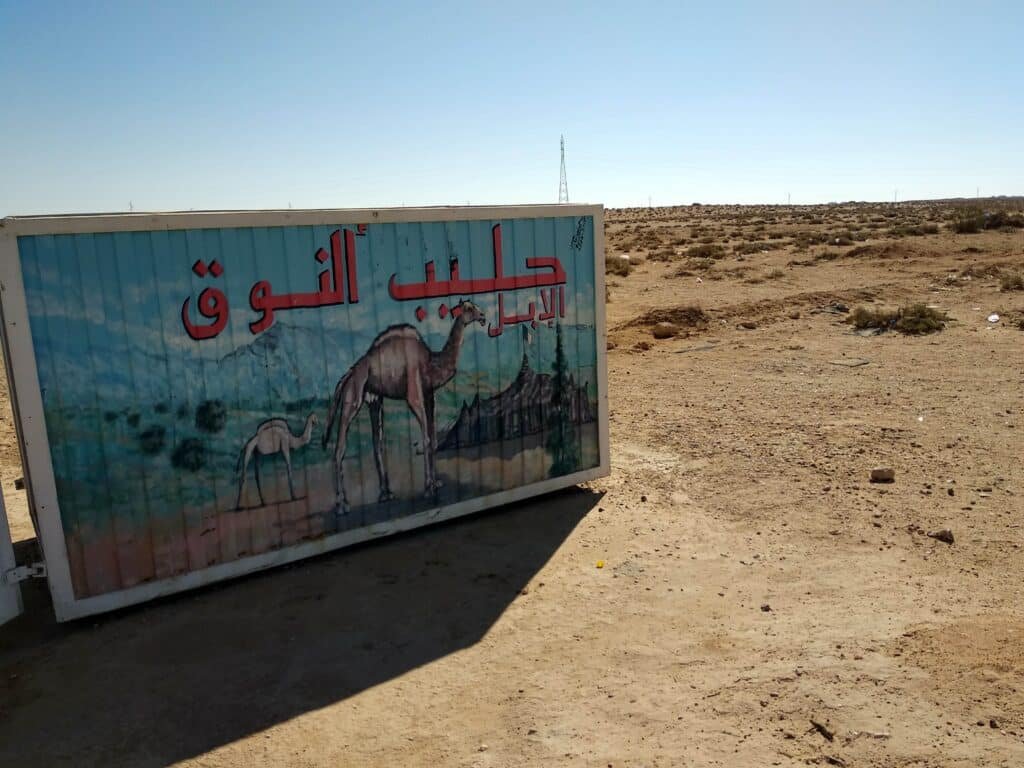
Off-the-Beaten-Path Sahara: Camel Milk Merchant
I read my own thoughts in his eyes: no, it didn’t matter what some dinar told us, we were going to head north; and so, that was that… But let’s not mix things up too much. That evening, we were going to part again. I was to join the women’s party, and he was to stay on with the M’zab men.
VI. Cultural Alterity: The Closed World of M’zab Women
So that I wouldn’t be tempted to take pictures on the sly, and out of respect for their letting me take part in the intimate life of their community, I left my phone behind.
The men also briefed me on what I ought to tell them about myself. Someone came up with the idea of adding married status to my disguise. Introducing myself as Fefa was a joke, but telling them I was married to Bakir was an annotation of a practical order whose reasoning I understood, but to which I opposed.
I feel awkward lying, which makes me devoid of talent in this field. We negotiated and agreed that I would tell them only that I was his fiancée. That way I would neither set an improper example for their women, nor stray so far from the truth as to feel uncomfortable.
I said goodbye and then Idir drove me to the other location. It was likewise a wedding house, like the one where the men were holding their party. They had explained to me that these were built specially for this purpose: large, spacious and, just like the villa we were staying in, either they belonged to no one or they belonged to the better-off people in the community, who made them available to everyone. We parted at the gate, where his sister took charge of me.
Entering the house she looked me up and down, after which she assumed a disapproving expression. But that was nothing compared to the reaction of the cheerful little group that was just coming down the stairs. Admittedly, the light in the hallway was rather dim, but seeing me in jeans and boots they got a real fright: for a moment they thought I was a man.
Perhaps my shock wasn’t as visible as theirs, but I still found it hard to come to my senses. The discrepancy was far too great: from the costumes of ghostly cyclopes they had moved on to shockingly revealing dresses.
It was truly striking to see so much skin after numerous days of shapeless garments. Arms, shoulders, deep necklines, sometimes a bare back, other times a slit that was too daring.
Before introducing me to the rest, they discreetly took me upstairs. Idir’s sister lent me a green dress and more gold jewellery than I had worn in my entire life. It didn’t really suit me. Or maybe it was just an aesthetic taste too far away from my own. Anyway, no one could take me for anything other than a woman anymore.
Almost everyone was sitting on the floor, on the carpet in the large ground-floor living room. The background noise reached the decibel level of a metro station at rush hour.
Everyone was talking to everyone and over everyone. It was strange —but what wasn’t strange for me in that place— to look down from above at that great mass of gossip. How could they be dressed in such dresses and sit on the floor?
And then it was obvious that most of them had invested a lot of energy in their appearance that evening. I didn’t see why; I mean, I’m not saying you shouldn’t dress neatly or elegantly when you see your friends, but with them it was more than that: they were taking a deliberate note of sex-appeal.
Before I could start wondering what was the point of being provocative in an environment to which only women have access, I remembered what Yahia had told me when I asked him how they marry without meeting their counterparts: «We tell our mother roughly what we like and she chooses for us.»
So, they were putting themselves on display to attract the mothers. And the ones who were already married? It probably became a habit or a standard of beauty.
Idir’s sister pointed out a little group in the middle of the room and I set off towards it, trying not to step on anyone, on anything.
I think there were more than 50 people in that room and I could literally see the gossip stirred up by my arrival propagating, passing from mouth to mouth, all the way to the furthest corners. The curiosity of novelty. Somehow, those in the little group I had been directed to squeezed together and made a small space for me too.
I understood why I had been sent there. It was the club of those who spoke English, more or less well. It was one of the strangest conversations I have ever had, not necessarily through its content, but because once I sat down, I too became part of that pluri-unitary organism in which information propagates from one to the next. They would ask me a question, I would answer, and then they would translate it onward to the next head, which in turn would turn around and relate it to the next, and so on.
As we had agreed, I adopted the guise of fiancée. Only they weren’t fooled.
—And is he your Boy-friend? As in, like a Boy-friend from the films? After you quarrel with him you get yourself another one?
The question came from a brash woman of forty-something. She had pronounced Boy more emphatically than the rest, as if she were trying to provoke me or make me complicit in a discussion we were already having anyway.
When interest in my person had died down a bit, I struck up a conversation with one of my neighbours, from whom I had learned with surprise that she is also a medical student, and I wanted to know how she manages to combine her studies with her status.
She seemed a level-headed sort, a year older than me and already married for four. She got along very well with her husband, and in turn he had nothing against her continuing her studies.
They both lived in Algiers and had come home only to attend the wedding. And yes, when she was in Ghardaïa she wore the haik like all the other girls and women, but at university she put on a simple hijab. And yet, it’s clear that medicine presupposes a certain ease regarding other bodies (among other things). She told me that from the start she had agreed with her husband to choose a feminine specialty, such as gynaecology, obstetrics, neonatology, paediatrics.
They both lived in Algiers and had come home only to attend the wedding. And yes, when she was in Ghardaïa she wore the haik like all the other girls and women, but at university she put on a simple hijab. And yet, it’s clear that medicine presupposes a certain ease regarding other bodies (among other things). She told me that from the start she had agreed with her husband to choose a feminine specialty, such as gynaecology, obstetrics, neonatology, paediatrics.
I also talked with a shy teenager of about 16, who liked reading very much and would have wanted, naturally, to study literature or foreign languages; but then Idir’s sister came and took us off to dance.
We went upstairs again, where there was likewise an unfurnished living room, except that the floor area had been reduced by half, leaving room for an interior balcony on all four sides, from which you could look down at the great hall. It was much freer than downstairs: only a few women sat with their backs to the wall.
I danced first with Idir’s sister, but then, one by one, others invited me too. It reminded me a little of medieval dances: simple steps, a respectable distance between partners. The songs, I think, were part of the local folklore and were sung in chorus by those sitting along the edge, while the rhythm was given by clapping.
I danced first with Idir’s sister, but then, one by one, others invited me too. It reminded me a little of medieval dances: simple steps, a respectable distance between partners. The songs, I think, were part of the local folklore and were sung in chorus by those sitting along the edge, while the rhythm was given by clapping.
I didn’t see the bride. It was the first day of the wedding (in the Muslim world it seems they last at least three) and it was assumed that, being a young virgin, she was very shy, so by tradition she showed herself only briefly, so that in the following days she would gather more and more courage.
The meal was as surprising as everything else. In little groups of five or six, we gathered around a large wooden vessel filled with black couscous, over which a vegetable and chicken sauce had been poured. On the floor, in our glittering dresses, each with a wooden spoon in hand, we devoured it together. Strange, but certainly mliha!
VII. Les cyclopes de Ghardaïa: Untold Stories of White-Veiled Ghosts
One of my neighbours turned out to be Idir’s wife. I didn’t pay her much attention; at first impression she seemed to me a conceited princess. Her name was Zohra and I would only come to know her truly the following evening, when we were to be invited to dinner at their home.
They lived in one of the new neighbourhoods, which on the face of it looked like any neighbourhood of identical houses designed by a developer. The house was entered through two doors and we were shown in through the one that opened directly into the guest living room; the other opened into a hallway giving access to the rest of the house (intentional segregation meant to keep male guests at a distance from the rest of the household). Without lingering too long, I asked Idir whether I could go and help Zohra with preparing the meal. I had no hidden motives; only this: I was beginning to feel bad in the role of a guest who receives everything ready-made.
In the kitchen, I did everything in my power to help her more than I was in her way. In addition, as far as her English and my French allowed, we began banal conversation.
Nothing struck me as out of place, until she asked me how we knew Idir. She hadn’t heard of Couchsurfing (although her husband had over 20 references) and believed that all the people he brought to visit were friends or work colleagues.
What’s more, until then it hadn’t occurred to anyone to help her in the kitchen, so she hadn’t had the chance to speak with any of Idir’s visitors. Or maybe his visitors were not female.
From there the conversation took an unusual turn —strange, unusual, odd, other: I couldn’t break free of the sphere of these impressions— and that is how I learned something about her life.
She had married at 18 and Idir already well past 30. And indeed, I allowed myself to be critical about the age difference, because it is one thing to want something and another to have it imposed on you without knowing what you’re getting into. And since then she had spent her entire life in Ghardaïa, divided between children, household and occasional visits to the neighbours.
What bewildered me was not the fact that she had a sad fate, since compared to many others it wasn’t in fact all that sad (at least it had nothing to do with the abjection of poverty and the brutalization of a lack of education), but that what she was telling me didn’t match the impression I had formed of Idir.
I was still far too aware of my own naivety regarding the world, and that made me fall sometimes into the other extreme: incredulity. Was she telling me the truth, or dressing it up? Was she playing the victim? Or was she simply making fun of me and of the way she imagined I viewed their way of life?
She would have wanted to go on studying literature, but wasn’t allowed. She also told me she had left her home town twice: once to go to the sea and once more to the capital, both times in childhood. She wasn’t allowed to open a Facebook account; but she had made one anyway: without photos and under a false name. And since sometimes the apparently trivial things are far more outrageous than the major ones, she finished by telling me that for 8 years, ever since she’d been married, she had been asking her husband to take her to Wahrān. She had seen on television how beautiful it is… I concluded that she was in fact serious.
The last part I could have accepted without gritting my teeth if I had read it in a book, but in real life, knowing that in another day we would just wait at the edge of the road and, with almost no effort, cover the 900 km that separated us from Oran… for the first time I perceived this privilege —of which, like any other privileged person, I wasn’t even aware, considering it part of the extreme that goes without saying— in a bitter way.
I didn’t understand. I didn’t understand how it is possible to live so long with someone and not grant them a simple wish like visiting a city in the same country. In fact I didn’t understand it in his particular case, because I couldn’t find any excuse for him. If he had been poor, or if he too had spent his entire life in an oasis in the middle of the desert —if that were all he had known, I would have understood why that was all he did—, if only I had seen in him certain flaws of character on the basis of which I could justify it to myself.
But it wasn’t so. He was a man of the world. He worked as an engineer for a company extracting natural gas in the area, he had travelled: France, Germany, Spain, all of North Africa, Tanzania, Mozambique; with us he spoke easily about the world and at the same time without pomp, without showing off, and with me he behaved naturally, without ever making me feel for a moment that he disapproved of the way I am. He even sided with me when I expressed my undisguised happiness about the fact that there is nowhere to buy cigarettes.
Volunteer weekend coach for children’s basketball teams, volunteer photographer at a friend’s wedding, always obliging towards us (one afternoon he went half an hour home and another half hour back to bring us food, since there was nowhere around from which to buy any): it could be a question neither of selfishness nor of laziness. He looked, spoke and behaved like a man of integrity. And that is precisely what prevented me from understanding him. You can not show guilt or remorse for some views or actions that are not part of your morality.
Throughout that evening I couldn’t shake the sensation that a trick was being played on me. When I returned to the living room, I again had the sensation that she was exaggerating. To refuse your life partner so many things seemed to me a wrongdoing, but at the same time I saw no trace of meanness in his serenity. I had to pinch myself mentally to remind myself that we were in a city where the woman is a ghostly presence who lives her public life wrapped in profound anonymity. In the street, if by chance a husband passes his wife, he has no chance of recognizing her. With a pang I observed that the same thing was happening in the intimacy of the home as well.
The malice existed, but only from the onlooker’s perspective. Within him I found no trace of any such thing, because what I was looking for: marks of malice, more or less disguised (a vaguely misogynistic remark, a small unkindness), would have existed only if he had been deliberately opposing my morality. Whereas he was content to live in harmony with the one he had been raised in. That harmony had its own quiet arrangements. She cooked us dinner, and the three of us ate in the living room while she dined alone in the kitchen (the children were at a neighbour’s). It was neither a demonstration of power nor a malice, but simply the way things were. Idir seemed a man of integrity, because he genuinely was. An integrity based on the morals he was raised with, all part of what was self-evident to him.
Out of a desire to preserve their M’zab tradition and because they represented no more than a dot on the world map, a sly particularity had come into being: they grew up with both the world inside and the one outside, being taught from the start to reconcile the two.
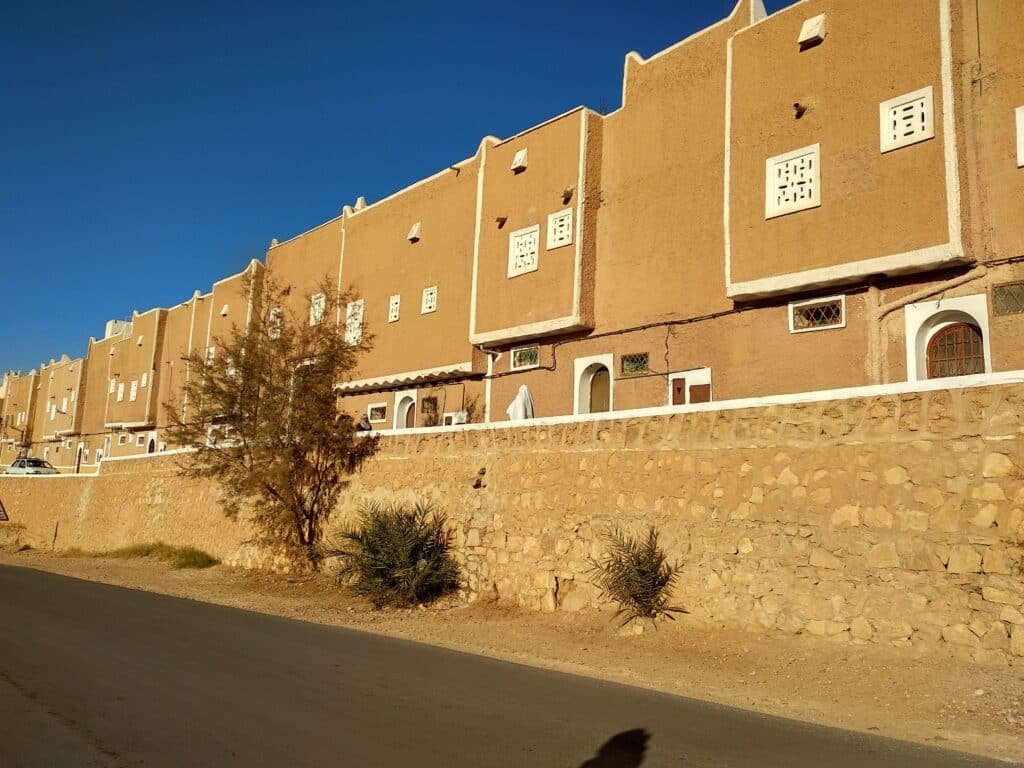
Among the Mozabites the traditional house is inward-looking, with rooms distributed around a small internal courtyard, commonly on two floors: a dwelling closed to the outside and open only to the sky, its bare walls deliberately carrying no exterior sign of wealth, by a principle of equality and social solidarity.
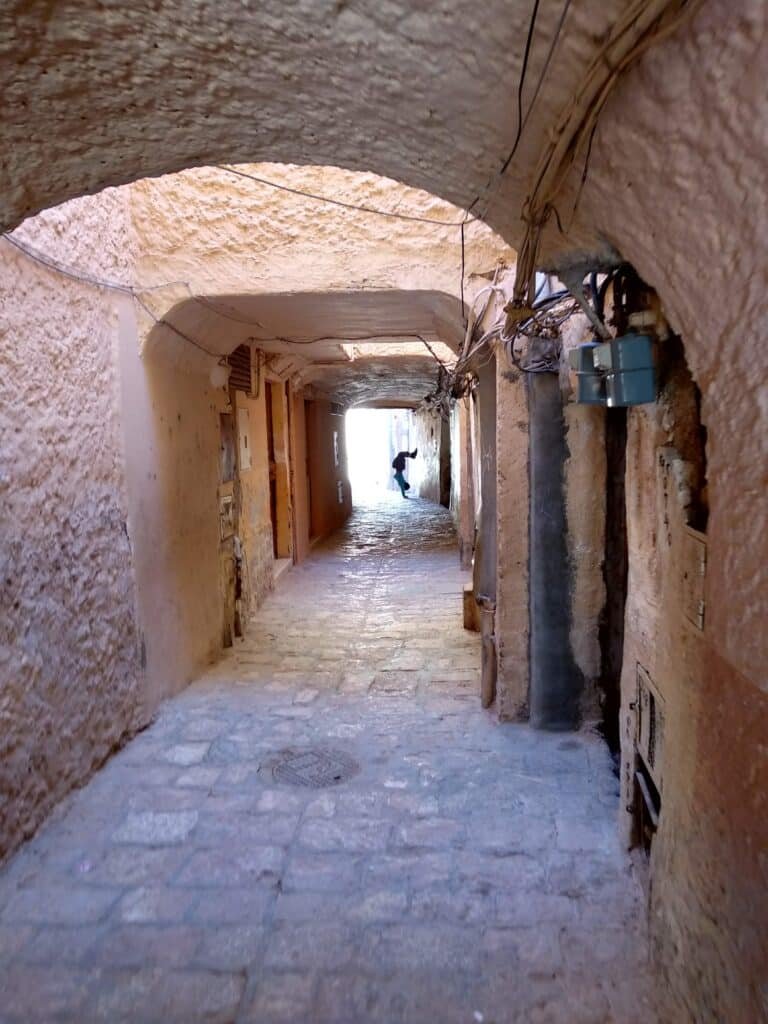
The threshold itself does the work of separation. The classic house is entered through a bent passage, an entrée en chicane or skiffa, designed to preserve the household’s privacy from strangers’ eyes: a dogleg corridor that breaks the sightline so that no one at the door can see into the west eddar, the central courtyard where the family’s domestic life unfolds. That doorway is more than a functional device; it is understood as the boundary between the exterior world of men and that of women. Some houses double this logic in their circulation, keeping two staircases — one for the women and family, the other communicating directly with the skiffa so as to give access to the upper floor while avoiding any view onto the west eddar.
This is where the Berber tribal traditions of the M’zab become legible as architecture. The principle organizing everything is the sorting of space by user rather than by function: the interior of the M’zab house separates the space of the family core from the zone of male visitors or male members of the family. A room near the entrance receives male guests, who need never penetrate the household proper; the courtyard and the spaces around it belong to the women, who move, work, and receive their own visitors out of any outsider’s line of sight — a female salon (the tizefri) connected to the men’s side only by a chouf, a small eye-level peephole. Newly married sons are commonly given rooms on the upper floor, and the open roof terraces serve as the women’s own realm of movement, an aerial city invisible from below, where women cross between neighbouring houses without ever descending to the street. This tribal gender segregation is not incidental to the M’zab, it is the very stone of it.
As long as the walls remained standing, the two complemented each other: the inner one offered them stability and the outer one freedom; without either of them outweighing the other.
I was part of the great world outside and as such I was naturally treated according to its rules. They, however, century after century, ended up beeing trapped in their own construction. They ended up supporting the walls of the ksour with their own lives, some of them beeing trapped between them.
That evening I came to understand her air of a wounded princess, and I felt the urge to tell her how sorry I was that she lived in a place with such a deep rift between the sexes. In a way paradoxical, since in other interactions they were quite affectionate, as people.
They live on that shore of the world where an aişek hoia!, a handshake, an embrace, can turn almost any stranger into a brother. They are warm by nature, which makes this segregation of the sexes all the more regrettable.
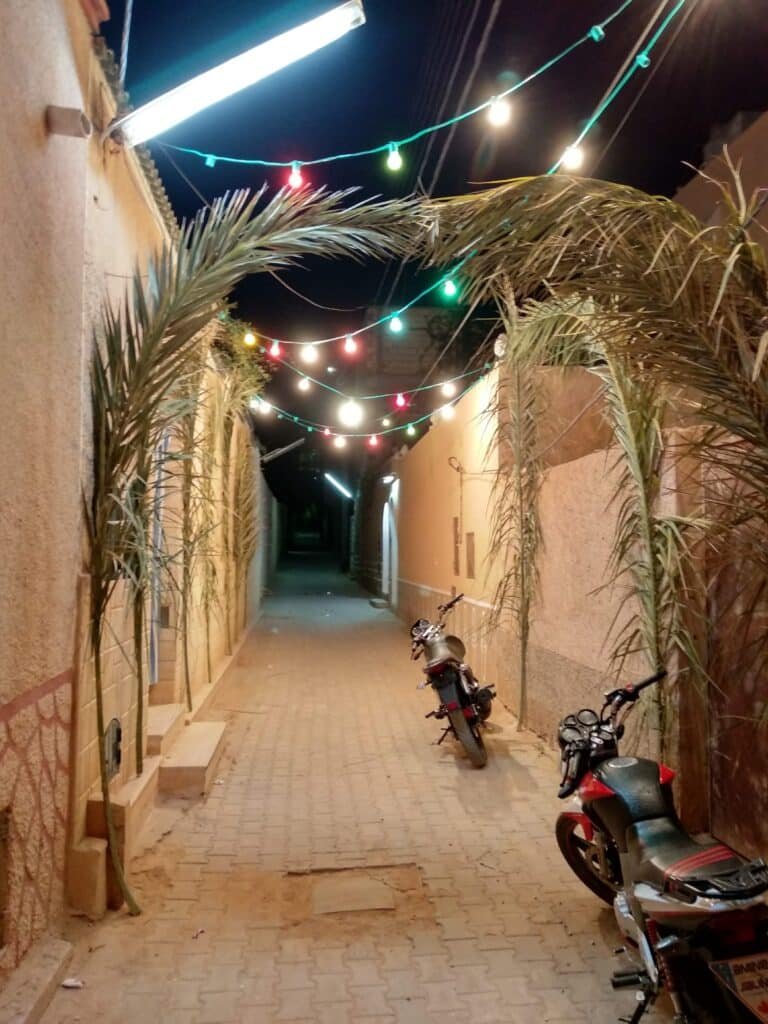
But let us return to the wedding. For if I did not have the pleasure of meeting the bride, I did at least catch a glimpse of the groom. We were on the point of leaving. I in jeans and boots again, Zohra in her haik, we were waiting for Idir, when suddenly a great commotion began to be heard from the street.
The whole house was seized with frenzy: they knew what it meant, the groom was coming to court! Every which way they were trying to remember where they had left their haik so as to get dressed in time. When everyone was ready, the bride’s mother went to the gate and opened it for them. But that didn’t mean the two camps were going to mix even for a moment; the women had gathered on the ground floor, while the men went straight up to the first floor. I followed them, hoping I wouldn’t stun anyone.
At first, the wedding guests gathered along the edges, leaving only the groom in the middle. He was dressed differently. The costume made him resemble the beys in the Topkapı miniatures, or any other sort of oriental prince with a yataghan at his belt. A few of those present offered him their good wishes in turn, after which the musicians began beating rhythmically on the drums again. Someone set the tone:
—ⴰⵣⵣⴰ ⵀⴰⵏⴰ ⵓⵛⴰⵏⴳ ⵜⴰⴽⴰⵔⵡⴰⵢⵜ!
And then everyone followed him in chorus:
—Azza hana ucang Takarwayt!
They shouted together, staccato, one word on each beat, and in the same rhythm gestured with the right fist in the air. The whole event has transformed into a tribal incantation. Only the groom said nothing, seemingly lost in the middle of a furious mob. From a more peaceful neighbour I learned that they were in fact demanding Takarwayt from the groom’s mother, a local potion meant to increase potency.
The nuptial ceremony of Algerian Ibadis carried on… until they finally received the Takarwayt, which, incidentally, tasted like children’s champagne. Then slowly the party dissolved and small groups of ghosts took the night streets accompanied by their husbands and brothers.
VIII. No matter who they were, no matter how they lived, death made them all equal
Are concepts of death relevant?
I think so — vaguely, they alter how we live.
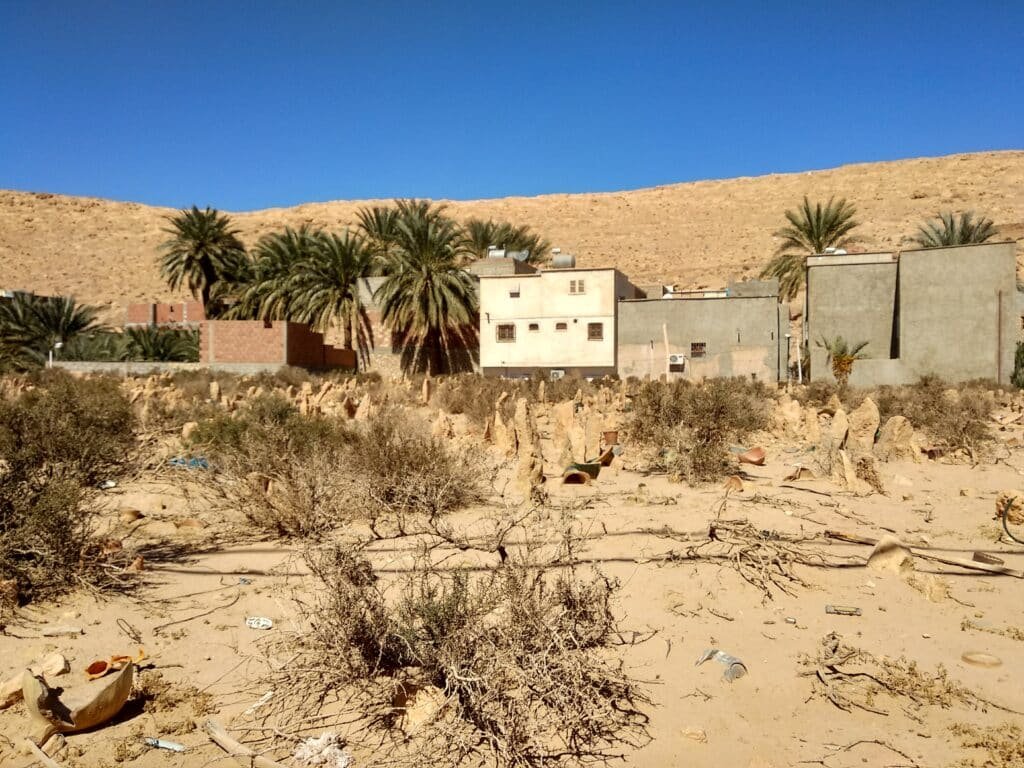
On our last stroll in the M’zab Valley, we passed through a cemetery. Yellow stones taken straight from the heart of the desert were used to mark the graves: unworked plaques of sandy rock, one taller for the head and one smaller for the feet. Anonymous graves that only living relatives could identify — saying that no matter who they were, no matter how they lived, death made them all equal. On some of the graves a personal object of the deceased had been left, to remind the living relatives where to find them. Their memory lived on as long as the last person who cared for them lived.
I liked this quiet, peaceful way of returning to the desert.
It’s not just about where you go. It’s about how the journey changes you.
This type of journey rewards the traveller who is drawn to what unsettles rather than what reassures, who wants to untangle the intricacies of a culture instead of ticking off its sights, and who can stand inside genuine strangeness without reaching for the comfort of a ready-made judgment. It asks, too, for a certain ease in uncertainty: the calm to let Plan B become Plan A, to accept hospitality without knowing what the evening will hold. Above all it asks for warmth and the willingness to meet people as they are, to be lent a green dress and more gold than you’ve ever worn, and to let yourself be changed a little by the encounter. If you recognised yourself in any of that, the Sahara may be waiting for you too. And if you’re curious what kind of traveller you are — what your own curiosity, your own openness, your own appetite for the unfamiliar might be built for — you can find out at The Verse Voyager. It’s not just about where you go. It’s about how the journey changes you.
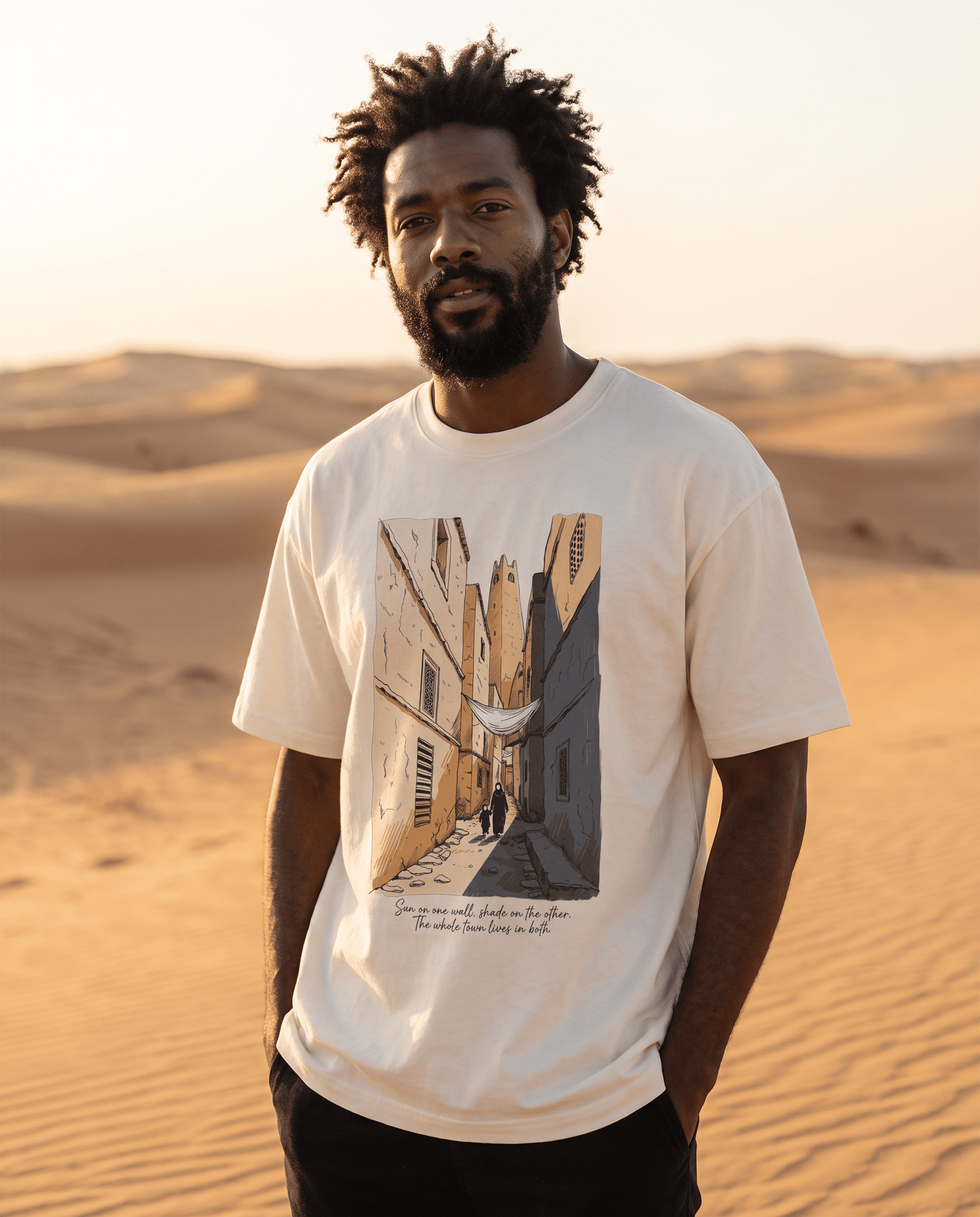
Those walled alleyways of the M’zab, sun on one side and shade on the other, are what inspired the Ghardaïa Tee: an illustrated alleyway from the valley printed on soft organic cotton, with “Sun on one wall, shade on the other” on the back, a small souvenir of a place built for two temperatures at once.
TLDR
TL;DR: A first-person account of living with Berbers in the Sahara — arriving in Ghardaïa by hitchhiking and Couchsurfing through Algeria’s M’zab Valley, a UNESCO pentapolis of five ksour founded by Ibadi refugees after the fall of the Rustamid dynasty. As a rare tourist in Algeria off the beaten path, I was taken into a traditional Berber wedding — its men’s and women’s halves held entirely apart — and into the closed world behind the white haik veil of Ghardaïa, where the Mozabites sustain a thousand-year-old dual-system society, austere desert architecture, and a strict tribal gender segregation built into the very walls of their homes. Part Sahara travel narrative, part meditation on cultural alterity and the ethics of travel, these are the untold stories of the white-veiled “cyclopes” — and of how one learns to see a tribal community clearly, without the deforming lens of prejudice.