
Table of Contents
Best things to do in Sweden: Is It Worth Visiting, and How to Plan the Trip
Sweden is one of those countries people put off. It sits at the top of the map, it has a reputation for being expensive, and the flight time feels longer than it usually is. So the trip stays on the “someday” list while people book their third week in Italy.
I think that’s a mistake, and I want to make the case properly.
This guide covers the whole country the way I’d walk a client through it before we design anything: the honest answer on whether Sweden is worth the trip, when to go depending on what you actually want, what it costs, the places that earn their spot, the quieter corners most people never reach, and the two things Sweden does better than almost anywhere else on Earth, the northern lights in winter and the midnight sun in summer. I’ve kept the big cities light on purpose. Stockholm, Gothenburg, and Malmö each get their own deep dive, and I link to those below so this stays a map of the whole country rather than a list of one street in one city.
By the end you’ll know whether Sweden fits the trip you have in mind, and roughly how to shape it.
TL;DR: What’s in This Guide
If you only read one box, read this one. It maps to the whole article below.
- Is Sweden worth visiting? Yes, if you want nature, calm, design, and space more than nightlife and heat. Less so if a beach holiday is the whole point.
- Best time to go: June to August for long days and the midnight sun, December to March for snow and the northern lights. Late May and September are the quiet sweet spots.
- The best cities: Stockholm, Gothenburg, and Malmö, kept light here since each has its own full guide, plus Kiruna and Visby as gateway towns.
- 7 amazing natural spots: Abisko National Park, the King’s Trail and Kebnekaise, the High Coast (Höga Kusten), the Stockholm archipelago, the Bohuslän coast, the Luleå archipelago and frozen sea, and Öland. Full section below.
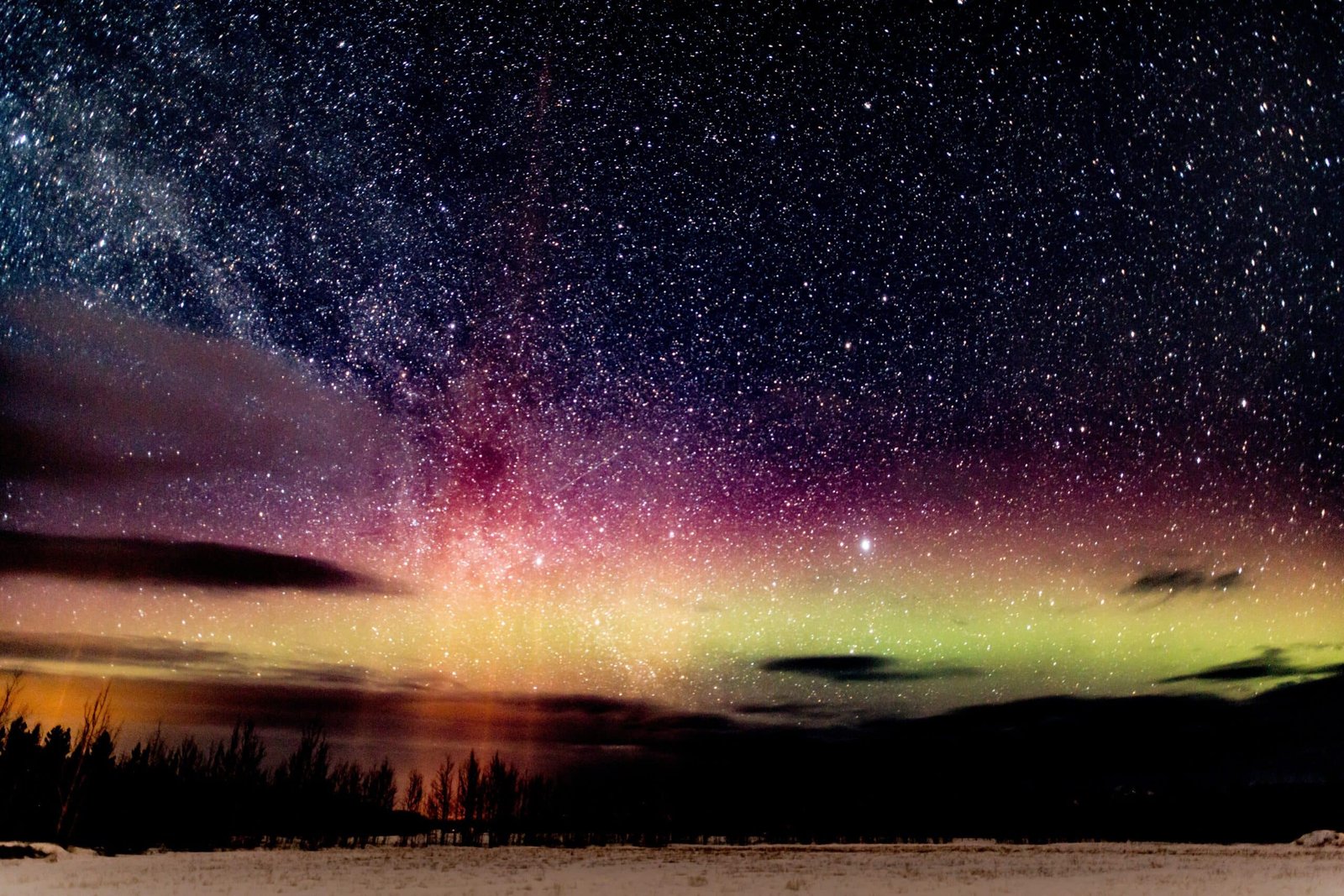
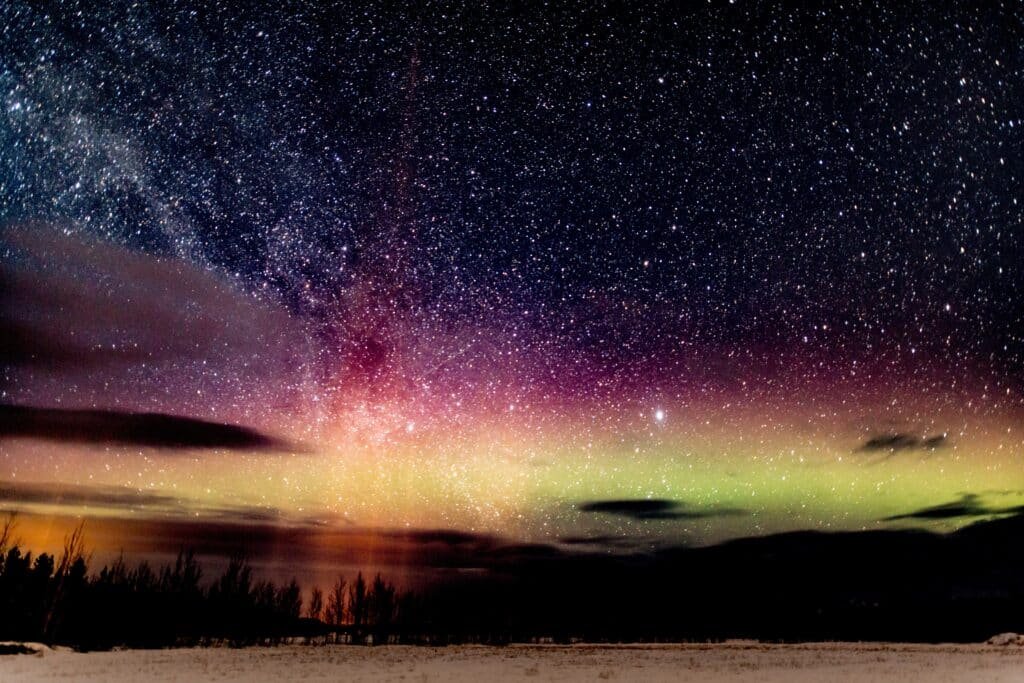
- Northern lights: Best in the far north around Abisko and Kiruna, roughly late September to early April, with the strongest odds from mid-November to mid-March.
- Midnight sun: Above the Arctic Circle from late May to mid-July, when the sun never fully sets.
- How long do you need? 5 to 7 days for one region, 10 to 14 days to combine a city with the Arctic north.
- Is it expensive? It’s not cheap, but it’s manageable. Nature is free, self-catering is easy, and the right-to-roam law lets you camp for nothing.
- Getting around: Trains are excellent and reach far north. You don’t need a car for the cities. You’ll want one for the countryside and the coast.
- Which Sweden trip is right for you? The guide ends with how your travel personality shapes the version of Sweden you’ll love most.
Is Sweden Worth Visiting? An Honest Answer
Yes, Sweden is worth visiting, but it rewards a specific kind of traveler, and I’d rather tell you that up front than sell you a trip you won’t enjoy.
Sweden is worth it if you’re drawn to nature, quiet, clean design, good food, and the feeling of having room to breathe. It’s a country of forests, lakes, islands, and mountains, with cities that are calm and walkable rather than loud and overwhelming. If your best travel memories involve a long walk, a slow meal, water you can actually swim in, and a landscape that empties your head, Sweden will land for you.
It’s less of a fit if you’re chasing heat, packed nightlife, or a wall-to-wall list of famous monuments. Sweden isn’t a museum country in the way Rome or Athens is. Its pull is atmosphere and nature, not a checklist of ruins. And the weather is a real variable. Summers are mild and gorgeous but short. Winters are dark, cold, and, in the far north, genuinely extreme, which is exactly the point if you’re there for snow and the aurora, and a problem if you’re not.
So the honest version is this. Sweden is worth visiting for the traveler who wants the trip to feel like an exhale. It’s one of the safest (with certain exceptions), cleanest, most easily navigated countries you can travel in, with almost no language barrier, excellent trains, and nature you’re legally allowed to walk into and sleep in. If that sounds like your kind of trip, the rest of this guide is about doing it well. If it doesn’t, I’d genuinely point you somewhere warmer, and I’d rather do that than have you fly north for the wrong reasons.
One more thing worth saying plainly. A lot of people ask whether Sweden is worth visiting in winter specifically, because winter is the harder sell. My answer is that winter is when Sweden does its most singular thing. The far north in the dark months gives you the northern lights, dog sledding, snow that muffles the whole world, and a stillness that’s hard to find anywhere else. If you go north and you go prepared, winter isn’t the compromise season. It might be the reason to go at all.
The Best Time to Visit Sweden, Season by Season
The best time to visit Sweden depends entirely on what you want the trip to be, because Sweden is really two countries in one, the long-day summer version and the dark, snow-covered winter version, and they offer opposite experiences.
Here’s the season-by-season breakdown.
Summer (June to August): long days and the outdoors
Summer is the easy answer and the most popular time to visit Sweden, for good reason. Days are long, the weather is mild, and the whole country moves outdoors. In the south, that means swimming, island-hopping in the archipelagos, cycling, and long dinners that stretch into a bright evening. In the north, it means the midnight sun and hiking under a sky that never fully darkens.
The trade-off is that summer is peak season. Prices rise, popular spots fill up, and Swedes themselves take their long holidays in July, which means some smaller businesses in cities close while the coast and countryside get busier. If you want the classic Swedish summer, aim for June or early July. If you want it slightly quieter and cheaper, the back half of August still delivers warm days with thinner crowds.
Autumn (September to October): the quiet sweet spot
Early autumn is my favorite time to send people who want the country without the crowds. September brings crisp air, forests turning color, and far fewer tourists, while the weather is still reasonable in the south. In the far north, September is also when the aurora season begins, so you get a rare overlap of walkable daytime weather and northern lights at night.
It’s a shoulder season, so you’ll pay less and share the trails with fewer people. The risk is weather variability, especially by October, when it can turn cold and wet fast. Pack for it and autumn is one of the best-value windows Sweden has.
Winter (December to March): snow, dark, and the aurora
Winter is the season Sweden does like almost nowhere else, and it splits sharply by latitude.
In the south, winter is dark and cold but not extreme, with short days and a cozy, indoor rhythm built around candles, coffee, and warmth. The cities look beautiful under snow and the Christmas markets are worth timing a trip around in December.
In the north, winter is the main event. This is northern lights season, dog sledding season, the season of the ICEHOTEL and snow-covered forests and frozen lakes. Days are very short, and in the deep north around midwinter you get little to no real daylight at all, which sounds daunting but creates the exact conditions the aurora needs. If you’re going to Sweden for winter, go north, go prepared for serious cold, and treat the darkness as the feature it is.
Spring (April to May): the shoulder before the rush
Spring is the underrated season. April can still be wintry in the north and muddy in the south as the thaw sets in, but by May the south comes alive, days lengthen quickly, and prices haven’t hit summer peak yet. Late May is a genuine sweet spot: the far north starts its midnight sun period, the south is green and pleasant, and you beat the July crowds entirely.
If I had to pick two windows for a first trip, I’d say late May to mid-June for the summer version, and February to mid-March for the winter and aurora version. Those give you the best of each without the worst of the crowds or the weather.
How Many Days Do You Need in Sweden?
For a first trip, plan 5 to 7 days for a single region and 10 to 14 days if you want to combine a city with the Arctic north. Sweden is a long country, longer than most people expect, and distance is the thing that catches travelers out.
Here’s how the math tends to work.
A short trip (4 to 5 days) works well if you stay in one place. A long weekend in Stockholm and its archipelago, or a focused winter trip to Swedish Lapland for the aurora and dog sledding, both fit comfortably in this window. Don’t try to combine north and south in under a week. You’ll spend the trip in transit.
A week (6 to 8 days) is the sweet spot for most people. It gives you a city plus a region: Stockholm and the archipelago, or Gothenburg and the west coast, or a full winter week in the north with time for the aurora to actually show up. That last point matters. The northern lights need clear skies and patience, so more nights in the north means better odds. Three to four nights up there is a sensible minimum.
Ten days to two weeks lets you do the trip most people dream about: a few days in a southern city, then the long train north to Kiruna and Abisko for the Arctic. This is the fullest version of Sweden, the contrast between the calm design of the cities and the raw scale of the north, and it’s the itinerary I most enjoy shaping because the two halves make each other feel bigger.
The distance point is worth repeating because it’s the single most common planning mistake. Stockholm to the far north is a long way, an overnight train or a domestic flight, not a day trip. If your list includes both a southern city and the Arctic, respect the travel time and don’t over-pack the days. Sweden rewards a slower pace, and the country is too big to rush.
For detailed day-by-day routes, contact me and I will help you planning the best experience in Sweden, which is designed specifically for you.
Is Sweden Expensive? What a Trip Really Costs
Sweden is not a cheap country, but it’s more manageable than its reputation suggests, and there are specific reasons the “Sweden is expensive” story is only half true.
The honest picture: dining out, alcohol, and hotels in the cities are where costs add up fast, roughly in line with other Nordic capitals and pricier than most of southern Europe. A restaurant dinner with drinks and a night in a central hotel are the two line items that will define your budget. Alcohol in particular is taxed heavily and sold through a state monopoly, so a night out costs more than you’d expect.
Now the part people miss. A lot of what makes Sweden special is free or close to it.
What’s cheap in Sweden
Nature costs nothing. The forests, lakes, trails, and coastline are open to everyone, which brings me to the single biggest budget lever in the country.
The right to roam lets you camp for free. Sweden’s allemansrätten, the constitutionally protected right of public access, lets you walk, cycle, and pitch a tent for a night or two on most uncultivated land, as long as you keep clear of homes and gardens and leave no trace. For travelers comfortable with a tent, this turns accommodation from the biggest cost into almost nothing. More on how this works in the experiences section below.
Self-catering is easy and normal. Supermarkets are good, kitchens are common in accommodation, and cooking a few of your own meals cuts the food budget hard.
Tap water is excellent and free everywhere. Never buy bottled water here.
Cities are walkable and transit is efficient, so you rarely need taxis.
What’s expensive in Sweden
Alcohol is the priciest line item relative to what you’re used to. It’s heavily taxed and sold through Systembolaget, the state-run store, for anything stronger than light beer. A few drinks out add up fast. If you drink, buying from Systembolaget to enjoy at your accommodation is far cheaper than bars.
Restaurants and city hotels come next, running at Nordic-capital levels. This is where a trip’s budget is won or lost. A daily restaurant dinner and central hotels will push you toward the high end.
Transport is moderate. Trains and buses are reasonable if you book ahead, and city transit is efficient and fairly priced. Car hire adds up but unlocks the countryside.
Activities vary. Guided aurora tours, dog sledding, and the ICEHOTEL are premium experiences priced accordingly. Hiking, swimming, and the outdoors are free.
Nature and camping cost nothing, which is the whole point below.
So the real answer to “is Sweden expensive” is: it can be, if you eat out every night, drink in bars, and stay in central hotels, and it doesn’t have to be, if you lean on nature, self-catering, trains, and the right to roam. A traveler who camps and cooks can do Sweden on a genuinely modest budget. A traveler who wants restaurants and hotels should plan for Nordic prices. Most people land somewhere in between, and the mix is yours to set.
My honest take after planning a lot of Nordic trips: Sweden costs less than people fear and rewards a little planning more than most countries, because the expensive things are easy to swap for free ones without the trip feeling like a compromise. If you want to get a better understanding of the numbers, you can check the estimate prices in Sweden and decide if it is cheap or expensive.
One practical note: Sweden is in the European Union but does not use the euro. The currency is the Swedish krona (SEK), and the country is famously close to cashless. Cards and phone payments work almost everywhere, and many places don’t take cash at all, so you can travel the whole trip without withdrawing a single note.
The Best Cities to Visit in Sweden
Sweden’s cities are calm, walkable, and easy, more about atmosphere than a checklist of monuments. Here’s where to base yourself, kept at overview depth since the big three each have their own detailed guide. The nature, which is the real reason most people come, gets its own section right after this.
Stockholm , the capital on the water
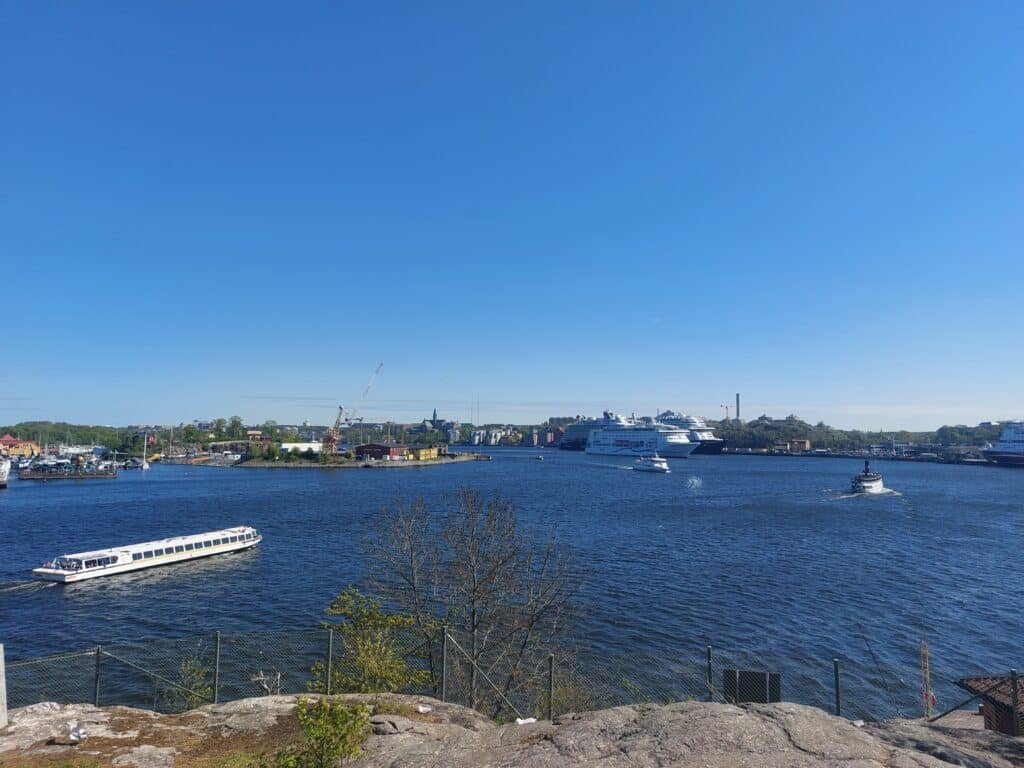
Stockholm is the obvious starting point and it deserves to be. The city spreads across fourteen islands where a lake meets the Baltic, which gives it a light and openness that few capitals have. The old town, Gamla Stan, is one of Europe’s best-preserved medieval centers, and the surrounding archipelago is a world of its own. Stockholm is calm, elegant, and easy, a soft landing into the country.
Gothenburg, the west coast city
Gothenburg, on the west coast, is Sweden’s second city and, to many people, its friendliest. It’s a city of canals, café culture, a serious food scene, and easy access to a rugged coastline of fishing villages and islands. It has a more relaxed, down-to-earth feel than Stockholm, and it’s the natural base for exploring the west coast.
Malmö and the south
Malmö, in the far south, is Sweden’s third city and its most continental, connected to Copenhagen by the famous bridge across the water. It’s compact, diverse, and green, and it opens up the whole southern region of Skåne, a landscape of castles, beaches, and farmland that feels different from the rest of the country.
Kiruna, the gateway to the Arctic north
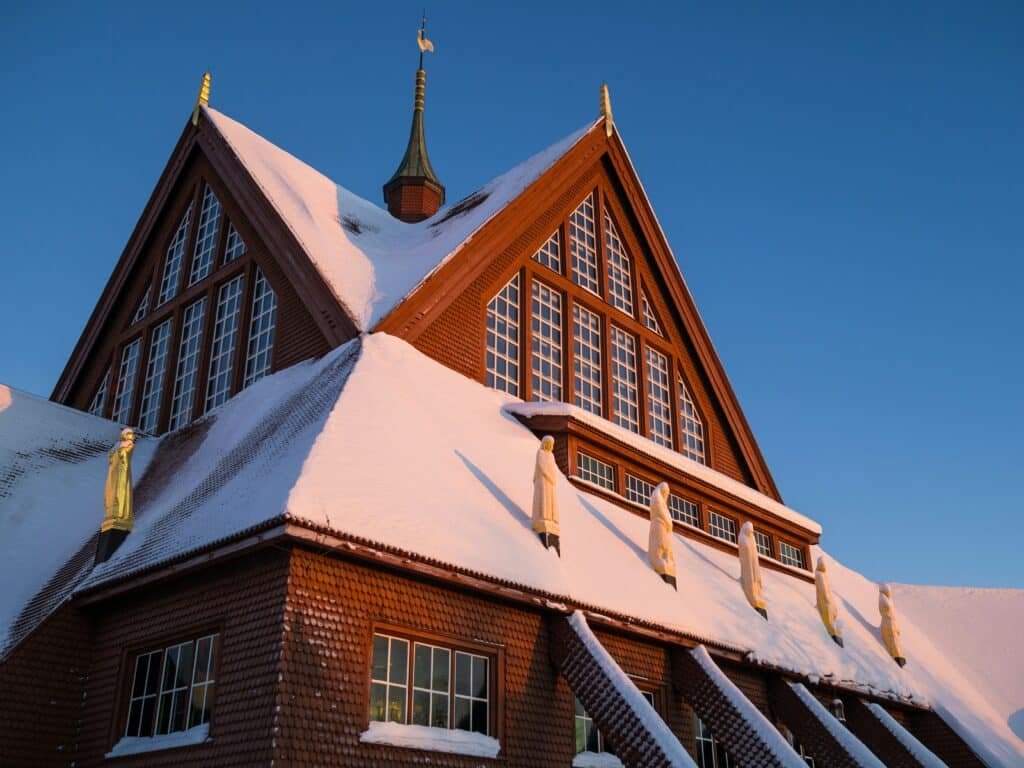
Kiruna is the north’s main town and the jumping-off point for Swedish Lapland, Sweden’s Arctic region, which covers roughly the northern quarter of the country. It’s the northernmost town of any real size, the base for dog sledding and the ICEHOTEL nearby, and the launch pad for the natural spots up here, Abisko and the mountains among them. In winter it’s the land of the aurora, in summer the land of the midnight sun and long-distance hiking.
Visby and Gotland
Out in the Baltic, Gotland is Sweden’s largest island, and its main town, Visby, is a walled medieval port and a UNESCO World Heritage Site, one of the best-preserved of its kind in Northern Europe. In summer the island fills with beaches, ruins, and light, and it’s an easy add-on to a southern trip by ferry or short flight.
7 Amazing Natural Spots in Sweden
Sweden’s real pull is its nature, and it has more of it, and emptier, than almost anywhere in Europe. These seven natural spots run from the iconic to the barely-visited, spread across the whole country so you can build a trip around whichever fits your season, route and personality. A few are famous. Several are places most visitors never reach, which for the right traveler is exactly the appeal.
1. Abisko National Park
In the far north, Abisko is the crown jewel of Swedish nature and the best base in the country for the northern lights, thanks to the “blue hole” microclimate I cover in its own section below. But it’s a year-round natural spot, not just a winter one. It sits at the head of the King’s Trail, wraps around a long lake beneath the mountains, and delivers the midnight sun right through summer. Come in winter for the aurora and the snow, or in summer for hiking under a sun that never sets.
2. The King’s Trail (Kungsleden) and Kebnekaise
Sweden’s most famous long-distance hike runs through the mountains of the far north, past glaciers, valleys, and Kebnekaise, the country’s highest peak. You don’t have to walk the whole thing. The stretch out of Abisko is one of the most accessible and rewarding sections, and in summer you can walk it under the midnight sun. This is Sweden’s great mountain landscape, and the best of it is on foot.
3. The High Coast (Höga Kusten)
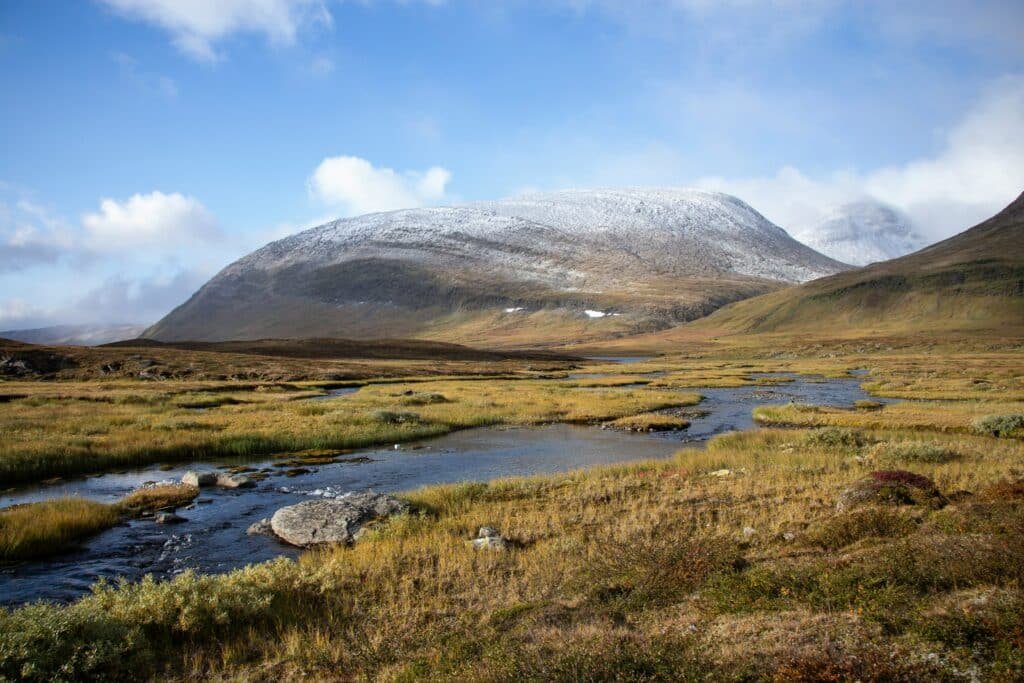
A few hours north of Stockholm on the Gulf of Bothnia, the High Coast is a UNESCO-listed landscape where the land is still visibly rising out of the sea after the last Ice Age, one of the fastest such rebounds anywhere on Earth. It’s dramatic and sparsely visited, with cliffs, forested islands, and hiking trails that see a fraction of the traffic of the famous spots. If you want big coastal scenery without the crowds, this is it.
4. The Stockholm Archipelago
Just off the capital, thousands of islands scatter across the Baltic, from busy day-trip islands with cafés and swimming to remote outer specks where you might have a rock and the open sea to yourself. Ferries make it easy, and it’s the classic Swedish summer: island-hopping, cold clean water, and a simple cabin on a rock. You can taste it on a day trip from Stockholm or lose a whole week in it.
5. The Bohuslän Coast
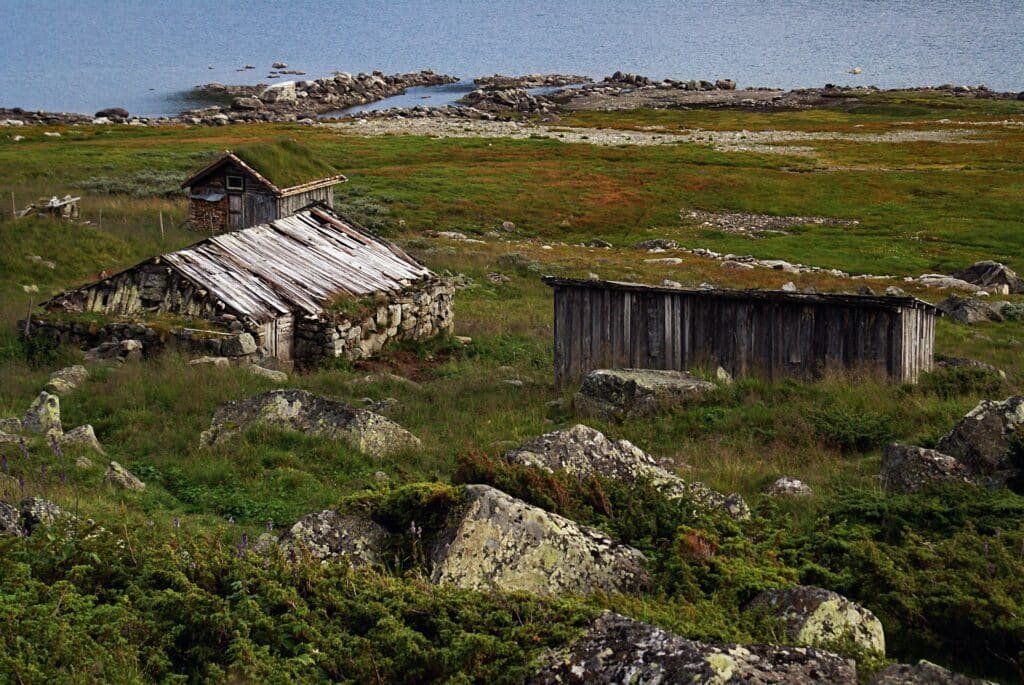
North of Gothenburg, the Bohuslän coast is all smooth pink granite, weathered fishing villages, and cold clear water. Think old wooden boathouses, seafood straight off the boat, and swimming off the rocks in summer, in places like Smögen and Fjällbacka. Busy in July, close to empty in September, and lovely in both. This is the west coast’s answer to the eastern archipelago, and to many Swedes it’s the better one.
6. Öland and the Stora Alvaret
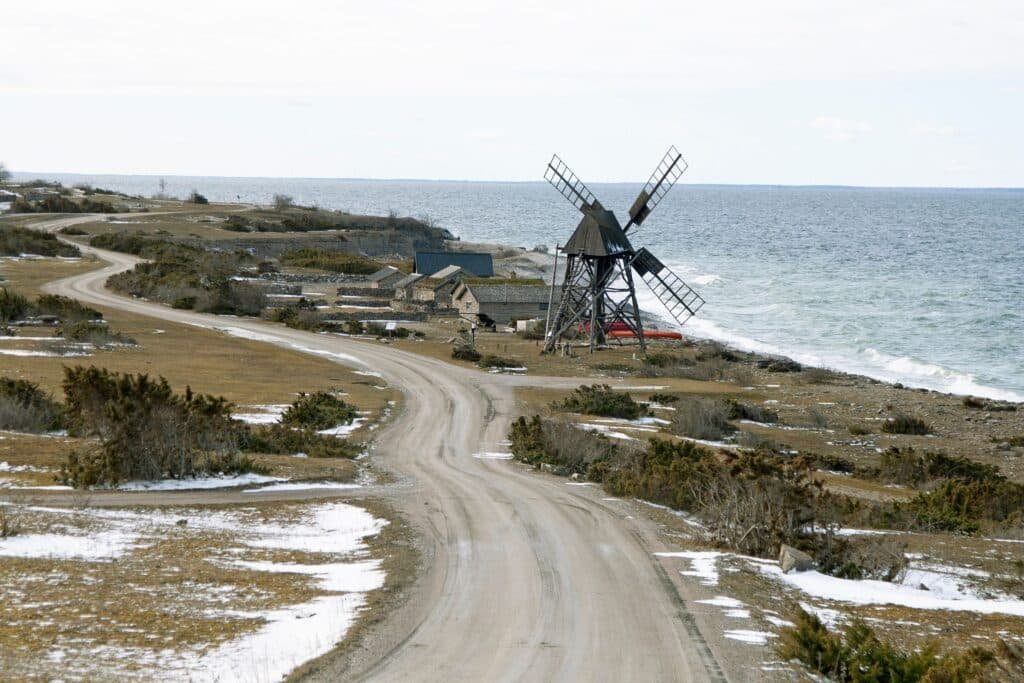
Connected to the mainland by a long bridge, Öland is easy to reach and yet stays under the radar for foreign visitors. It’s a place of windmills, wildflowers, and some of the best birdlife in the country, and in the south it holds the Stora Alvaret, a vast, treeless limestone plain unlike anything else in Sweden and part of a UNESCO World Heritage area. Flat, quiet, and made for cycling. Come in late spring or early summer when the wildflowers are out.
7. The Luleå Archipelago and Frozen Sea
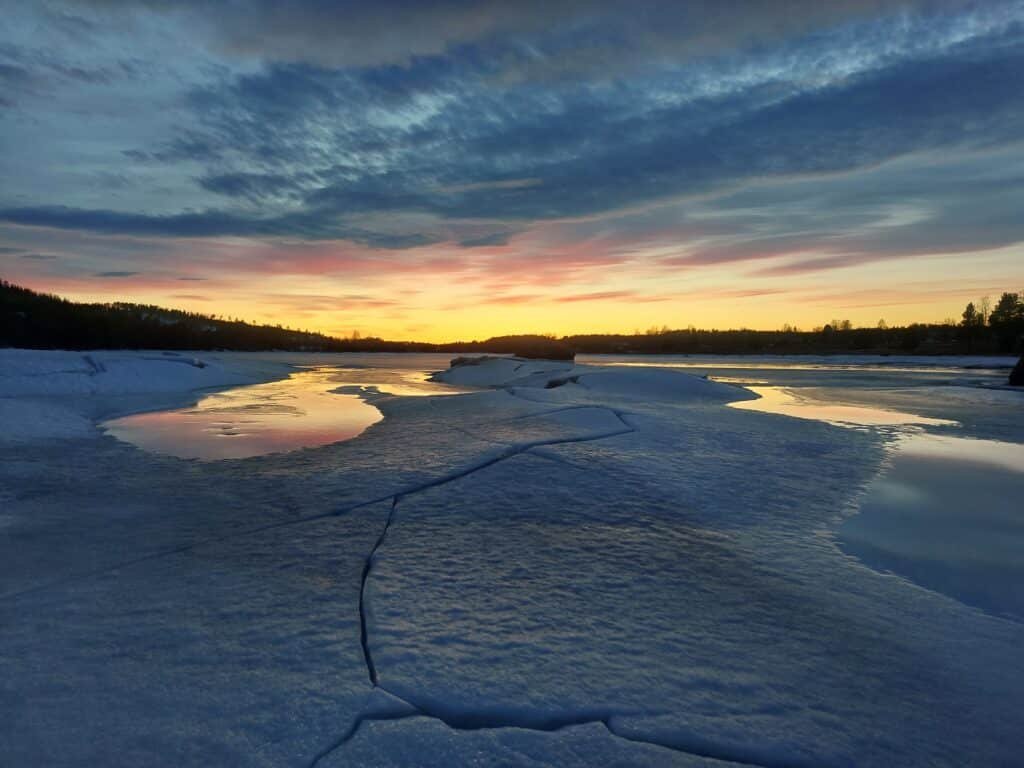
Up on the northern coast, Luleå sits at the edge of an archipelago of more than 1,300 islands, and it does something almost nowhere else can. In winter the Bothnian Sea freezes solid enough to walk, skate, and even drive on, and the city ploughs a long ice track plus a network of ice roads out to the islands, all free and used by locals as everyday routes. In summer the same islands are for kayaking and hiking under the midnight sun. Just outside town, Gammelstad Church Town is a UNESCO World Heritage Site of more than 400 old wooden church cottages around a medieval stone church. Underrated, easy to reach by air, and unlike anywhere else on this list.
The Northern Lights in Sweden: Where and When to See the Aurora Borealis
Sweden is one of the best countries in the world to see the northern lights, and the reason comes down to one specific place with a specific advantage. If catching the aurora borealis is the point of your trip, this section is the one to read closely.
Where to see the aurora in Sweden
The far north is the answer, and Abisko is the best single location in the country. It’s widely rated the most reliable aurora spot in Sweden, and one of the best in the world, because of a microclimate called the Blue Hole that delivers clearer skies than almost anywhere else in Scandinavia. Here’s why that matters: seeing the aurora isn’t only about aurora activity, it’s about clear skies, and cloud is what ruins most people’s chances. Abisko sits in a rain shadow created by the surrounding mountains and the long lake below it, so weather systems tend to drop their cloud before they reach it. Locals from nearby Kiruna will drive to Abisko when their own skies cloud over.
Practically, that gives you two main bases. Kiruna is the larger hub, easy to reach by flight or overnight train, with the ICEHOTEL nearby and plenty of tour operators. Abisko, about an hour further on, is smaller and more focused, with the Aurora Sky Station perched on a mountain above the village for some of the best viewing conditions anywhere. Many people base in one and day-trip to the other.
When to see the northern lights in Sweden
The aurora season is long. The aurora season runs from late September to early April, with the best chances on dark, clear nights between mid-November and mid-March. The lights are present far more often than people realize, but you need darkness and clear skies to see them, which is why the deep winter months are the prime window.
Within a night, timing matters too. On a clear evening the lights are most likely to show between about 6 pm and 2 am, with the strongest activity usually around 10 to 11 pm. So the rhythm of an aurora trip is: fill the short daylight hours with dog sledding or snowshoeing, eat, then head out into the cold late in the evening and wait.
How to actually catch them: managing the odds
The single most important thing I tell people is to give it time. The aurora is a natural phenomenon, not a scheduled show, so a single night is a gamble and several nights turns the odds strongly in your favor. Visitors spending 3-4 nights in Abisko during peak season have approximately 80-90% probability of experiencing at least one clear night with aurora displays. That’s the real planning takeaway: budget at least three or four nights in the north, not one.
A few more practical points. Get away from town lights, a frozen lake or an open valley is ideal. Dress far warmer than you think you need to, because you’ll be standing still in deep cold for hours. And consider a guided tour for at least one night, because guides know which direction the skies are clearing and can drive you to them.
The Midnight Sun and Sweden in Summer
Sweden’s other astronomical headline is the opposite of the aurora. Above the Arctic Circle in summer, the sun simply doesn’t set, and the far north lives in continuous daylight for weeks. It’s a genuinely disorienting, wonderful thing to experience, and it reshapes what a summer trip north can be.
When and where to see the midnight sun
The midnight sun happens above the Arctic Circle in the northern summer, when the Earth’s tilt keeps the sun above the horizon around the clock. In Sweden that means the far north, and the timing shifts with latitude. Broadly, head to Arctic Sweden, also known as Swedish Lapland, between late May and mid-July to bask in the 24-hour daylight, and the further north you go, the longer the phenomenon lasts.
For specific places, the window is roughly: in Abisko the Midnight Sun can be experienced from approximately 25 May to 18 July, and in Kiruna, Sweden’s northernmost town, from around early June to mid-July. Even outside those exact dates and for some distance south of the Arctic Circle, you get the “midnight light,” where the sun dips just below the horizon but the sky never goes properly dark. You can see the midnight sun as far as 90 kilometres south of the Arctic Circle, and the bright-night season in Swedish Lapland runs around a hundred days.
What to actually do with endless daylight
The magic of the midnight sun isn’t just seeing it, it’s using it. With no darkness to stop you, the day loses its edges. People hike at midnight, fish at 2 am, paddle a mirror-flat lake in golden light that would be sunset anywhere else and here just goes on. It’s the ideal season for the north’s great hiking, for the mountains, and for the kind of slow, unstructured outdoor time that Sweden does so well.
The one catch is sleep. Constant daylight genuinely disrupts your body clock, so bring a good eye mask and don’t be surprised if the first couple of nights are strange. Most people adjust, and honestly, the trade of a few odd nights’ sleep for weeks of endless golden evenings is one worth making. If you want the summer north rather than the winter north, aim for June, and combine the midnight sun with hiking for the fullest version of the season.
Not decided where to go and what to choose? Planning your Sweden trip depends on your personality, too. Take the two-minute quiz and find out whether it fits the way you actually travel, before you copy a single day of it.
Types of Travel Experiences in Sweden
Sweden isn’t a country you “see” so much as one you do, and the experiences on offer split cleanly by season. Here’s the menu, so you can build a trip around what you actually want to feel rather than a list of sights.
Winter experiences
Chasing the northern lights. Covered in full above. The defining winter experience, best in the far north from November to March.
Dog sledding. Standing on the runners behind a team of huskies through a silent snow-covered forest is, for many people, the most memorable single thing they do in the north. Kiruna and the surrounding area are the main base for it, with everything from half-day taster runs to multi-day expeditions where you camp in the wild.
The ICEHOTEL. Near Kiruna, in the village of Jukkasjärvi, a hotel is rebuilt each winter out of ice and snow from the local river, with rooms carved by artists. You can stay a night in a sub-zero suite on a bed of ice, or just visit for the experience of it. It’s touristy and it’s also genuinely remarkable.
Snow everything else. Snowmobiling, snowshoeing, cross-country skiing, and ice fishing are all easy to arrange in the north and fill the short daylight hours between aurora nights.
Summer experiences
Hiking. Sweden’s north holds some of Europe’s finest long-distance hiking, most famously the King’s Trail (Kungsleden) through the mountains, passing Sweden’s highest peak. You don’t have to do the whole thing, day sections from Abisko are accessible and spectacular under the midnight sun.
Island-hopping and swimming. In summer, the archipelagos and coasts come into their own. Ferry between islands in the Stockholm archipelago, swim off the granite on the west coast, or rent a simple cabin on an island and do very little. This is peak Swedish summer.
Kayaking and canoeing. Sweden’s lakes and coasts are made for paddling, and thanks to the right to roam you can paddle for days, camping on shores as you go. It’s one of the purest ways to experience the country’s water and quiet.
The experience that runs through all of it: the right to roam
The single most Swedish thing about traveling here is allemansrätten, the right of public access, and it’s worth understanding because it unlocks the whole country. In short, it gives you the right to walk, cycle, ride, ski, and camp across most land, the main exceptions being private gardens, the area right around someone’s home, and cultivated fields. You can pitch a tent for a night or two, swim in any lake, and pick wild berries and mushrooms, all completely free, on land you don’t own.
It comes with real responsibility, summed up in the Swedish phrase inte störa, inte förstöra, “don’t disturb, don’t destroy.” The rules that matter in practice: you can camp for one night on most land as long as you’re out of sight of houses, don’t damage anything, and leave no trace, and fires are allowed where safe but never on rocks or during fire bans. A few things the right does not cover, because tourists get these wrong: it applies to people on foot, bike, horse, or non-motorized boat, so driving cars, motorcycles, ATVs, or snowmobiles off-road across open terrain is flatly illegal, and larger groups need the landowner’s permission to camp. Protected plant species are off-limits to pick.
Understood and respected, the right to roam is a gift almost no other country gives travelers: the legal freedom to walk into the landscape and belong there for a night. For a lot of the people I design trips for, it ends up being the thing they remember most.
Swedish Food, Fika, and Culture
Swedish cuisine has quietly become one of the better reasons to visit, and it’s moved a long way past the meatball cliché, though the meatballs are still excellent.
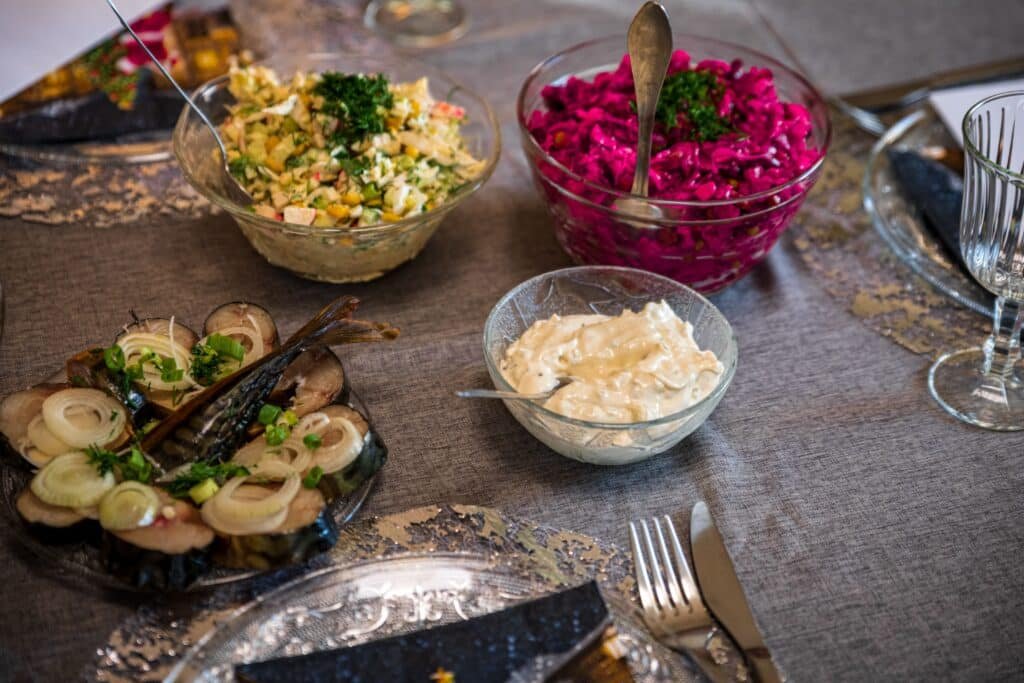
The traditional side (husmanskost, “home cooking”) is hearty and seasonal: meatballs with lingonberry, cured and pickled herring, gravlax, creamy potato dishes, cinnamon and cardamom buns, and in the north, reindeer, cloudberries, and Arctic char. Much of it is built around preserving and making the most of short growing seasons, which gives it a specific northern character. The New Nordic movement, centered in Copenhagen but felt strongly across Sweden, has pushed the country’s cooking toward foraged, local, seasonal, and precise, and Sweden’s cities now have a food scene that punches well above their size.
But the piece of Swedish food culture you should actually build into your days is fika. Fika is the ritual of stopping for coffee and something sweet, usually a cinnamon bun, ideally with other people, ideally without rushing. It’s not a coffee break so much as a small daily act of slowing down, and it’s central to how Swedes live. Do it properly at least once a day. It tells you more about the culture than any museum will.
Culturally, the threads that show up again and again are a deep relationship with nature, a strong instinct toward equality and understatement (the concept of lagom, “just the right amount,” runs through everything), and a design sensibility that prizes clean, functional beauty. You feel all of this as a traveler: in how calm the cities are, how good the everyday design is, how much space people give each other, and how seriously the country takes the outdoors. Sweden’s culture is quiet, and that quiet is exactly what a lot of people come for.
For the record, the country’s most famous cultural export beyond design is probably its music and its long tradition of celebrating the seasons, above all Midsummer in June, when the whole country decamps to the countryside for the year’s biggest celebration. If you can time a summer trip around Midsummer, do, it’s Sweden at its most itself.
How Sweden Fits Different Kinds of Travelers
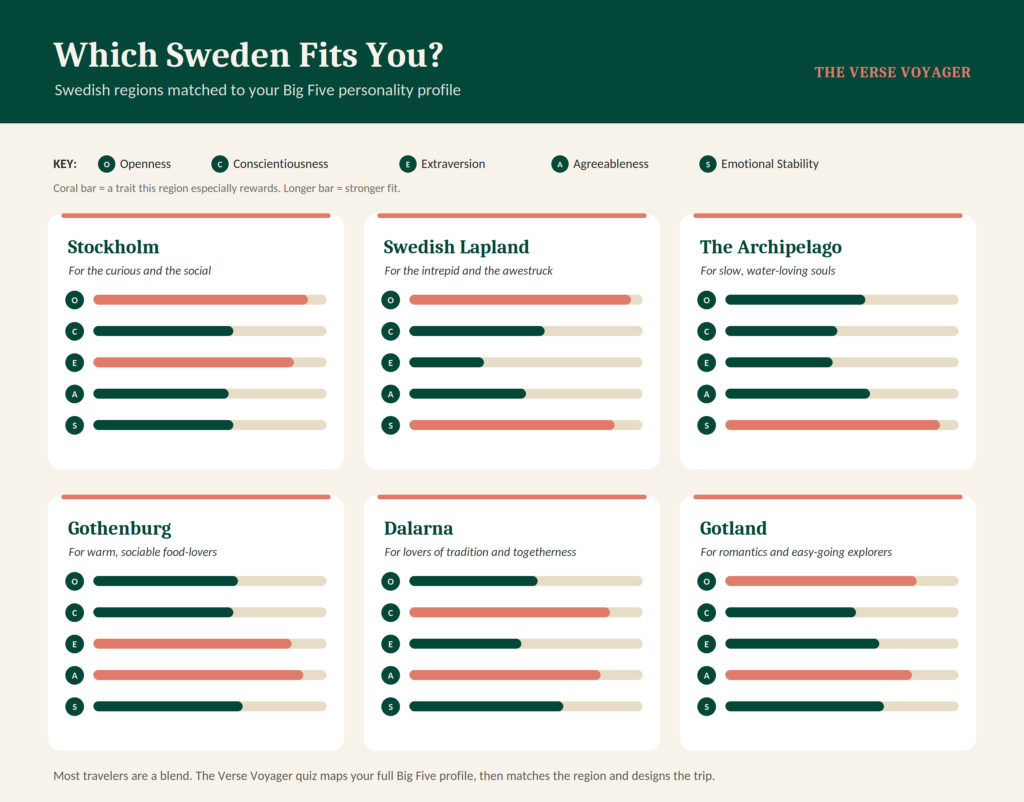
Here’s where I put my other hat on. I design trips around traveler personality using the Big Five model, and Sweden is a useful country to think through that way, because it genuinely rewards some temperaments more than others, and in different seasons. This isn’t about labels. It’s about matching the shape of the trip to the shape of the person, so I’ll walk it through as design logic rather than types.
If you score high on openness to experience, the traits linked to curiosity, imagination, and a pull toward the new, Sweden’s north is built for you. The aurora, the midnight sun, the wilderness, the Sámi culture, the sheer strangeness of continuous daylight or continuous dark, these are novel, sensory, once-in-a-lifetime experiences, and they land hardest with people wired to seek exactly that. I’d point this traveler straight to Abisko, Jokkmokk, and the far north, and I’d build in unstructured time to let the place surprise them.
If you value structure and planning, the traits around conscientiousness and wanting things to work, Sweden is one of the most rewarding countries you can travel in, because it works. Trains run on time and reach the Arctic, payment is seamless and cashless, information is clear, and the whole country is easy to navigate with confidence. A trip here can be planned tightly and it’ll hold together, which is deeply satisfying for people who travel that way. I lean into that with clear day structures and pre-booked key experiences, so the machine runs smoothly.
If you’re energized by people and social buzz, the extraversion dimension, Sweden asks you to choose your season carefully, and this is where the design work matters most. Swedish summer, with its festivals, long bright social evenings, island parties, and Midsummer, gives you plenty of energy and connection. Swedish winter in the deep north, by contrast, is quiet and solitary by design. Neither is better, but they’re opposite, and matching the season to how you recharge is the difference between a trip that fills you up and one that feels flat. I’d send a socially driven traveler to the cities and coast in summer, and I’d design deliberate social touchpoints, shared tours, and lively bases into a winter trip.
If calm and low-friction travel matter most to you, the qualities around emotional steadiness and wanting a trip that soothes rather than stresses, Sweden might be the best country in Europe for you. It’s safe, clean, quiet, spacious, and unhurried. The nature itself is regulating, and the right to roam means you can always find solitude. This is the traveler I most often send to a cabin by a lake, or a slow week in the archipelago, with nature as the whole point and very little on the schedule.
The reason I plan this way is simple: the same country gives completely different trips, and the best version of Sweden for you depends on who you are, not just where you go. If you want to see where you land across these dimensions and get a trip shaped around it, that’s exactly what my free travel personality assessment is built to do. In order to find out what is your travel personality try The Verse Voyager free travel quiz.
Where to Stay in Sweden
Accommodation in Sweden runs from free to unforgettable, and the type you choose shapes the trip as much as the destination does. Here’s the range, roughly from most budget to most premium.
Wild camping is the free end, thanks to the right to roam. For hikers and paddlers comfortable with a tent, this is the purest and cheapest way to sleep in the country, a night or two on a lakeshore or a mountainside at no cost. Covered in full in the experiences section above.
Campsites and hostels (vandrarhem) are plentiful, well-run, and reasonably priced, often with self-catering kitchens that cut your food costs too. Sweden’s hostels are generally clean, calm, and a world away from the party-hostel stereotype, which suits solo travelers and families alike.
Cabins (stugor) are the classic Swedish stay, especially in summer. Renting a simple red wooden cabin by a lake or on an island, cooking your own food, and doing very little is arguably the most Swedish holiday there is. This is the accommodation I steer a lot of people toward, because the cabin is the experience.
Mountain stations and lodges in the north give hikers a comfortable base at the trailheads, particularly along the King’s Trail and around Abisko. They book up in peak seasons, so reserve ahead.
City hotels cover the full range from design-forward boutique to international chains, at Nordic-capital prices. Book central for walkability, or a little out for value.
The signature stays. For a splurge, the north delivers genuinely one-of-a-kind places: the ICEHOTEL near Kiruna, rebuilt from ice each winter, and various glass-roofed cabins and treetop rooms built for watching the aurora or the midnight sun from bed. These are premium and worth it as the centerpiece of a trip rather than a whole itinerary.
My general steer: mix your accommodation to match the leg of the trip. Cabins and camping for the nature days, a good central hotel for the city days, and one signature northern stay as the memory you build the trip around.
Getting Around Sweden and Practical Tips
A few practical things that make a Sweden trip smoother, gathered in one place.
Trains are the way to travel long distances. Sweden’s rail network is excellent, comfortable, and reaches remarkably far north. The overnight train from Stockholm up to Kiruna and Abisko is a classic journey and a genuinely good way to cover the distance while you sleep. For the cities and the south, trains connect everything you’ll want and you won’t need a car.
You’ll want a car for the countryside and coast. The archipelagos, the west coast fishing villages, the inland regions like Dalarna, and the quieter national parks are far easier with a car. Roads are good and quiet, driving is calm, and it opens up the parts of the country that reward independence. Combine the two: train for the long hauls and the cities, car hire for a countryside leg.
Flights save time on the big distances. If you’re short on days and want to combine Stockholm with the far north, a domestic flight to Kiruna turns a long train journey into a short hop. Worth it when time is tight.
Language is not a barrier. English is spoken almost universally and spoken well. You can travel the entire country comfortably in English, though learning “tack” (thank you) and “hej” (hello) is a nice courtesy.
Sweden is close to cashless. As noted above, bring a card or a phone and you’re set. Many places don’t take cash at all. The currency is the Swedish krona, not the euro.
Pack for the season honestly. This is the one that catches people. Summer needs layers and rain protection even when it’s warm, because weather shifts. Winter in the north needs serious cold-weather gear, insulated boots, thermal layers, and a proper coat, not a city winter jacket. Many aurora and dog sledding operators lend heavy outer gear, but check before you rely on it.
Timing the daylight. Remember that daylight itself is a planning variable here in a way it isn’t further south. Midsummer gives you endless light, midwinter in the north gives you very little, and both are features to plan around rather than fight.
Sweden vs Norway: Which Should You Visit?
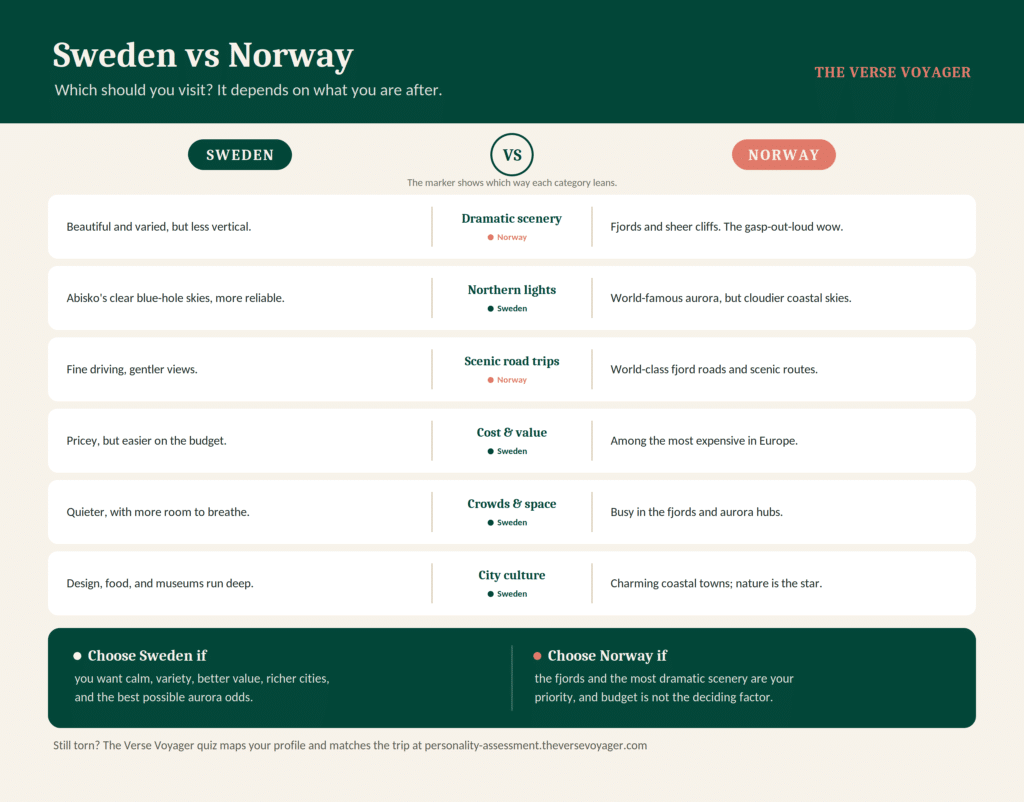
This is the comparison I get asked about most, because the two countries sit side by side and get lumped together, and they really shouldn’t be. They offer different trips, and the right one depends on what you’re after.
Norway is the country of the fjords, the dramatic vertical landscape of steep walls dropping into deep water, the coastal drama, and the postcard scenery that fills most Scandinavia marketing. It’s more visually spectacular in the obvious, gasp-out-loud way. It’s also generally more expensive than Sweden and, in the popular fjord areas and around the aurora hubs, more crowded.
Sweden is broader, calmer, and more varied. It trades some of Norway’s vertical drama for forests, lakes, islands, gentle coastlines, deeper cultural texture in its cities, and, crucially, better odds for one specific thing. For the northern lights, Sweden has a real edge that surprises people: Abisko’s blue-hole microclimate delivers clearer skies than Norway’s cloudier coastal aurora spots, so if the aurora is the goal, then Sweden
My rule of thumb: go to Norway if the fjords and the most dramatic scenery are non-negotiable and budget isn’t the deciding factor. Go to Sweden if you want a broader, calmer, better-value trip, richer city culture, and the best possible aurora odds, or if you simply prefer travel that feels spacious over travel that feels like a highlight reel. And if you can, the far north of both countries sits close together, so a serious Arctic trip can touch both. For most people choosing one, though, these are genuinely different holidays, not two versions of the same one.
Sweden Travel FAQ
Is Sweden worth visiting? Yes, especially if you’re drawn to nature, calm, design, and space rather than heat and nightlife. It’s one of the safest, cleanest, easiest countries to travel in, with almost no language barrier. It’s a weaker fit if a beach holiday is the main goal.
What is the best time to visit Sweden? June to August for long days, warm weather, and the midnight sun in the north. December to March for snow and the northern lights. Late May and September are excellent quieter, cheaper windows with good conditions.
When can I see the northern lights in Sweden? The aurora season runs from late September to early April, with the strongest chances between mid-November and mid-March. Head to the far north, Abisko or Kiruna, and stay at least three or four nights to give clear skies time to appear.
Where is the best place to see the aurora borealis in Sweden? Abisko, in Swedish Lapland. Its “blue hole” microclimate produces clearer skies than almost anywhere else in Scandinavia, which is the key to actually seeing the lights. Kiruna, about an hour away, is the larger and easier-to-reach hub.
When is the midnight sun in Sweden? Above the Arctic Circle from roughly late May to mid-July, when the sun never fully sets. In Abisko it runs from about 25 May to 18 July. The bright “midnight light” extends the effect for around a hundred days and reaches some distance south of the Circle.
How many days do I need in Sweden? 5 to 7 days for one region, such as Stockholm and its archipelago or a focused winter trip north. 10 to 14 days to combine a southern city with the Arctic north, which is the fullest version of the country.
Is Sweden expensive? It can be, mainly for restaurants, alcohol, and city hotels, which run at Nordic prices. But nature is free, self-catering is easy, tap water is excellent, and the right-to-roam law lets you camp for nothing, so a budget-conscious trip is very doable.
Do I need a car in Sweden? Not for the cities, where trains and transit cover everything. Yes, ideally, for the countryside, the coast, and the archipelagos, which are far easier to explore independently. A mix of train and car hire works best.
Is Sweden good for solo travelers? Very. It’s safe, easy to navigate, English-friendly, and the culture gives people plenty of personal space, which many solo travelers find comfortable. The right to roam and the strong outdoor culture make independent travel especially rewarding here.
What is allemansrätten? The right of public access, protected by the Swedish constitution. It lets everyone walk, cycle, ski, and camp on most uncultivated land, swim in any lake, and pick wild berries and mushrooms, all free, as long as you keep clear of homes, don’t disturb or damage anything, and leave no trace.
What currency does Sweden use? The Swedish krona (SEK). Sweden is in the EU but not the eurozone, and it’s close to fully cashless, so cards and phone payments work almost everywhere.
Is Sweden worth visiting in winter? Yes, and the far north in winter is when Sweden does its most singular thing. Winter up north gives you the northern lights, dog sledding, the ICEHOTEL, and deep-snow stillness you won’t find easily elsewhere. Go north, go prepared for serious cold, and treat the darkness as the feature it is. In the south, winter is milder, darker, and cozy rather than dramatic.
Is Sweden or Norway better for the northern lights? Sweden, for a surprising reason. Norway gets more of the attention, but Abisko in Swedish Lapland has a “blue hole” microclimate that produces clearer skies than Norway’s cloudier coastal aurora spots. Since seeing the aurora is mostly about clear skies, Sweden’s Abisko gives you some of the best odds anywhere in Scandinavia.
What should I pack for Sweden? Layers year-round, since weather shifts even in summer, plus rain protection. For a winter trip to the north, pack serious cold-weather gear: insulated boots, thermal base layers, and a proper heavy coat, not a city winter jacket. Many aurora and dog sledding operators lend outer gear, but confirm before relying on it.
What are the best natural places to visit in Sweden? Seven stand out: Abisko National Park, the King’s Trail and Kebnekaise, the High Coast (Höga Kusten), the Stockholm archipelago, the Bohuslän coast, the Luleå archipelago and its frozen sea, and the island of Öland. Together they cover the far-north mountains, both coastlines, and the southern islands, so there’s a natural spot to suit any season and route.
Do people in Sweden speak English? Yes, almost universally and very well. You can travel the entire country comfortably in English. Learning a couple of words like “tack” (thank you) and “hej” (hello) is a nice courtesy but not a necessity.
Ready to plan a Sweden trip that actually fits you?
Sweden gives completely different trips to different people, and the best version for you depends on who you are as much as where you go. If you want a trip shaped around your travel personality rather than a generic list, start with my free assessment, and book a discovery call and we’ll design it together.