

Table of Contents
What is personality-based travel?
Personality-based travel means planning a trip around how you travel, not around a list of top attractions. Two people can visit the same town and have very different days. One wants the market at nine. The other wants a bench by the river at six.
It uses the Big Five, a widely used model of personality in research, to describe those differences in a consistent way. Then it matches them to places, routes and rhythm.
We design itineraries by hand on this basis. This guide explains the Big Five, what published research says about personality and travel, and how we use it, including where it stops. You can also read the method in one place on our methodology page.
In short: The Big Five describes personality on five traits. Published studies link those traits to travel preferences, with effects that tend to be small to moderate. We use that as a guide to patterns, then adjust the plan with you.
What are the Big Five personality traits?
The five traits in plain terms
The Big Five, also called the Five Factor Model, is a widely used framework for describing personality in psychology. Researchers have studied it for decades and across many cultures, including a 2007 study of self-descriptions in 56 nations (Schmitt et al.). A good starting point is the review by McCrae and John (1992). The model describes personality on five broad traits. Each trait is a spectrum, and most people sit somewhere in the middle on at least some of them.
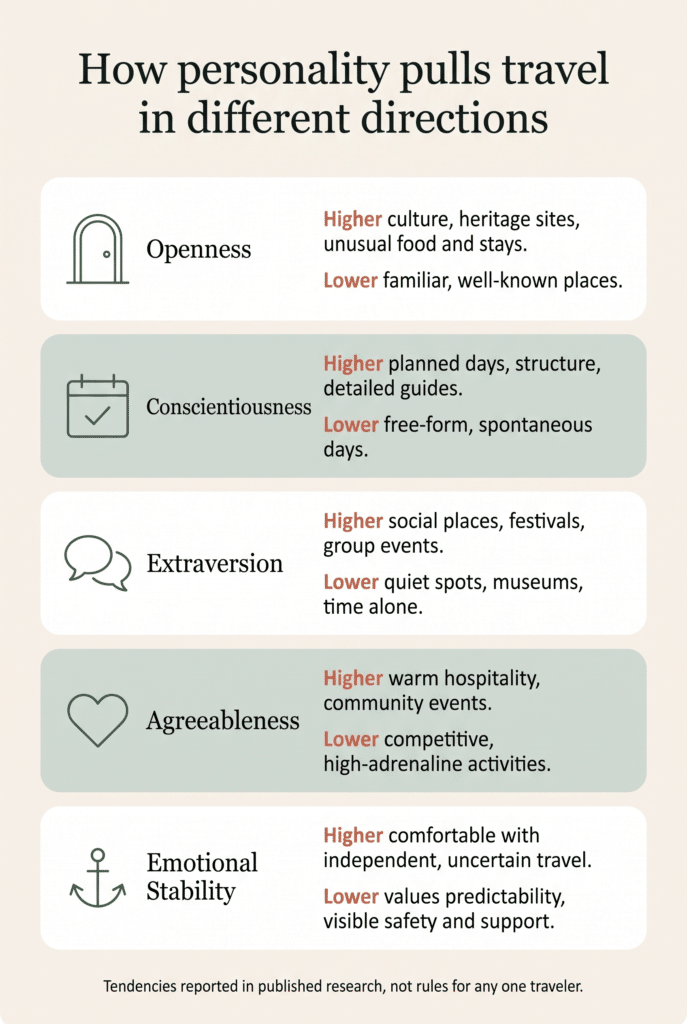
- Openness to Experience: curiosity, imagination and interest in new ideas. Travelers who score higher tend to enjoy unfamiliar places and unplanned detours. Those who score lower tend to enjoy going deeper into somewhere they know.
- Conscientiousness: organization, reliability and self-discipline. Higher scorers tend to like a clear plan with timings. Lower scorers tend to like loose days.
- Extraversion: sociability and energy drawn from company. Higher scorers tend to enjoy lively places and group activities. Lower scorers tend to need quiet time to recharge.
- Agreeableness: warmth, cooperation and trust. Higher scorers tend to value shared meals and cultural exchange. Lower scorers tend to prefer setting their own course.
- Neuroticism: how easily stress and uncertainty affect you. Higher scorers tend to value predictability and a calm base. Lower scorers tend to handle a change of plan more easily.
None of these is good or bad. A trait describes a tendency, not a verdict, and plenty of travelers want a trip that is unlike their usual self.
Traits and facets
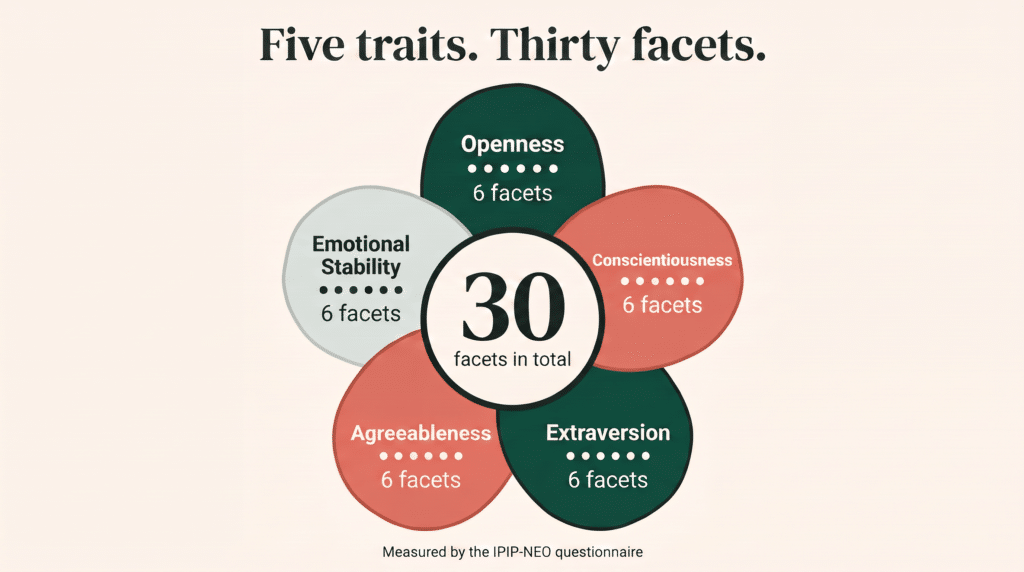
Each trait is made up of six facets, which gives 30 facets in total. A trait is the wide view. A facet is the closer one. Two people can score alike on Extraversion for different reasons: one likes crowds and late nights, the other likes long talks with a few people. The facets help us tell them apart.
What research says about personality and travel
Over the past decade, published studies have linked the Big Five traits to travel preferences. We drew on ten of them, and we list them on our methodology page. Findings in this field are mixed. Effects tend to be small to moderate, and some studies find few significant links. We treat the research as a guide to patterns, not as a rule for any one traveler.
Key studies at a glance
Five of the ten studies are summarized below. Each looks at one group of travelers, so results do not carry over neatly from one country to another.
- Alves et al. (2020): Among Portuguese tourists, Agreeableness predicted a love of adventure and nature, while Extraversion and Openness favored entertainment, nightlife, and sun destinations. Conscientiousness was linked to well-structured, cultural heritage trips.
Read study summary - Kovačić et al. (2022): In Serbia, Openness was the strongest predictor of positive destination image and preference for cultural routes. Extraversion led to more participation in events; Conscientiousness and Agreeableness shaped structured, socially engaging travel.
Read study - Verma et al. (2023): Indian travelers high in Openness preferred unique, culturally rich destinations. Conscientiousness and Agreeableness drove careful planning and positive group experiences. Neuroticism led to a preference for safe, stress-free locations.
Read study abstract - Coudounaris et al. (2025): At Cyprus airports, Neuroticism was linked to novelty-seeking, while Openness predicted a desire for refreshing, memorable experiences.
- Akhrani et al. (2020): Indonesian soft-adventure tourists with high Extraversion, Conscientiousness, and Agreeableness were more likely to seek adventure travel.
Read study
Taken together, the studies point the same way on some links. Openness shows up with culturally rich, unfamiliar destinations, and Conscientiousness with planned, structured trips. They disagree on others, which is one reason we keep the plan open to your own view.
Further reading
- Schmitt, D.P., et al. (2007). “The Geographic Distribution of Big Five Personality Traits: Patterns and Profiles of Human Self-Description Across 56 Nations.” Journal of Cross-Cultural Psychology. Read study
- McCrae, R.R., & John, O.P. (1992). “An Introduction to the Five-Factor Model and Its Applications.” Annual Review of Psychology. Read review
How each trait can shape a trip
Personality shapes how we move through a trip, not only what we choose to see. These are sketches, not predictions. You may recognize yourself in one end of a trait, or in both. If you want ideas for where to go, our destination guides are a good place to look.
Openness: new streets or familiar ones
If you score higher on Openness, you may be happiest wandering lantern-lit alleys in Kyoto or losing track of time at an art festival in Medellín. If you score lower, the best day might be a favorite city square, a classic museum or a tradition you know well.
Conscientiousness: a plan or an open day
Higher scorers tend to enjoy a day where every detail is in place: tickets booked, timings checked, a bag packed with intent. Lower scorers tend to prefer loose days that follow the weather and the mood. Neither style is better. A plan can be tight on the days that need it and open on the rest.
Extraversion: company or quiet
Shared meals and late nights in a lively city such as Buenos Aires or Barcelona suit many higher scorers. Lower scorers often get more from a forest path or a quiet sunrise. Many travelers want both, in a sensible order.
Agreeableness: shared tables or your own route
Cooking with locals in Tuscany, joining a village celebration in Nepal or listening to stories over tea tend to appeal to higher scorers. Others prefer the freedom of a self-guided day. A plan can leave room for both.
Neuroticism: certainty or surprise
Higher scorers tend to feel stress sooner when plans change, so a calm base, clear transfers and an easy-to-read city often help. Lower scorers tend to enjoy the unpredictable edges of a trip. When we plan for this trait, we look closely at long transfers and low predictability.
How we use personality when we plan a trip
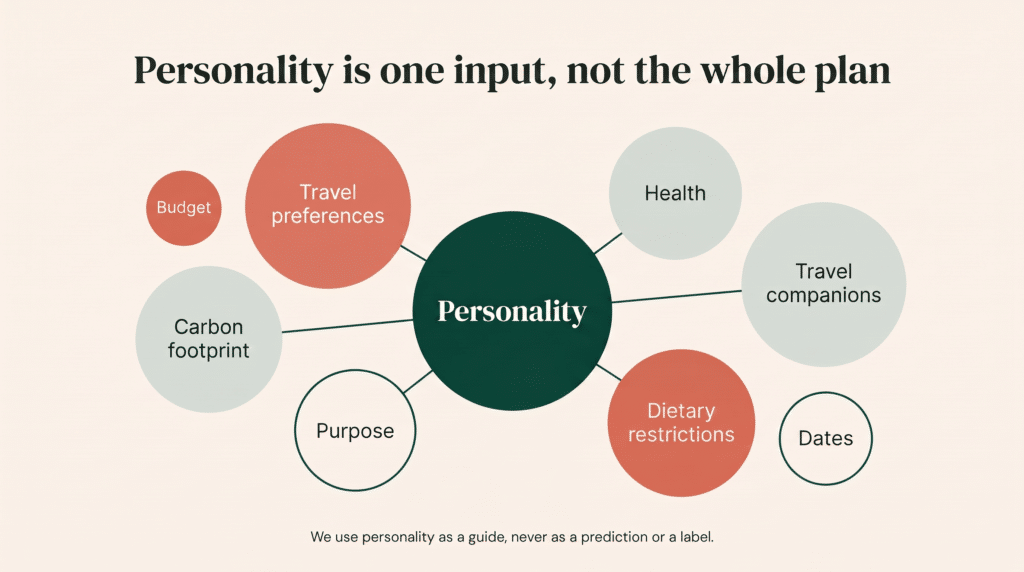
We start from the Big Five. If you take the assessment, we compare your profile with places described on the same five traits, and we give more weight to facets than to averages. Then we review the result with you on the discovery call. You tell us what feels right and what doesn’t, and we adjust. The plan also takes your budget, your dates, your companions and your health into account.
The IPIP-NEO assessment
The IPIP-NEO is a Big Five questionnaire built from the International Personality Item Pool, a public collection of personality items used in research. It measures the five broad traits and their 30 facets, and its reliability and validity have been tested in published studies. That applies to the questionnaire. The way we match personality to places is our own method, and we explain it, limits included, on our methodology page.
Personality is where we start when you want it to be. You can take the assessment, or we can work from a conversation on the discovery call. Either way, the plan is built around you.
The mini quiz is free and takes about 3 minutes. It is a brief Big Five check that gives you a first read. The full assessment takes about 15 minutes and gives you a detailed profile. You can start with the mini quiz.
What the match looks like
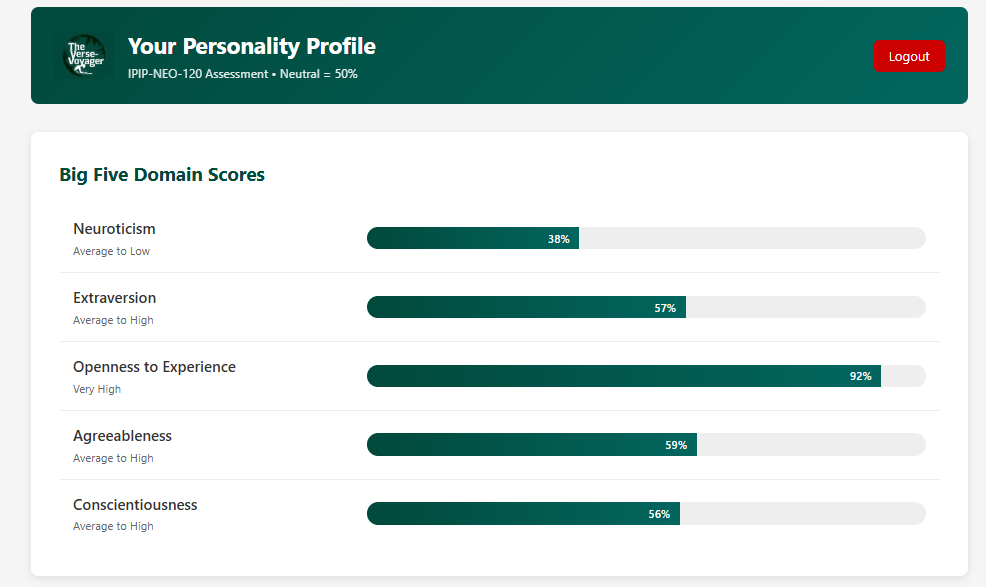
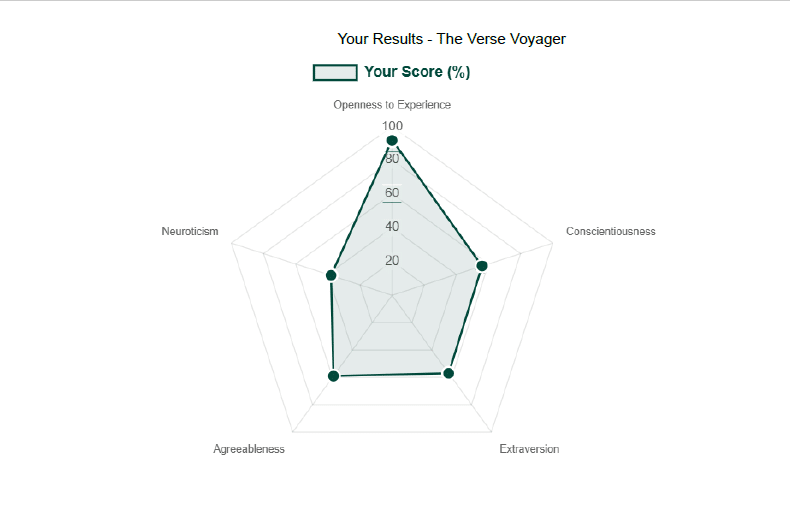
Say your profile shows high Openness and low Neuroticism. We might lean toward creative, varied and lively places where you can take in art, culture and new ideas. If you score higher on Conscientiousness and Agreeableness, we might lean toward places known for order, safety and welcoming communities. These are examples of how we think about it, not fixed rules.
Where personality stops
Personality is a guide, not a prediction. It can’t tell us what you will enjoy on a given Tuesday, and it is one input among several. It is not a clinical or diagnostic tool, and we don’t use it that way. The way we match personality to places is our own method, built on the research above. Our methodology page explains it, limits included.
The benefits of personality-based travel planning
Travel can feel overwhelming. There are endless destinations, reviews and top-ten lists, and it is easy to end up with a trip that doesn’t quite fit. Planning around personality helps you cut through the noise. Instead of fitting yourself to someone else’s idea of a good trip, you start from your own.
What you can gain
- A better fit: places and activities that match your interests and comfort zones are easier to enjoy.
- Less decision fatigue: the options narrow to those that suit you, so planning takes less effort.
- Fewer mismatches: you find out early if a place asks for more crowds, noise, structure or surprise than you want.
- Room for what you enjoy: a plan shaped around you leaves space for the days you’ll want to repeat.
How a Verse Voyager itinerary works
Our custom travel design is built around this idea. We design each itinerary by hand around your personality, your pace and the places that suit you. You get a clear day-by-day plan, ready to book and easy to adjust. You book flights, hotels and tours yourself. We book nothing.
You get your time back
We take on the research and planning, which saves you 15+ hours. You get to look forward to the trip instead of working through a to-do list.
A plan built around you
Personality research gives us the structure, and our own travels give us the detail: the quiet town, the better route, the day you’ll want to repeat.
Room to change it
You can follow the plan closely or adjust it as you go. Flexibility is part of every itinerary.
Support for unfamiliar places
Heading somewhere new can feel uncertain. A clear day-by-day plan makes it easier to know what comes next, so you can spend your attention on the place.
Workcations too
Planning a workcation? We match your rhythm with a place that suits it and design the plan around your pace.
Frequently asked questions
What makes personality-based travel different from traditional travel planning?
Traditional planning often starts from a destination list or a set of popular sights. Personality-based planning starts from you: how you handle novelty, structure, company and uncertainty. We then match places and pace to that, so the plan fits how you travel.
How do you decide which destinations fit me?
If you take the assessment, we compare your Big Five profile with places described on the same five traits. If you prefer, we work from a conversation on the discovery call. Either way, we review the result with you and adjust. The matching method is our own, and we describe it, limits included, on our methodology page.
Do I have to take the personality assessment?
Personality is where we start when you want it to be. You can take the assessment, or we can work from a conversation on the discovery call. Either way, the plan is built around you.
How long does the personality assessment take?
The mini quiz is free and takes about 3 minutes. It is a brief Big Five check that gives you a first read. The full assessment takes about 15 minutes and gives you a detailed profile.
Can I adjust my itinerary after I receive it?
Yes. You can follow the plan closely or change it as you go. We design every itinerary to be easy to adjust.
Is this service only for solo travelers?
No. We design itineraries for solo travelers, couples, families and small groups.
What if I want to visit a destination you haven’t covered?
Tell us where you want to go. We research it and design the plan around your personality and interests.
How do I get started?
Take the free mini quiz, or book a free discovery call via the contact page. We’ll guide you from there. You can also read more answers on our FAQs page.
Personality-based travel in 2026: where to start
Personality doesn’t decide where you should go. It gives us a consistent way to talk about how you like to travel, and the research points to some patterns worth paying attention to. Used as a guide, it can make planning simpler and the trip a better fit.
If you’re curious, take the free mini quiz. If you’d rather talk first, book a discovery call. Either way, the plan is built around you.
Next step
Take the quiz or talk to us
The mini quiz is free and takes about 3 minutes. If you would rather talk first, write to us on the contact page.