Tag: personality based travel

  • Spain Regions by Personality: A Big Five Travel Guide [2026]

    Spain Regions by Personality: A Big Five Travel Guide [2026]

    Most travel guides do not label Spain regions by personality and start with a destination and ask you to fit yourself into it. You read about Barcelona, decide it sounds nice, book a flight, and hope your personality does not quietly rebel three days in. Anyone who has stood in a midday queue outside the Sagrada Familia in August, sweating, hungry, and faintly furious, knows the feeling.

    This article runs the question backwards. You start with who you are, and we work toward where in Spain you will feel most alive.

    The framework is the Big Five personality model, which is the most validated structure in personality science. Five traits: Openness, Conscientiousness, Extraversion, Agreeableness, and Neuroticism. Each has been studied for decades, and several specific facets within them, like Excitement-Seeking, Aesthetics, and Anxiety, are unusually strong predictors of which kinds of places restore you and which ones drain you.

    Spain is the perfect country to apply this lens to. Few other destinations contain so many genuinely different worlds inside one border. Catalonia and Andalusia barely share a temperament. The green Atlantic north feels closer to Ireland than to Seville. Tenerife sits four hours by plane from Madrid and might as well be a different planet. Picking the wrong corner of Spain for your personality is not a small mistake. It is the difference between a holiday that loosens something inside you and a holiday that just leaves you tired.

    What follows is a tour through seven Spanish regions, mapped to the kinds of travelers each one tends to suit best. Barcelona, the Pyrenees, Cantabria and Asturias, Andalusia, Tenerife, the Basque Country, and Galicia. Read with curiosity. The point is not to box yourself in but to recognize the regions where the way you naturally move through the world is met halfway by the way the place is.

    A Brief Note on the Big Five (and Why It Beats “Adventurous vs Relaxed”)

    If you have ever taken a personality quiz online, you have probably been told you are an “explorer,” a “wanderer,” or a “free spirit.” These categories are flattering and almost entirely useless for travel planning, because they describe what you want to be, not how you actually function under pressure, fatigue, novelty, or social demand.

    The Big Five works differently. It measures five dimensions on a continuum:

    • Openness: how much you crave novelty, beauty, and ideas.
    • Conscientiousness: how much you rely on order, planning, and discipline.
    • Extraversion: how much energy you draw from people and stimulation.
    • Agreeableness: how much you value warmth, harmony, and trust.
    • Neuroticism: how reactive you are to stress, uncertainty, and discomfort.

    Each trait also breaks down into smaller facets that matter even more for travel. Excitement-Seeking, a facet of Extraversion, predicts whether you light up in a Madrid plaza at midnight or want to lie down. Aesthetics, a facet of Openness, predicts whether the Alhambra moves you to tears or registers as “nice tilework.” Anxiety, a facet of Neuroticism, predicts whether unfamiliar transit systems feel like an adventure or a slow horror.

    Travel research consistently finds that these facets predict trip satisfaction better than the broad traits do. Someone scoring high on Openness in general but low on Excitement-Seeking will love a Galician monastery and hate a Barcelona club. The averages lie. The details tell the truth.

    This is the framework we use at The Verse Voyager when designing tailor-made trips. The IPIP-NEO assessment gives a structured read on these five traits and their thirty facets, and the result becomes the quiet logic underneath every recommendation we make. The regional matches below follow the same logic, distilled.
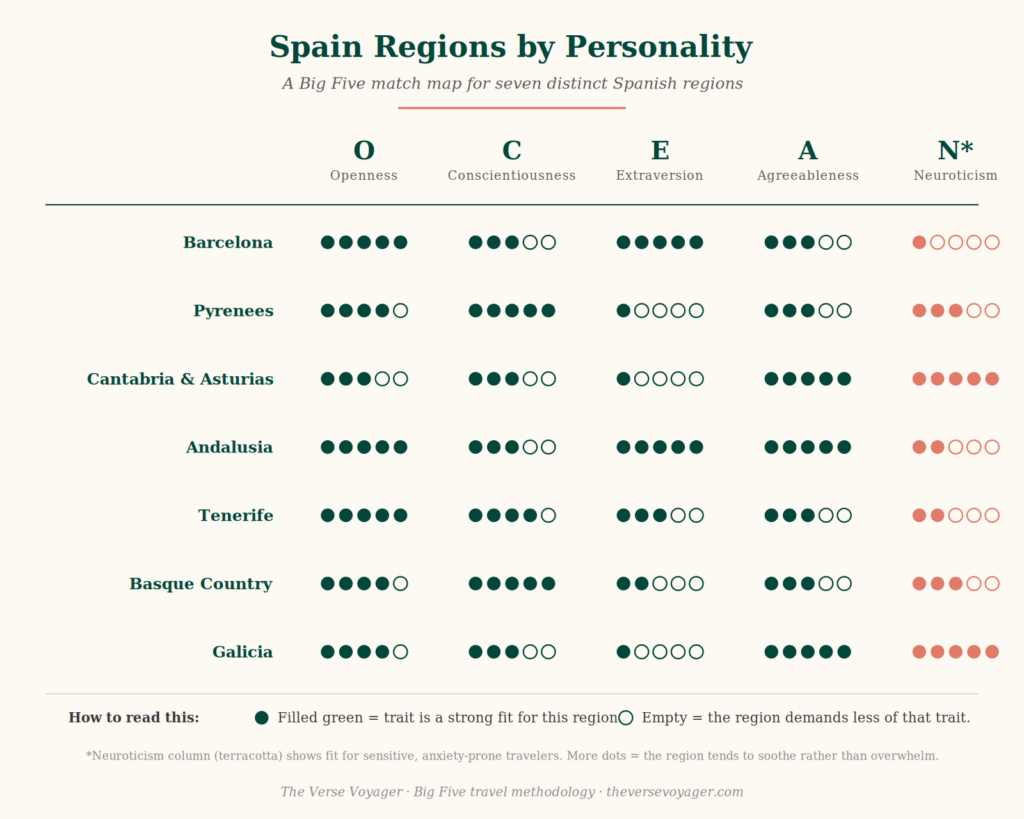
    Spain regions by personality, matched to Big Five personality traits chart showing Barcelona, Pyrenees, Cantabria and Asturias, Andalusia, Tenerife, Basque Country and Galicia

    1. Barcelona: For High Openness, High Extraversion, Low Anxiety
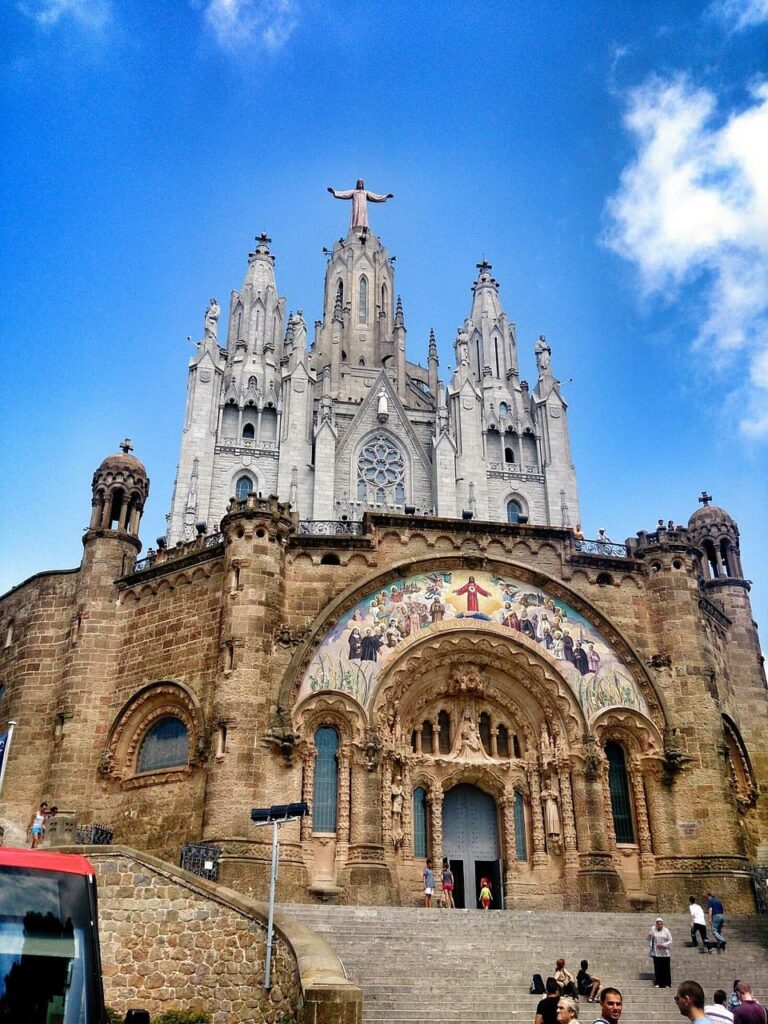
    Tibidabo cathedral in Barcleona

    Barcelona is the easiest Spanish region to explain in personality terms, because it is so unambiguously stimulating. Density, architecture you have to physically lean back to take in, food eaten standing up at 11 p.m., a coastline pressed against a mountain range pressed against a medieval grid. The city does not whisper. It performs.

    This rewards two specific patterns. The first is high Openness, especially the Aesthetics facet. Gaudi, Miro, the Modernista facades along Passeig de Gracia, the Gothic Quarter’s compressed centuries, all of it rewards a mind that genuinely enjoys taking in unusual forms. If “interesting buildings” is something you would say aloud to no one in particular while walking, you will do well here.

    The second is moderate-to-high Extraversion. Barcelona’s social tempo is closer to Buenos Aires than to most of Northern Europe. Dinner at 10. Conversation at full volume. Strangers happy to keep talking past midnight. If you score high on Excitement-Seeking, this is where Spain will feel most like itself. If you lean introverted, the city is still rich, but you will need to design more recovery time than you think, and the quieter neighborhoods (Gracia, Sant Antoni, parts of Poblenou) become essential rather than optional.

    The pattern that struggles in Barcelona is high Neuroticism combined with low Openness. The constant input, the pickpocket vigilance, the August heat, the sheer choice of where to eat and what to skip, all of it amplifies anxiety in travelers who already arrive a little stretched. In the years I lived in Barcelona, the friends who returned again and again were the ones who treated the city as a long bath rather than a checklist. The friends who came once and never came back tried to see everything in four days.

    We sometimes redirect anxiety-prone travelers to Girona or the Costa Brava villages instead, with day trips into the city, and they come away loving Catalonia far more than they would have.

    Best fits: travelers high in Openness, especially the Aesthetics and Ideas facets, with moderate-to-high Extraversion and the resilience to handle a busy environment. If you are in this category check my article about what to see in Barcelona in 3 days.

    2. The Pyrenees: For High Conscientiousness, Low Excitement-Seeking, High Openness to Nature
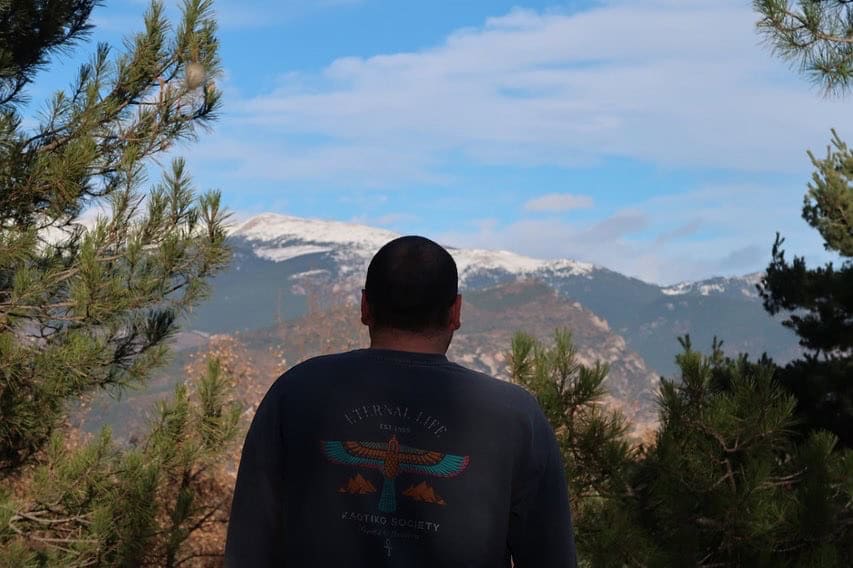
    Person gazing at the Pyrenees mountain landscape.

    The Pyrenees do not announce themselves the way the Alps do. The Spanish side, in particular, runs quieter and rougher and more local. Stone villages sitting at valley heads. Trails that have been walked since the medieval pilgrimage routes. Wolves still in the Sierra de Guara. Few crowds outside of high August.

    This is a region for travelers who feel restored by physical effort and clear structure. High Conscientiousness, especially the Achievement-Striving facet, finds something deeply satisfying in a multi-day route with a measurable arc. The Carros de Foc circuit, a section of the GR-11 traverse, the climb up to Aiguestortes lakes, all of these are the kind of trips where the day’s purpose is honestly described by a kilometre count and an elevation gain.

    Openness matters too, but a particular kind. High Aesthetics for natural landscapes, less so for urban variety. Travelers who score high on Openness but low on the Actions facet (the one that predicts variety-seeking) often do beautifully here, because the Pyrenees offer one consistent register, slowly varying, rather than a constant change of scene.

    Where the Pyrenees push back is on Excitement-Seeking and Gregariousness. There is no nightlife. Restaurants close at nine. Dinner in a refugio with eight strangers can be the social peak of the week. If you score high on these facets, you will find the silence productive for two days and then start to itch.

    There is also an unexpected fit worth naming. Moderately anxious travelers who score high on Conscientiousness often do beautifully in the Pyrenees, because the structure of a mountain day, leave at seven, water at the col, summit by noon, descend before the afternoon storms, feels containing rather than exposing. Anxiety likes a plan that respects it. The mountains give you one for free. Read about one of my favorite rustic town in the Pyrenees, La Seu D’Urgell.

    Best fits: high Conscientiousness, low to moderate Extraversion, high Openness to natural environments, comfort with quiet.

    3. Cantabria and Asturias: For High Agreeableness, Sensitive Travelers, and the Quietly Curious
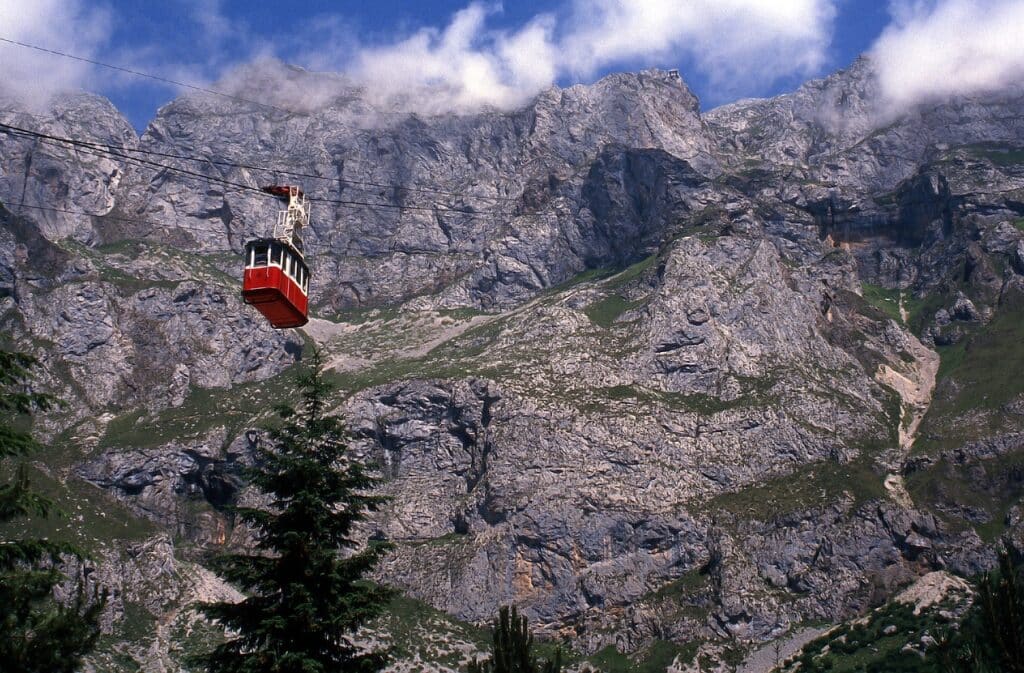
    Fuente De funicular in Cantabria

    The green coast of Spain is the country’s best-kept secret, and the personality reasons it stays a secret are also the reasons it works so well for the people it suits.

    This is a slow region. Asturian fishing villages tucked into Atlantic coves. Cantabrian valleys with cows and chestnut forests and the Picos de Europa rising behind. Cider houses where the server pours from above their head and you eat seafood your grandmother would recognize. The pace is genuinely deliberate, not curated as deliberate.

    Two patterns thrive here. The first is high Agreeableness, especially the Altruism and Trust facets. The communities in this part of Spain are unusually warm in a quiet, unfussy way. People look you in the eye. Kindness shows up in small unannounced gestures. Travelers who value warmth and emotional honesty over spectacle find themselves disarmed in the best way.

    The second is unusual but worth naming carefully. Travelers who score high on Neuroticism, particularly the Anxiety facet, often do badly in Spain’s marquee destinations because the sensory volume is too much. Cantabria and Asturias dial that volume down. The food is gentle. The towns are small. The pace gives the nervous system room to settle. We have sent several anxiety-prone travelers here who came back saying it was the first vacation in years that did not require recovery afterward.

    Where the green coast does not work is for travelers high on Excitement-Seeking or low on patience. There is no Ibiza here, no Madrid energy, no late-night plaza scene. Sunsets along the Camino del Norte and a slow bowl of fabada are the structure. If that sounds like not enough, listen to that signal.

    If you are travelling with someone whose personality runs hotter than yours, Cantabria can also work as a recovery base between busier trips. A week of green quiet between Madrid and Barcelona resets things in a way few other regions in Europe can match.

    Best fits: high Agreeableness, sensitive or anxiety-prone travelers, those who restore through quiet rather than stimulation.

    4. Andalusia: For High Aesthetic Openness, High Extraversion, High Warmth
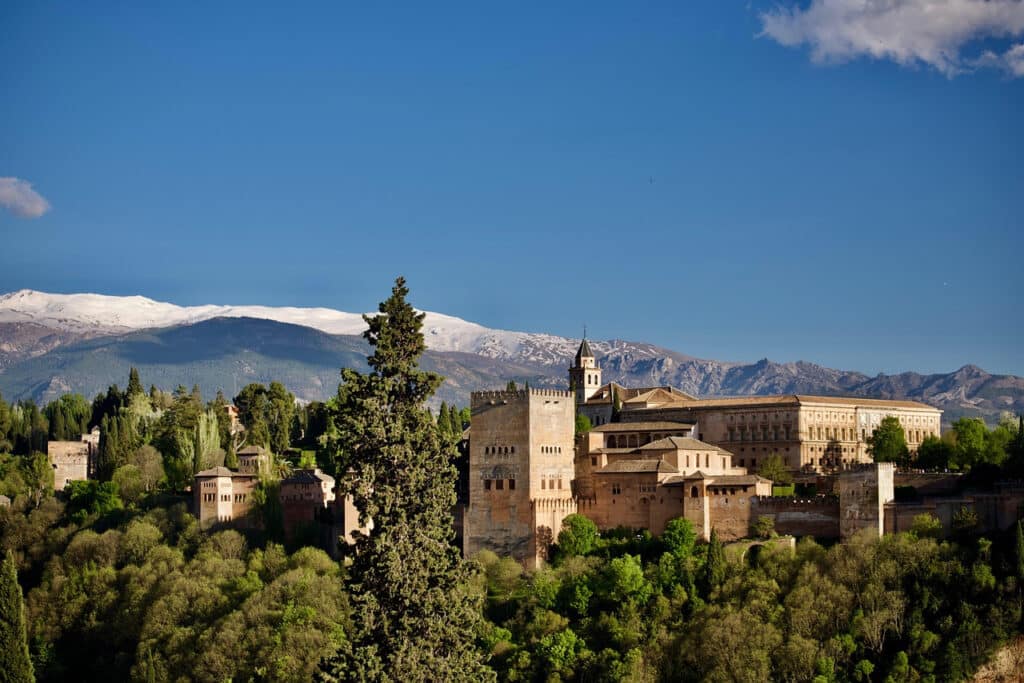
    Alhambra palace landscape, Granada, Andalusia

    Andalusia is the Spain that lives in the global imagination. Flamenco, white villages, the Alhambra, sherry, Moorish arches, sun. What is less obvious is that this is one of the most personality-demanding regions in Spain, in the sense that it rewards a specific configuration deeply and overwhelms people without it.

    The first thing that has to be high is Openness, especially the Aesthetics facet. Andalusia is one of the great aesthetic concentrations in Europe. The Alhambra in Granada, the Mezquita-Catedral in Cordoba, the Real Alcazar in Seville, the white villages of the Sierra de Grazalema. Travelers who score high on Aesthetics describe these as among the most moving experiences of their lives. Travelers who score low describe them as “old buildings.” Both are honest reports of the same place. The trait does the talking.

    The second is Extraversion, particularly the Gregariousness and Warmth facets. Andalusian social life is participatory. Tapas culture means standing close to strangers. Flamenco is best in tiny rooms. Plazas are where people live, not where tourists pose. If you draw energy from this, you will float through Seville. If you do not, ten days here will feel exhausting, no matter how impressive the architecture.

    Agreeableness adds the third layer. Andalusian hospitality is real but it has a specific texture. Travelers who lead with warmth get warmth back. Travelers who lead with reserve sometimes report the region as “unfriendly,” which is almost always a misreading. The relational style matches the climate. Open, direct, generous, immediate.

    The pattern that struggles is high Neuroticism combined with low Openness. The summer heat above 40 degrees Celsius, the sensory density of the cities, the noise, the late dinners, all of it pushes nervous systems hard. Anxious travelers do better in the white villages and shoulder seasons (October to early May) than in Seville in August. We almost always recommend the off-season for first-timers, and the difference in their experience is dramatic. If you are interested in planning a trip to Andalusia you can read more about this in my article where we present a 10 days Andalusia itinerary. Or if you want something which is made for you, let us plan the trip for you.

    Best fits: high Openness with strong Aesthetics, high Extraversion with high Warmth, high Agreeableness, low to moderate Neuroticism.

    5. Tenerife: For High Openness to Variety, Moderate Conscientiousness, and Low Anxiety
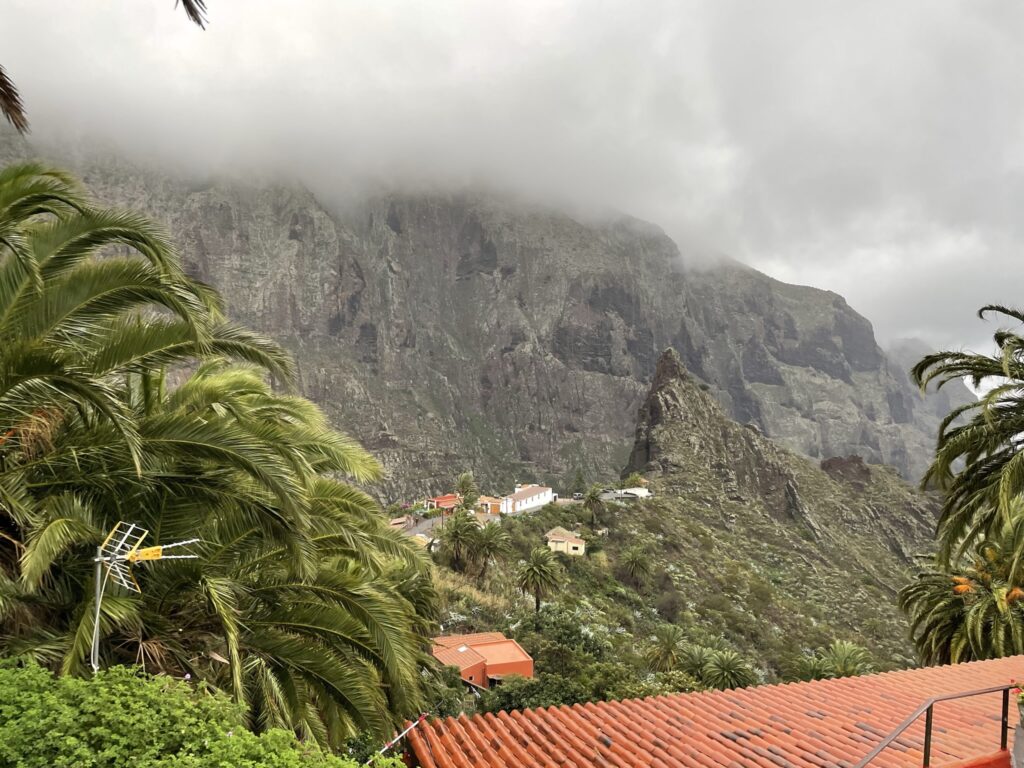
    Rainy landscape of Masca, Tenerife, Spain

    Tenerife is misunderstood. Most travelers see only the south coast resorts and write the island off. The actual island, the one north of the autopista, has more landscape variety per square kilometre than almost anywhere in Europe. Volcanic moonscapes, ancient laurel forests, cloud-piercing peaks, banana plantations, sheer cliffs falling into the Atlantic, all within a two-hour drive.

    This is why Tenerife rewards a specific Openness facet: Actions, the variety-seeking one. Travelers who get bored on the third day in any single landscape and start looking for the next thing tend to thrive here. In one day you can hike Teide National Park at 2,300 metres in the morning, descend through pine forest, and swim in a black sand cove by sunset. If that sequence sounds tiring, Tenerife is not your island. If it sounds clarifying, it is.

    Moderate Conscientiousness helps. The island’s geography is steep, the roads are slow, and good logistics matter. Travelers who like a loose plan with a few key reservations (sunrise at Teide requires permits, the Anaga forest needs an early start) do better than travelers who want everything spontaneous or everything micromanaged.

    Low Anxiety is also useful. The driving in the north can be vertiginous. The weather changes fast at altitude. The microclimates surprise people. Travelers who treat unpredictability as part of the texture of the place rather than as a logistical failure get the best of Tenerife.

    The pattern that struggles is travelers seeking pure rest. The south coast offers that, but it is not really Tenerife. Travelers who arrive expecting the Canary Islands to be a generic beach destination and discover the island wanting variety from them sometimes resent it. If you want the island to ask nothing of you, pick another. If you want it to surprise you, almost daily, with amazing hidden gems, this is the right one.

    Best fits: high Openness in the Actions facet, moderate Conscientiousness, low Anxiety, comfortable with active days.

    6. The Basque Country: For High Conscientiousness, High Openness to Craft, and Comfort With Reserve
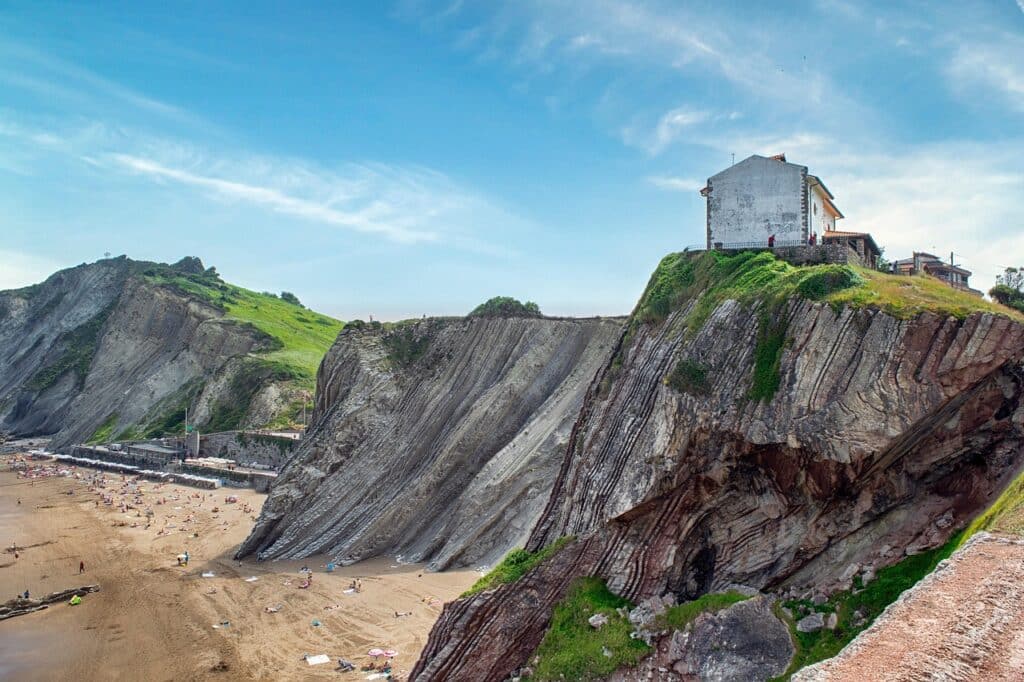
    Zoumaia, Basque Country, Spain

    The Basque Country is, in personality terms, the most demanding region in Spain to describe well, because it rewards an unusual combination: high standards, intellectual openness, and a tolerance for emotional reserve.

    Start with Conscientiousness. The Basque approach to food, design, and craft is unusually precise. The pintxos at a serious bar in San Sebastian are not casual snacks. They are constructed. The kitchens of Asador Etxebarri, Mugaritz, and Arzak operate at a level of seriousness about technique that is rare anywhere in the world. Travelers high in Conscientiousness, especially the Order and Achievement-Striving facets, recognize this immediately and feel respected by it. Also, the Basque country is, for sure, the best region in Spain for foodies.

    Openness matters too, in a specific way. High on Aesthetics, particularly for restrained design rather than ornamentation. The Guggenheim in Bilbao, the Chillida-Leku sculpture park, the way a Basque txoko (a private gastronomic society) holds its own quiet rituals. This is openness for the considered, not the flamboyant.

    The unexpected piece is Extraversion, where the Basque Country runs lower than the rest of Spain. Basques are warm but reserved. Conversations build slowly. Eye contact has weight. The social style is closer to Northern Europe than to Andalusia. Introverted travelers, or moderately extraverted ones who appreciate depth over breadth, and quiet shore landscapes like in Zoumaia, often describe the region as the first place in Spain where they felt fully comfortable.

    Where the Basque Country does not work is for travelers seeking the typical Spanish stereotype. The flamenco, the late-night plaza energy, the warm chaos. None of that is here. Travelers who arrive expecting it sometimes describe the region as “not Spanish enough,” which is true and beside the point. The Basques have been here longer than Spain has.

    Best fits: high Conscientiousness with strong Order and Achievement-Striving, high Openness for restrained craft, moderate Extraversion or comfort with reserve.

    7. Galicia: For Sensitive Travelers, High Openness, and Anyone Carrying a Question

    Misty Galician shore

    Galicia sits in Spain’s northwest corner, soaked in Atlantic weather and mythology. Stone villages, granite churches, the long arrival of the Camino de Santiago, oysters and Albarino from the rias, fog rolling in over the Costa da Morte. It is the most introspective region in the country, and one of the most genuinely transformative places in Europe to travel through.

    This is where high Neuroticism, the trait most travel guides treat as a problem to be hidden, becomes an asset. Travelers who are sensitive, reflective, easily moved, prone to thinking too much, find a region that operates at their tempo. The weather slows everything down. The Camino in particular, walked by hundreds of thousands of pilgrims a year, is a structure that lets sensitive minds metabolize their lives. We have sent several travelers here in the middle of difficult years (a divorce, a job loss, the death of a parent) and they returned different. Not fixed. Different.

    Openness matters here, especially the Aesthetics facet, but tilted toward melancholy beauty rather than grandeur. The cathedral in Santiago de Compostela. Cabo Fisterra at sunset. The Roman walls of Lugo. Galician piano music. Travelers who are moved by the slightly mournful and the genuinely old find a deep groove here.

    Agreeableness completes the fit. Galicians are warm in a quiet, undemanding way. The hospitality of pulperias and rural inns has a familial quality. Travelers high in Agreeableness feel met without performing.

    Where Galicia does not work is for travelers who need sun, energy, and momentum. The weather is genuinely temperamental, even in summer. The pace is genuinely slow. Travelers high on Excitement-Seeking get restless within a week, and travelers low on Openness sometimes describe the region as “a lot of stones and rain,” which is also true and also beside the point.

    Best fits: high Openness Aesthetics, sensitive or reflective travelers, high Agreeableness, comfort with rain and reflection.

    How to Use This Big Five Travel Guide Without Boxing Yourself In

    The risk of any personality-based travel guide for Spain is that you read it as a verdict. It is not. It is a starting point. Most travelers are not pure types. You might score high in Openness and Excitement-Seeking but also high in Anxiety, which means Barcelona’s energy attracts you and exhausts you in roughly equal measure, and the answer is to design the trip differently rather than to skip the city. Early-morning museum slots. A quiet apartment in Gracia rather than a hotel on La Rambla. Day trips to the Costa Brava when the city tips over.

    This is why we always start with the IPIP-NEO assessment before designing a tailor-made Spain trip at The Verse Voyager. Trait scores tell us which Spain region to lean toward. Facet scores tell us how to balance the itinerary once we get there. A traveler scoring high on Openness, low on Extraversion, and moderate on Neuroticism does not need a single region. They need a Galicia base with one carefully designed Barcelona weekend, planned for early arrivals at museums and quiet dinners in Gracia, with an exit strategy if the city gets loud.

    Matching your personality to a Spain region is not about narrowing your options. It is about stopping you from picking against yourself.

    If you are not sure which part of Spain to visit next, the most useful first step is not more research on the best regions in Spain. It is taking the free travel personality quiz, getting your Big Five and facet scores, and reading the result with the seven regions above in mind. The pattern usually clarifies fast.

    Take the Next Step

    The Verse Voyager designs tailor-made trips around who you actually are, not who you wish you were. Every itinerary starts with the same free personality assessment used in the methodology above, then becomes a day-by-day plan built for your pace, your energy, and the kind of beauty that actually moves you. Contact us and make your next travel in Spain personality based.

    TLDR

    Spain is not one place. It is seven distinct worlds, each suited to a different kind of traveler. Barcelona rewards high Openness and high Extraversion but overwhelms anxious travelers.

    The Pyrenees suit high Conscientiousness and low Extraversion.

    Cantabria and Asturias are the best Spanish regions for sensitive, anxiety-prone travelers who restore through quiet.

    Andalusia is for high Aesthetics, high Warmth, and the social confidence to participate rather than observe.

    Tenerife suits variety-seekers high on the Openness Actions facet who want active, unpredictable days.

    The Basque Country rewards high Conscientiousness and a taste for restrained craft over spectacle.

    Galicia is the most introspective region in Spain, best suited to sensitive, reflective travelers carrying a question they have not yet answered. The Big Five personality model predicts which of these will restore you and which will quietly drain you.

    Take the free personality quiz to find your match before you book.

    FAQ

    Which region of Spain is best for introverts? Galicia, the Pyrenees, and the Basque Country are the three regions that consistently suit introverted travelers best. Galicia offers slow pace, misty Atlantic landscapes, and warm but undemanding hospitality. The Pyrenees reward solitude and physical structure. The Basque Country’s reserve makes it unusually comfortable for travelers who prefer depth over breadth. Cantabria and Asturias are also strong options for introverts who want a quieter version of Spanish culture without giving up good food and coastal scenery.

    Which part of Spain is best for anxious or sensitive travelers? Cantabria and Asturias are the best regions in Spain for anxiety-prone travelers. The pace is slow, the towns are small, and the sensory volume is genuinely low compared to the marquee destinations. Galicia is a close second, particularly if the traveler finds purpose in a Camino de Santiago walk, which provides structure and meaning alongside the quiet. Both regions are best in spring and early autumn.

    Which region of Spain has the best food? The Basque Country is widely considered the food capital of Spain, with the highest concentration of Michelin-starred restaurants in the world relative to population and a pintxos culture in San Sebastian that is a travel experience in its own right. Andalusia is the second strong answer, particularly for travelers who love tapas culture, fresh seafood, and locally produced sherry and olive oil.

    Is Barcelona right for me if I am a first-time Spain visitor? Barcelona is a strong first visit for travelers who score high on Openness and are comfortable in dense, fast-moving cities. It is a poor first visit for travelers high in Anxiety or low in Openness, who tend to find it exhausting rather than energizing. If you are unsure which camp you fall into, take the personality quiz before booking. The result will tell you whether Barcelona is your entry point or whether starting in Andalusia or the Basque Country would give you a stronger first impression of Spain.

    What is the calmest region of Spain to visit? Cantabria and Asturias are the calmest regions in mainland Spain. Galicia is a close second. Both sit on the Atlantic coast, run at a slower pace than the south or east, and attract fewer international tourists. For island calm, the quieter parts of Tenerife (the Anaga peninsula, the north coast villages) offer a gentler experience than the south coast resorts, though the island itself is more active than the green north.

    How do I know which Spain region matches my personality? The most reliable way is to take a validated Big Five personality assessment, such as the free IPIP-NEO quiz, and read your trait and facet scores against the regional profiles in this guide. At The Verse Voyager, we use this exact framework as the first step in every tailor-made Spain itinerary we design. The free travel personality quiz on our site gives you a travel-specific interpretation of your results, which makes the match significantly clearer than reading the raw scores alone.

  • Personality-Based Travel: How the Big Five Personality Traits Shape Your Travel Preferences 2026

    Personality-Based Travel: How the Big Five Personality Traits Shape Your Travel Preferences 2026

    Table of Contents

    Introduction: The Psychology of Personality-Based Travel

    What if your next journey wasn’t just about where you go, but about who you are? We believe that travel is more than a destination—it’s an exploration of the self. Our personality-based travel planning service is built on the science of the Big Five personality traits, using psychology to design custom travel experiences that mirror your inner world. Whether you’re a curious explorer, a mindful planner, or a serene adventurer, your travel personality type holds the key to journeys that feel truly meaningful.

    Imagine a travel planning service that doesn’t just ask, “Where do you want to go?” but “Who are you becoming?” Whether you crave the creative pulse of hidden cities, the calm of remote landscapes, or the comfort of well-planned journeys, your travel personality type shapes every step. At Verse Voyager, we invite you to discover travel psychology in action, where science meets story, and every trip becomes a chapter in your personal epic.

    What Are the Big Five Personality Traits?

    The Foundation of Travel Psychology

    At the heart of personality-based travel lies the Big Five personality traits—a model that has transformed how psychologists, researchers, and even travel designers understand human individuality. The Big Five (also known as the Five Factor Model) is the most widely accepted framework for describing personality in modern psychology, validated across decades and cultures (McCrae & John, 1992).

    The Big Five Personality Traits:

    • Openness to Experience: Creativity, curiosity, appreciation for art and adventure. People high in Openness are drawn to novel experiences and unconventional destinations.
    • Conscientiousness: Organization, dependability, and self-discipline. High scorers often prefer structured, well-planned trips and value safety and reliability.
    • Extraversion: Sociability, assertiveness, and enthusiasm. Extraverts thrive in lively environments, group activities, and destinations rich in social opportunities.
    • Agreeableness: Compassion, cooperation, and kindness. Highly agreeable travelers seek harmony, cultural exchange, and meaningful connections on the road.
    • Neuroticism: Emotional sensitivity, vulnerability to stress, and depth of feeling. Those with higher Neuroticism may gravitate towards comfort, wellness, and reassurance in their travel choices.

    Scientific Credibility and Cross-Cultural Validation

    The Big Five model is supported by extensive research, including cross-cultural validation in over 50 countries. It is used in both academic and applied settings, including travel psychology, to predict preferences, well-being, and even destination satisfaction

    Example Peer-Reviewed Studies:

    • Schmitt, D.P., et al. (2007). “The Geographic Distribution of Big Five Personality Traits: Patterns and Profiles of Human Self-Description Across 56 Nations.” Journal of Cross-Cultural Psychology. Read study
    • Patrícia Alves, Pedro Saraiva,(2020). “Modeling Tourists’ Personality in Recommender Systems: How Does Personality Influence Preferences for Tourist Attractions?” International Journal of Tourism Research. Read article
    • McCrae, R.R., & John, O.P. (1992). “An Introduction to the Five-Factor Model and Its Applications.” Annual Review of Psychology. Read review

    The Big Five are not only the foundation for personality assessment for travel, but also the scientific backbone of our custom travel design at The Verse Voyager. By understanding your unique profile, we match you with travel experiences that feel authentic and deeply satisfying.

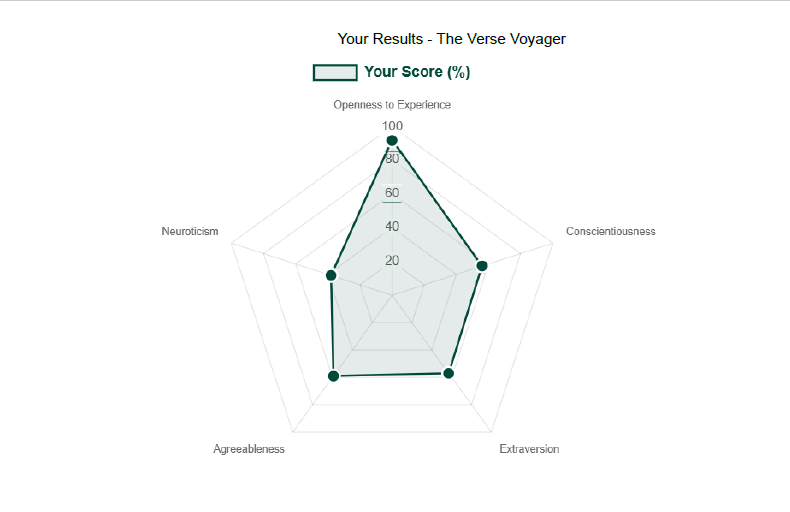
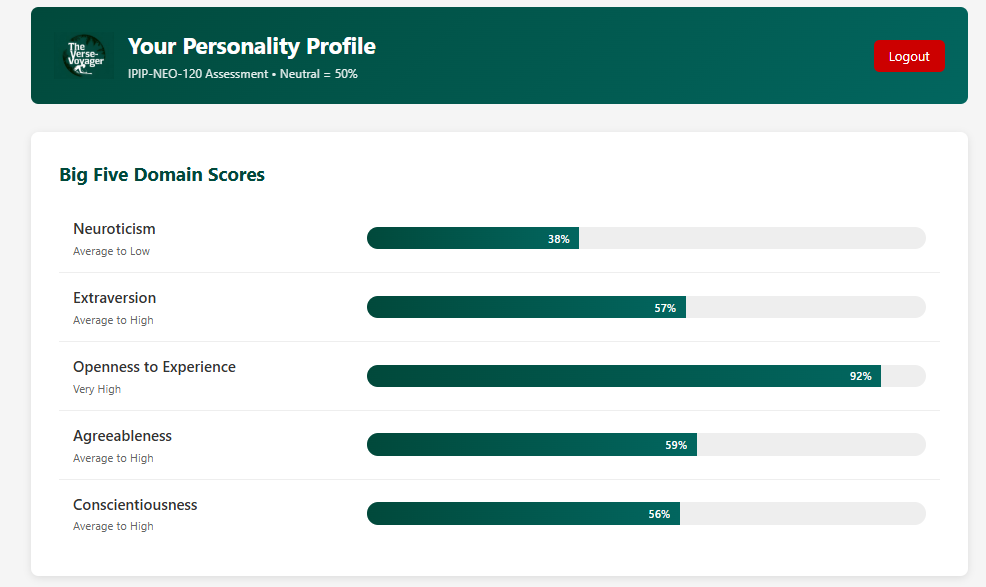
    personality-based travel results

    Big Five Personality type Spider Chart

    Personality and Travel Preferences According to Travel Psychology

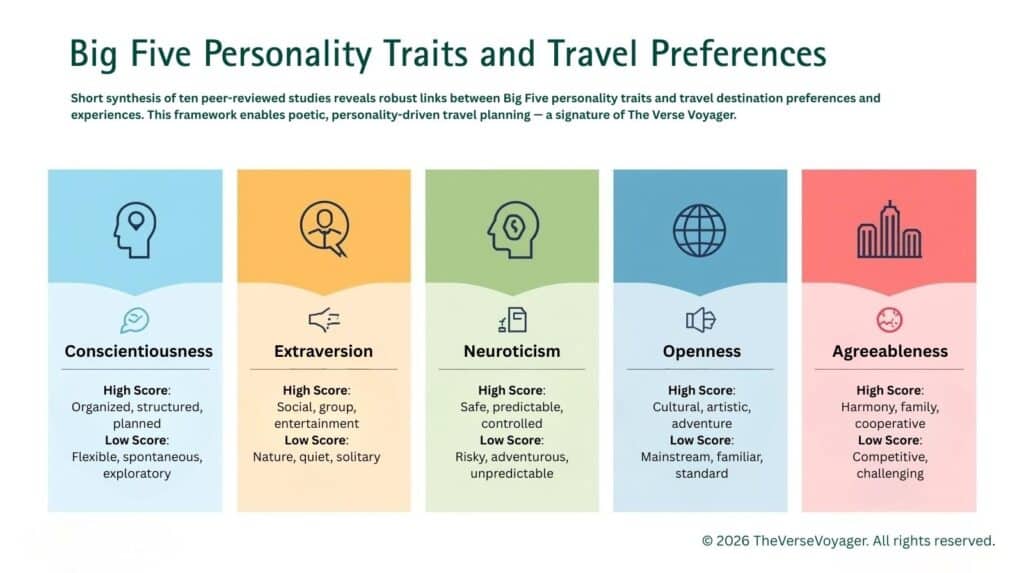
    Personality-based travel is not just a poetic idea—it’s a concept grounded in robust travel psychology research. Over the past decade, the connection between the Big Five personality traits and travel preferences has been confirmed by a synthesis of ten peer-reviewed studies. These studies reveal that our unique travel personality types influence everything from our ideal destinations to the kinds of experiences we find most meaningful.

    What the Science Means for Custom Travel Design

    • Openness and travel: Artistic, immersive, and unconventional destinations (e.g., Kyoto, Medellín).
    • Extraversion and travel: Social, lively, group-oriented trips (e.g., Barcelona, New York).
    • Conscientiousness and travel: Structured, safe, and planned journeys (e.g., Switzerland, Japan).
    • Agreeableness and travel: Community, nature, and family-friendly experiences (e.g., Nepal, Tuscany).
    • Neuroticism and travel: Safe, wellness-focused, and predictable destinations (e.g., Bali, wellness resorts).

    Travel preferences by personality are now measurable, allowing for truly custom travel design. By using a validated personality assessment for travel, The Verse Voyager’s travel planning service matches you with destinations and activities aligned with your unique profile, reducing decision fatigue and increasing satisfaction.

    Key Studies on Personality-Based Travel

    • Alves et al. (2020): Among Portuguese tourists, Agreeableness predicted a love of adventure and nature, while Extraversion and Openness favored entertainment, nightlife, and sun destinations. Conscientiousness was linked to well-structured, cultural heritage trips.
      Read study summary
    • Kovačić et al. (2022): In Serbia, Openness was the strongest predictor of positive destination image and preference for cultural routes. Extraversion led to more participation in events; Conscientiousness and Agreeableness shaped structured, socially engaging travel.
      Read study
    • Verma et al. (2023): Indian travelers high in Openness preferred unique, culturally rich destinations. Conscientiousness and Agreeableness drove meticulous planning and positive group experiences. Neuroticism led to a preference for safe, stress-free locations.
      Read study abstract
    • Coudounaris et al. (2025): At Cyprus airports, Neuroticism was linked to novelty-seeking, while Openness predicted a desire for refreshing, memorable experiences.
    • Akhrani et al. (2020): Indonesian soft-adventure tourists with high Extraversion, Conscientiousness, and Agreeableness were more likely to seek adventure travel.
      Read study
    How Personality influences travel destinations and experiences

    How Each Personality Trait Shapes Your Travel Story

    Personality shapes the way we move through the world, not just in daily life but especially when we travel. Each of the Big Five traits brings its own color to the experience of exploring new places, influencing what feels meaningful, comfortable, or exciting. Understanding these patterns can help us choose journeys that fit us more naturally, making travel not just a break from routine but a true extension of who we are.

    Openness: For the Wonderstruck

    If you have a curious spirit, you might find yourself wandering lantern-lit alleys in Kyoto or losing track of time at a contemporary art festival in Medellín. The world feels like an unfinished canvas, and you travel to add your own brushstrokes. If you prefer the comfort of routine, joy might be found in a beloved city square, a classic museum, or the steady pulse of tradition.

    Conscientiousness: For the Architects of Experience

    You find beauty in order and calm in knowing every detail is in place. Your suitcase is packed with intention, and your steps are mapped with care. Or perhaps you’re happiest when plans are loose, letting the day unfold by whim and weather—a gentle rebellion against the clock.

    Extraversion: For the Social Storytellers

    Laughter, shared meals, and the music of new friendships fill your travels, whether you’re dancing in Buenos Aires or soaking up the city lights in Barcelona. If solitude calls, you might seek the hush of a forest path or the quiet of sunrise, letting reflection become your travel companion.

    Agreeableness: For the Harmonizers

    Meaning is found in shared moments: cooking with locals in Tuscany, joining a village celebration in Nepal, or listening to stories over tea. If your compass points to independence, you might savor the freedom of charting your own course and the gentle solitude of self-guided discovery.

    Neuroticism: For the Seekers of Sanctuary

    You journey for peace, perhaps to a tranquil spa in Bali or the reassuring order of a safe city, a retreat where the world’s noise fades. Or maybe you chase the thrill of unpredictability, embracing the wild edges of travel where each moment is a new leap.

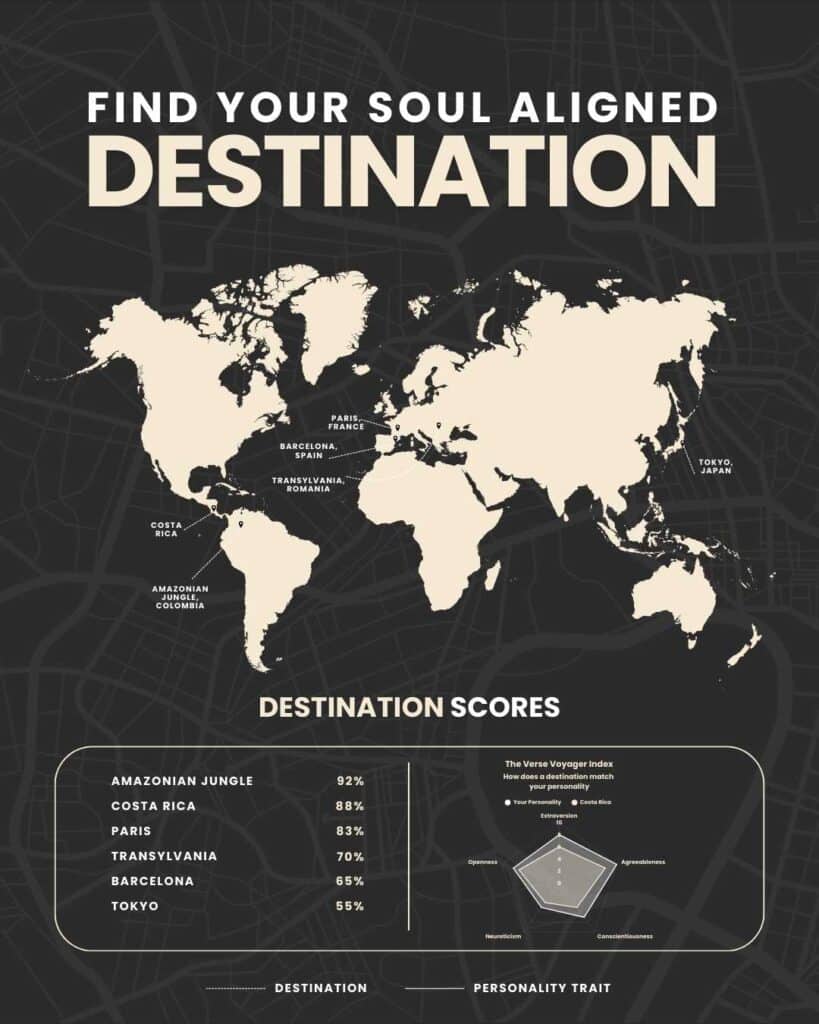
    Personality-Driven Destination Matching: The Verse Voyager Index in Action

    No two travelers experience a place in quite the same way. At The Verse Voyager, we use a blend of psychological insight and real-world travel wisdom to make sure the destinations we recommend truly fit who you are.

    How It Starts: A Science-Backed Assessment

    Your journey begins with a peer-reviewed personality questionnaire, the IPIP NEO 120. This globally respected tool is trusted by researchers and psychologists to measure the Big Five traits with nuance and reliability. When you take our personality assessment, you’re not just answering questions—you’re creating a detailed map of your travel style, preferences, and comfort zones.

    How the Index Works

    After your assessment, we match your results to our proprietary destination profiles. Each location in our system is rated across the Big Five dimensions—Openness, Conscientiousness, Extraversion, Agreeableness, and Neuroticism. These destination scores are never static: they’re built from in-depth research, analysis of travel indexes, and, crucially, updated as travelers share honest feedback after each trip.

    Imagine you’re high in Openness and low in Neuroticism. You might be matched with cities and experiences that are creative, adventurous, and vibrant—places where you can immerse yourself in art, culture, and new ideas. If you score higher on Conscientiousness and Agreeableness, you may be guided toward destinations known for their order, safety, and welcoming communities.

    Why It Matters

    This approach moves beyond generic travel lists. Your recommendations are shaped by both scientific evidence and the lived experiences of travelers like you. As more people use our service and share their impressions, the Index becomes smarter and more personal, creating a living network of insights.

    Curious how it all comes together? You can read more about our custom travel design process and see how personality-driven matching is woven into every itinerary we create.

    How personality destination matching works with The Verse Voyager
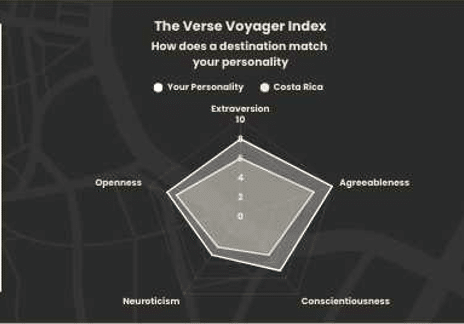
    The Verse Voyager personality index spider chart representation

    The Benefits of Personality-Based Travel Planning

    Personalized travel is more than a buzzword—it’s a way to make each journey feel genuinely rewarding. When your personality shapes your itinerary, the experience becomes more meaningful, authentic, and satisfying.

    Why Personalization Matters

    Travel can be overwhelming. With so many destinations, reviews, and “must-see” lists, it’s easy to get lost in options or end up with a trip that doesn’t quite fit. Personality-based planning helps you cut through the noise. Instead of forcing yourself into someone else’s idea of a perfect vacation, you get recommendations that feel right for you.

    What You Gain

    • Deeper enjoyment: Activities and places match your natural interests and comfort zones, so you’re more likely to feel engaged and fulfilled.
    • Reduced decision fatigue: The process narrows choices to those that truly suit you, making planning less stressful and more enjoyable.
    • Authentic connections: You’re guided toward experiences where you can be yourself, meet like-minded people, or find the solitude you crave.
    • Lasting memories: When your travels reflect who you are, the moments you collect feel more significant and memorable.

    5 Benefits of Verse Voyager’s Approach: Travel That Changes You

    Travel should lift your spirit, not weigh you down. Yet for many, planning a trip becomes a source of stress and decision fatigue. At The Verse Voyager, we believe your journey should start with joy, not overwhelm.

    1) We Turn Planning into Anticipation

    Most people get bogged down in logistics, missing out on the simple happiness of looking forward to an adventure. By handling every detail and crafting soulful, personalized itineraries, we let you savor the anticipation—so excitement grows as your departure date approaches, not your to-do list.

    2) We Create Meaning, Not Just Memories

    Routine and generic tours leave many travelers feeling unfulfilled. We believe that every person has a unique inner landscape, and there’s a destination to match it. Our itineraries are designed to spark wonder, create core memories, and help you live out your story in a way that feels authentic and deeply personal.

    3) We Offer Freedom Without the High Price

    Tailor-made travel shouldn’t be reserved for a select few. Our service gives you a bespoke itinerary at a fair price, with the flexibility to follow our expert plan or improvise along the way. You get guidance and inspiration, but the freedom to make the journey your own.

    4) We Turn Adventure Into Confidence

    Dreaming of exploring somewhere new but worried about the unknown? Our expert-curated itineraries give you the tools and support to move confidently through even the most unfamiliar destinations. We transform uncertainty into excitement, so you can focus on discovery—not doubt.

    5) For Workcations and Beyond

    Need a change of scenery to inspire your work? We’ll match your rhythm with the right place, designing workcations that restore focus and turn routine into renewal.


    Ready to begin your next chapter?

    Frequently Asked Questions

    What makes personality-based travel different from traditional travel planning?

    Personality-based travel goes beyond generic recommendations. Instead of one-size-fits-all lists, your itinerary is matched to your unique preferences and travel style, making every journey more meaningful and comfortable.

    How does The Verse Voyager determine which destinations fit me best?

    We use a science-backed personality assessment and our proprietary Verse Voyager Index, which combines research, destination analysis, and real traveler feedback to find the best matches for you.

    Can I adjust my itinerary after I receive it?

    Absolutely. Flexibility is built into every plan. You can follow our recommendations closely or adapt them as you go—your journey is yours to shape.

    Is this service only for solo travelers?

    Not at all. We design itineraries for solo adventurers, couples, families, and small groups. Your travel personality is always at the heart of the plan.

    What if I want to visit a destination that isn’t in your system?

    We love a challenge! If you have a dream destination, let us know. We’ll research and create a custom itinerary that fits your personality and interests.

    How do I get started?

    You can schedule a free discovery call, message us on Instagram, or leave a comment below. We’ll guide you through each step and answer any questions you have.

    Conclusion: The Journey Within – Personality-Based Travel in 2026

    In 2026, travel is no longer just about geography—it’s about self-discovery. The science of personality-based travel has shown that the Big Five traits quietly shape not only what we seek on the road, but how deeply we experience it. When we understand our own Openness, Conscientiousness, Extraversion, Agreeableness, and Neuroticism, we open the door to journeys that truly fit—trips that feel less like escapes and more like homecomings.

    Matching destinations to personality isn’t a trend; it’s a movement toward more meaningful, satisfying, and authentic adventures. Whether you crave the creative pulse of a new city, the calm of a well-planned retreat, or the thrill of the unknown, your personality is the compass that can guide you to the right place at the right time.

    As research continues to evolve, and more travelers share their stories, the future of travel will be shaped by the inner landscapes we carry with us. The next chapter of exploration is not just about where you go, but about how travel helps you grow.

    Ready to reflect on your own travel style? Consider taking a personality assessment, starting a conversation in the comments, or connecting with fellow travelers who share your spirit. Your next journey might just begin with a single, honest look within.

  • Travel Planning Service: What It Includes, Cost, and Who It’s For (2026 Guide)

    Travel Planning Service: What It Includes, Cost, and Who It’s For (2026 Guide)

    Planning a trip should spark excitement, not overwhelm. Yet many busy professionals end up drowning in research—comparing hotels, cross-checking flight times, and stitching logistics across ten tabs—while their calendar keeps filling up.

    A travel planning service replaces that chaos with a clear, custom plan: a professionally designed itinerary tailored to your preferences, pace, and travel style. In this guide, I’ll walk you through what’s included, what affects cost, who it’s for (and who it’s not), and what happens when you book a discovery call with The Verse Voyager.

    If you want clarity fast: you can book a discovery call here:

    What is a travel planning service?

    A travel planning service is a personalized, fee-based collaboration where a travel
    planner designs a custom travel itinerary around your goals, constraints, and
    preferences. Instead of generic “Top 10” lists, you get strategy: how your days flow,
    where to stay (with curated options), what experiences match your interests, and how
    to reduce friction across the trip.
    If you’re comparing options, here’s the simplest distinction: – Booking platforms handle
    transactions. – Many travel agents sell pre-built packages through supplier networks. – A travel planning service delivers experience design + itinerary strategy tailored to you.

    Travel planner vs travel agent vs DIY vs AI itineraries

    When someone searches “travel planning service,” they’re usually looking for a trip that feels intentional—not just booked.

    Before the table, here’s the honest shortcut I use:

    • If you love research and you have time, DIY can be genuinely fun.
    • If you want ideas fast, AI can help you brainstorm—but it rarely protects you from bad pacing or logistical friction.
    • If you want someone to book a standard product, a travel agent can be a good fit.
    • If you want a trip that feels like it was designed for you—your pace, your interests, your comfort level, your personality—a travel planning service is the most direct path.
    OptionBest forWhat you getCommon downside
    DIY planningPeople who love researchFull controlTime cost, decision fatigue, missed details
    AI itineraryQuick inspirationFast ideasGeneric recommendations, weak logistics, wrong or outdated data
    Travel agentBooking packaged productsTransactions + supplier optionsLimited customization, commission incentives
    Travel planning serviceTravelers who want a meaningful trip that fits themCustom itinerary + curated options + logistics strategy + freedom do to on spot changes and adaptFee-based investment

    After the table, one nuance matters: these options can combine.

    For example, many of my clients start with a few ideas from AI agents or saved posts—and that’s fine. The value of a planner is turning that inspiration into a coherent route, realistic timing, and a plan you can actually execute without second-guessing every day.

    What’s included in a travel planning service (deliverables checklist)

    When you hire a travel planner, you should expect a tangible set of deliverables as a custom itinerary service—not vague advice.

    Typical deliverables include:

    • Trip concept + route logic: why these places, in this order, at this pace
    • Day-by-day itinerary: a realistic flow from morning to evening (with breathing room)
    • Accommodation shortlists by budget and style: a curated set of options (so you stop scrolling)
    • Experience and dining recommendations: aligned to your interests (not generic templates)
    • Logistics notes: local transport, timing buffers, key friction points to avoid
    • Safety advice: safety advice so that you can have the best possible experience in a safe manner
    • Final PDF itinerary: one beautiful, shareable document you can actually use
    • Destination guide book: useful information and tips and tricks about your destination

    Travel planning service cost: what affects pricing?

    One of the most common questions is: how much does a travel planner cost?

    Pricing varies because the work varies. The biggest cost drivers are:

    • destination complexity (multi-city, multi-country, remote places)
    • trip length
    • number of travelers
    • pace and travel style (structured vs flexible)
    • special interests (food, art, wellness, nature, architecture, etc.)
    • seasonality and booking timeline

    For The Verse Voyager, services start at €50 for destination matching and €99 for custom travel design for short trips.

    The Verse Voyager approach (what makes it different)

    The Verse Voyager is travel planning by a personality-based travel designer—where psychological insight meets real destination experience.

    The foundation is simple: the wisest journeys begin with understanding.

    We use Big Five personality psychology (research-backed) alongside years of destination knowledge to help you:

    • choose places that fit you (not just what’s trending)
    • travel in a way that matches your natural pace and comfort level
    • build days that feel meaningful, not crammed
    • set clear expectation about a trip (what possible challenges, or uncomfortable situation you may face)
    • craft a travelling experiences according to your desires for this specific trip (visit, relax, grow etc..)

    In other words: we don’t just plan trips. We help you align your inner compass with the outer journey.

    The Verse Voyager services (what’s included, explained clearly)

    On The Verse Voyager, you can choose one of four pathways—depending on whether you’re still choosing a destination, already know where you’re going, or want the most comprehensive support.

    1) Personality-Driven Destination Matching (from €50)

    This is for the “dreaming phase”—when you know the kind of trip you want, but you’re not sure where you’ll thrive.

    What you get:

    • Delivery in 2–3 business days
    • A comprehensive Big Five personality assessment
    • Scientifically matched destinations (so your shortlist is grounded in psychology, not guesswork)

    This is a great starting point if you’ve been stuck between a few very different options (city vs nature, fast vs slow, social vs quiet) and you want clarity.

    2) Custom Travel Design – Essential (from €99)

    This is for travelers who already know the destination and want a plan that’s actually usable—day by day, with a sensible rhythm.

    What you get:

    • 30-minute discovery consultation
    • A day-by-day detailed itinerary
    • Delivery in 5–7 business days

    Think of it as the difference between “a list of places” and “a trip that flows.”

    3) Custom Travel Design – Elevated (from €199)

    This is the most comprehensive option—built for travelers who want maximum clarity and peace of mind.

    What you get:

    • Delivery in 7–10 business days
    • A custom guidebook (so you don’t have to keep ten tabs open while traveling)
    • Local guides and agencies recommendation
    • Strategic planning for transportation and cost optimization strategies
    • Pre-programmed Google Maps routes
    • Email support during your trip
    • Everything included in the essential tier

    It’s designed to help you travel like a knowledgeable explorer, not a stressed-out tourist.

    4) Addon: The Quest Experience (from €49)

    This is a playful, creative layer you can add to any Custom Travel Design.

    What you get:

    • destination-specific challenges
    • Photo missions & achievement tracking
    • Designed to add to any Custom Travel Design

    A few examples (so you can feel what it’s like):

    • Discover a local’s favorite breakfast spot (not found in any guidebook)
    • Learn three essential phrases and use them in genuine conversations
    • Find the best sunset viewpoint recommended by a longtime resident
    • Capture the most vibrant, colorful street in the historic quarter

    The difference deep knowledge makes

    A good itinerary isn’t just a list—it’s a reduction of uncertainty.

    Here’s what clients typically gain:

    • Save 15+ hours of research Skip the spiral of endless blogs, conflicting reviews, and decision paralysis.
    • Access insider wisdom Hidden gems, local favorites, and experiences that feel authentic—not generic.
    • Travel with confidence Less second-guessing, fewer mid-trip “did we miss something?” moments.
    • Travel safely in a cost optimal way

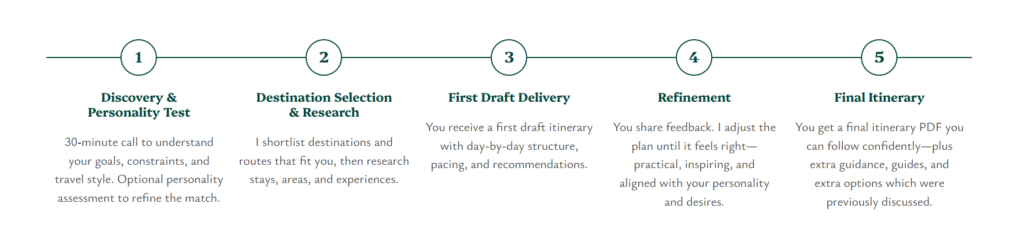
    What happens after you book a discovery call?

    The first step is simple and low-pressure.

    1. Contact us.
    2. We clarify your destination ideas, timeline, and what “a great trip” means to you
    3. If you move forward, you can take a short personality assessment (optional)
    4. I research and build your draft itinerary
    5. You review it, and we refine it
    6. You receive your final PDF itinerary (and support, depending on the service you choose)
    The Verse Voyager travel planning services roadmap

    Your next step: book a discovery call + follow along on Instagram

    FAQs about travel planning services

    How much does a travel planning service cost?

    It depends on trip length, complexity, and customization depth. For The Verse Voyager, services start at €50 for destination matching and the price can increase depending on many factors length of the trip, destination, number of persons, level of customization and support etc..

    Do travel planners book flights and hotels for you?

    Some do; many focus on strategy and curated options. The Verse Voyager is designed around giving you a clear plan and vetted choices so you can book yourself with confidence.

    What’s the difference between a travel planner and a travel agent?

    A travel agent often sells existing packages and handles transactions. A travel planner is typically fee-based and designs a custom itinerary around your preferences.

    How far in advance should I hire a travel planner?

    Ideally 4–8 weeks before departure. If you’re closer than that, it can still work—your options may just be narrower.

    Is a custom travel itinerary worth it?

    Yes, especially for complex, meaningful, or milestone trips. The value comes from:
    Time saved (20+ hours of research condensed)
    Stress eliminated (logistics handled, decisions made)
    Experience quality elevated (personality-matched recommendations)
    Exclusive perks accessed (supplier relationships yield savings)
    Personality alignment (travel designed for how you actually want to experience theworld)
    For short, straightforward trips, DIY planning might suffice. For trips that matter—where you want the experience to match who you are—a custom itinerary delivers far more thanthe planning fee costs.

    Can you plan trips worldwide, or just specific regions?

    The Verse Voyager designs trips anywhere in the world. We have particular specialization and expertise in: Europe, LATAM area, Middle East and Asia.

    What if I want to change the itinerary after the first draft?

    Revisions are part of the process. You can adjust activities, swap properties, modify pace, orrequest entirely different recommendations. The Verse Voyager includes at least one revision round depending on your package. This iterative refinement ensures the final plan feels authentic to you.

    What makes The Verse Voyager different from other travel planners?

    The Verse Voyager uniquely combines:

    • Personality-based design using Big Five psychology
    • Destination expertise in key global regions
    • Flexibility philosophy (structure + spontaneity)
    • Continuity approach where every trip informs the next
    • Human expertise + intelligent systems blending behavioral science with real-worldtravel experience
    • Soulful curation focused on meaningful, transformational travel

    Most travel planners design itineraries based on destination popularity. The Verse Voyager designs based on
    who you are
    and how you travel best.

    What if I’m still uncertain about whether to book a call?

    That’s exactly what the discovery call is for. There’s no obligation. You’ll explore your travelvision, learn about the planning process, and make an informed decision together. Manyclients book their first call just to see if personality-based planning resonates with them—and discover it’s exactly what they needed.