
Table of Contents
Places to visit in France outside of Paris: cycling itinerary in Burgundy
The idea of this France by bike tour, was to cycle through the most scenic parts and to move fast through the others. This itinerary is suitable for cyclists that wont shy away from using the train and want to discover the French countryside in a slow pace. In what follows I will detail my cycling itinerary in Burgundy.
After a short and comfortable train ride from Lorraine, I have arrived in Dijon. I stopped there a couple of hours in order to discover the city and took a second train to Auxerre, where the ride would start. From there I cycled toward Arcy-sur-Cure, stopping for the night in a village just short of the town. The next morning I visited the prehistoric cave paintings at Arcy-sur-Cure, then set off through the northern edge of the Morvan natural park and on to Vézelay (one of the best places to visit in Burgundy), where I happened to arrive for Father’s Day. Next came Varzy, where I stopped for a summer harvest festival and fell into conversation with a couple of Romanian sculptors, before pointing the bike toward the next section of the journey: the Loire Valley, beginning at La Charité-sur-Loire. Three days is a comfortable minimum to enjoy slow travel and discover the french villages along the way. In what follows you can read the account of the time I spend discovering Burgundy and at the end of the story you will find out about an unexpected encounter with a couple of artists: a marble sculptor and a painter.
Dijon: The Owl’s trail, artistic corners and central asian dances
After a comfortable train trip, I left the elegant and historically rich realm of Lorraine to enter Bourgogne.
Here, the French countryside still has a medieval air: mellow hills, vineyards, cobblestone streets and bridges, cylindrical towers with gray rooftops, and courtyards abounding in blue, pink, or white boules de neige.
I wasn’t planning to rest too long in Dijon, only for three hours. I spent my time roaming the vibrant, coquettish streets. The mood around me was contagious: light, enjoyable, and carefree. On the terraces of little cafés, tourists and locals alike were enjoying the afternoon.
The absence of any past, present, or foreseeable pain was quite refreshing. There was a time in my life when I sought to understand the pain that can be lived in our times. The three coming weeks were not going to be about that.
Strolling around, I discovered a repeating pattern of little owls embedded in the asphalt or at the corners of the streets. It was the Parcours de la Chouette, The Owl’s Trail, a well-known self-guided tour that leads you from one architectural gem to another. I decided to play along and follow the little owls.
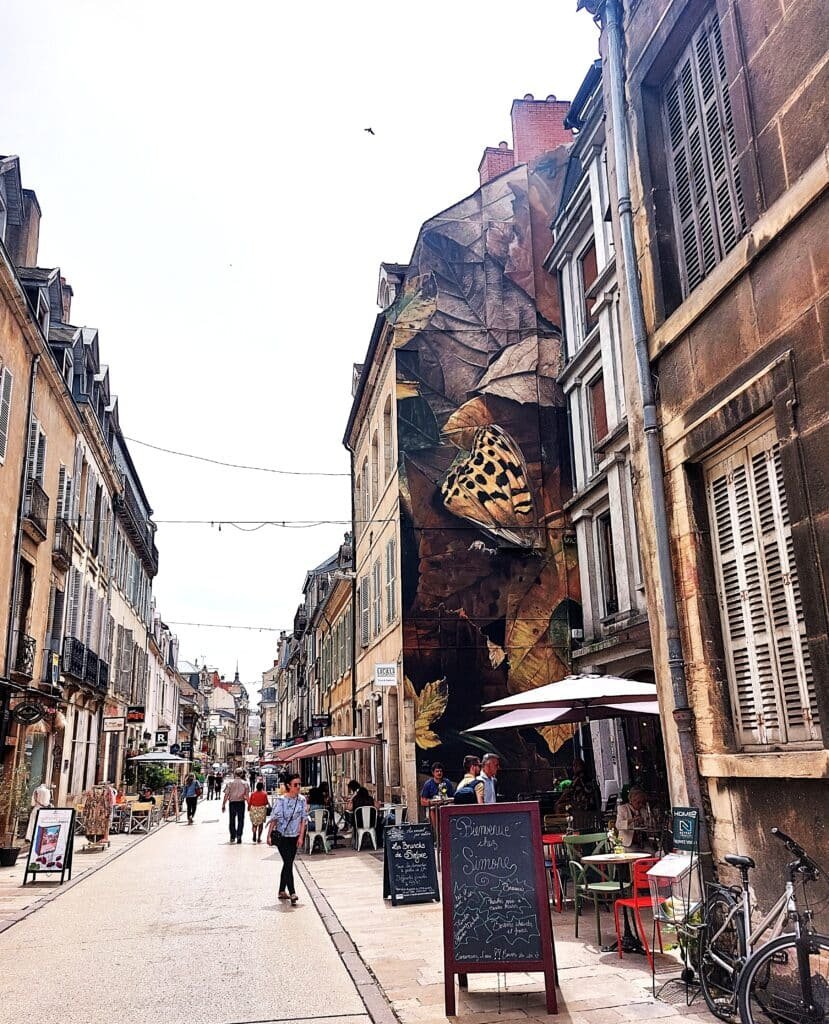
Dijon packs a remarkable amount into a walkable center. The Palace of the Dukes of Burgundy anchors the elegant Place de la Libération, while the old Saint-Bénigne crypt showcases the city’s Romanesque roots. Wandering the streets, you pass medieval half-timbered colombage houses, Renaissance hôtels particuliers with carved façades and spiral staircases, and Haussmannian boulevards lined with wrought-iron balconets. The best way to take it all in is the Parcours de la Chouette (the Owl’s Trail: travel guide burgundy France), a self-guided route marked by little owls set into the pavement that links the city’s finest architectural gems, all rounded off with a taste of Dijon’s famous mustard on a lively café terrace.
Dijon is rich in architectural development: from the Romanesque of the old Saint-Bénigne crypt to the 19th-century Haussmannian-influenced uniform façades, it metamorphoses into the shapes of gothic, medieval, renaissance, and neoclassical. I walked on Parisian-like buildings, with regularly placed portes-fenêtres and small wrought-iron balconets.
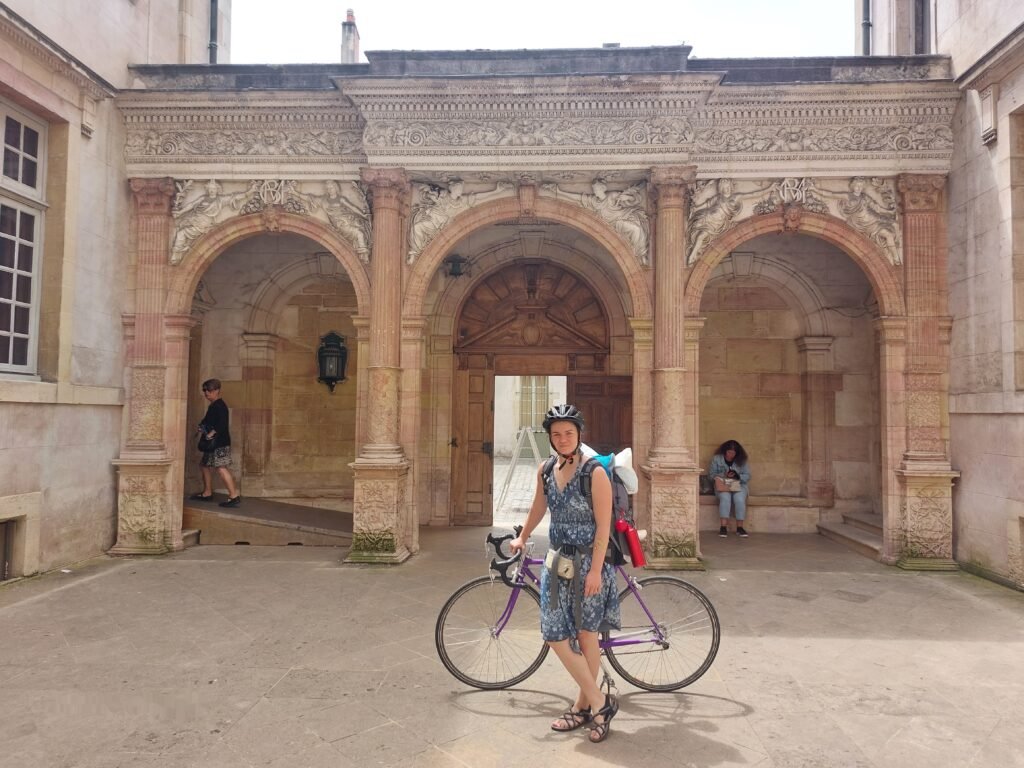
Cycling Burgundy is the kind of slow travel that rewards patience over speed. This one of the regions most suitable for a France by bike tour, a region where the D-roads matter more than the motorways: quiet, well-paved departmental routes that thread from one wine village to the next, often with barely a car for company.
In terms of difficulty, Burgundy by bike is forgiving. The canal routes are almost entirely flat and beginner-friendly, ideal for unhurried days. The vineyard climbs are short rather than brutal, the sort of rolling terrain that keeps things interesting without wearing you down. A road bike handles the paved routes well; a gravel or touring bike opens up the towpaths.
For a Burgundy itinerary, three unhurried days is a comfortable minimum, Dijon to La Charité-sur-Loire along the vineyards, then out toward the canals, though the region rewards lingering. This is slow travel in France at its best: you go at the pace of the landscape, stop when a café terrace or a boule-de-neige-filled courtyard asks you to, and let the distance take care of itself.
Right after a street corner, the peysage suddenly changed and one walked between timber houses from medieval times. At the mouth of a narrow medieval lane, one of Dijon’s oldest half-timbered houses leans out over the cobbles. This is colombage, timber-frame construction dating from the late medieval period, when the town’s merchants built upward in oak and plaster to save on precious ground-floor space. After another corner, the historical period shifted again and suddenly, rich hôtels particuliers, propelled the walker into the Renaissance with their carved façades, spiral staircases, and inner courtyards. The centerpiece was the Palace of the Dukes of Burgundy, dominating the Place de la Libération.
Dijon is a lively city. I arrived in the middle of a festival dedicated to traditional Central Asian dances, if I had to guess, I would have said Georgian, but I had no idea. It seems that the world still comes to France.
Off the beaten path: cycling along the Yonne and prehistoric paintings in Arcy-sur-Cure
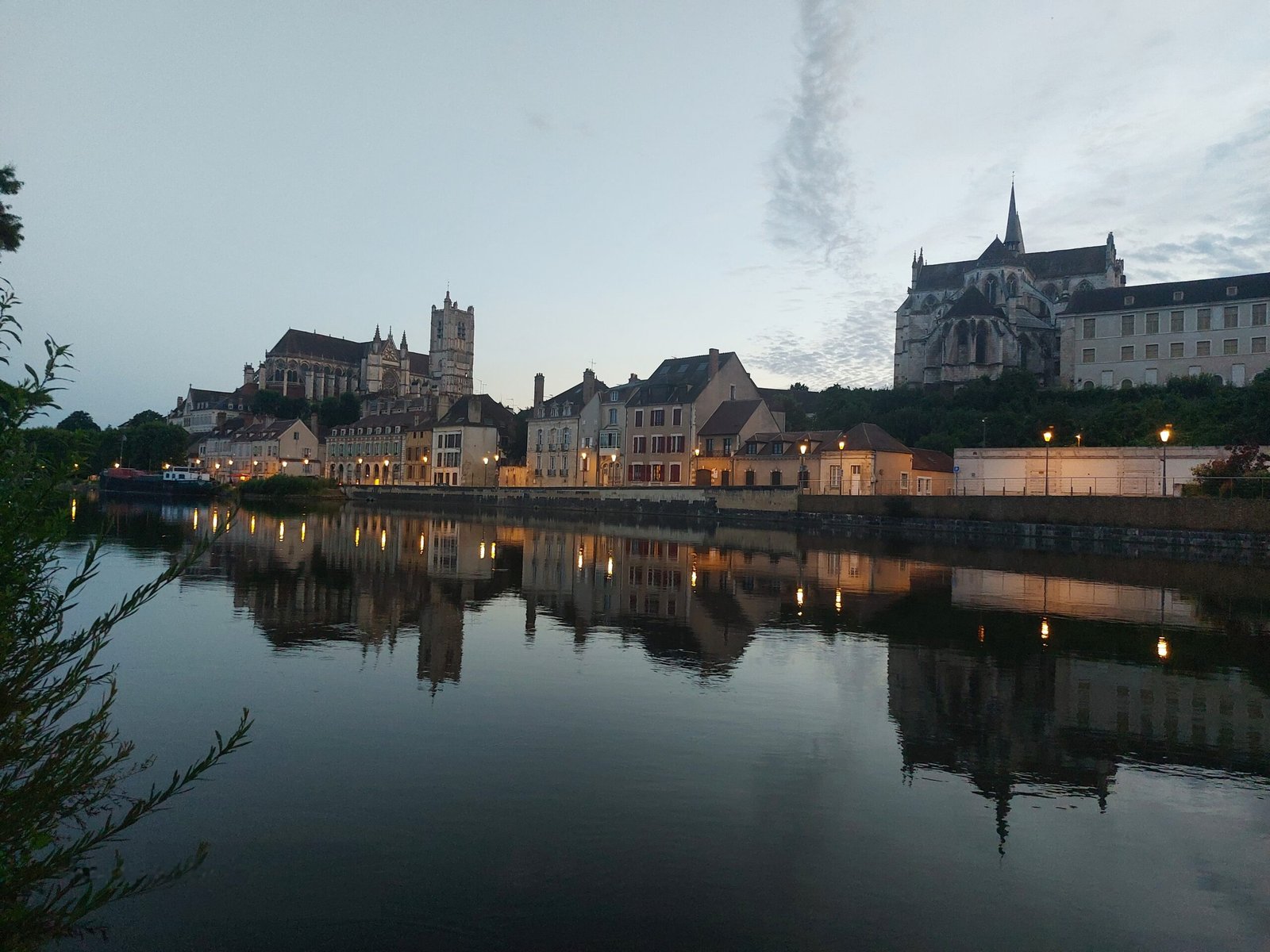
It was not my plan to spend the night in Dijon, so I took an afternoon train towards Auxerre. The plan was to spend my first night under the starry sky somewhere on the banks of the Yonne river. I still had two or three hours of cycling ahead; the sky was an incredible blue, the river’s flow was perfectly regulated, and from time to time small dams formed little lakes. The small boat locks were adorned with pots of red geraniums. Humans weren’t the only ones building dams on the Yonne. At one point, two beavers were hard at work on their own. The river was a peaceful spectacle of serene human settlements, stone houses, blooming boule de neige bushes, and Gothic cathedrals. A play of light and water unfolded during the golden hour.
I decided to rest for the night in an old forest near Bessy-sur-Cure. I set up my hammock under a big sycamore, ate something, and in the simplest way possible, called it a day.
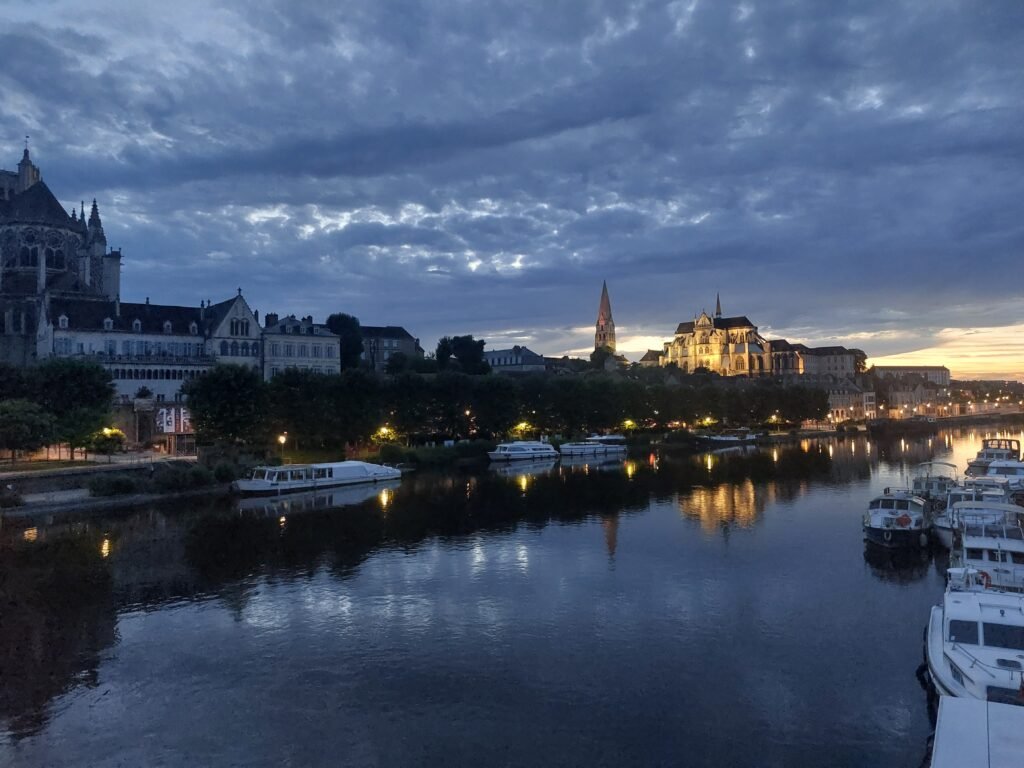
Places to visit in France outside of Paris: The Yonne river in Auxerre
The next day I faced a problem that I hadn’t quite expected. I couldn’t find an open shop in the villages on my route. And I was out of food and water. For electricity I took out my portable solar panel, hooked it on my rucksack and connected my phone.
It was still morning when I reached Arcy-sur-Cure and the cave. What attracted me here were of course the prehistoric paintings. It was a type of art that I had previously only looked upon in atlases and documentaries and here, they were in front of me: visual proof of the mammoths and cave lions, red shades of prehistoric human hands, one of France hidden gems.
The cave art here was a pale comparison with its more elaborate relatives: Lascaux, Chauvet, Altamira, Sulawesi, Bhimbetka, Tassili N’Ajjer.
The little red contour of a child’s hand, the elegant lines of the animal groups were enough to stir inside me a feeling of awe and endearment towards those paleolithic early-humans who were capable of such beauties even though they lived underground and constantly fought for their lives. These were proof that we had inside of us the search for beauty, representation, art, and the means to form a culture and transmit it further to future generations.
I continued my cycling, crossing the southern tip of the Morvan Natural Park, a portion of old forest and steeper hills. On the other side the forest was replaced by well maintained vineyards. I passed a number of small groups of men walking on the roads, until my curiosity overcame the restraint and I finally asked them where they were heading. With enthusiasm they replied that it was La fete de pères de familles and they were pilgrimming towards the Basilique de Vézelay. The funny fact was that I was also heading there. The basilique is a UNESCO site, and it was part of my itinerary for the day.
Most beautiful towns in France: Vézelay during Father’s Day Pilgrimage
Vézelay is situated on the highest hill of the region, dominating the area. It is a medieval town with the houses nested inside the defending walls and with the Basilica on the highest ground, and five times taller than any other building. There were countless pilgrims going up and down the street, gathered from all surroundings. Some of them had been marching for three days before reaching Vézelay.
At the gates, fruit merchants waited behind piles of apricots and cherries. A steep narrow street continued on the crest of the hill finding its way up towards the basilica. Little artisan shops displaying local products, small tasteful cafés rewarded the pilgrims with refreshments. I bought some of the early summer black cherries and enjoyed their fleshy sweetness while going uphill. The church was full. I took a short dive into the sea of pilgrims, and made it in front of the sculptured portal. It displayed a story of how this religion was spread. I gassed for a while, interested in the lines of old medieval art.
After a refreshing pause, I resumed my journey westwards towards Charité-sur-Loire, the point where I planned to enter the Loire Valley. For a while, the road was downhill so I just enjoyed the scenery, hills drawn with straight, regular green lines of endless vineyards. From the highest points I could see small groups of pilgrims spread on the roads to Vézelay. Soon the hills flattened and were replaced by fields.
I passed a number of small stone houses and villages, well maintained, yet seemingly deserted. I thought that maybe everybody had left for Father’s Day. Again there were no open stores to be found, nor restaurants or boulangeries. And yet, slowly, village after village, something entered into my awareness. In almost every settlement one could find either an atelier or a poster inviting people to join the local choir or band or a club for painting nature. One place, in a small village on the road, had an iron workshop with imaginative sculptures made of recycled metal components. It made me realise that creativity and art were truly valued among the French. I would have expected to see that in Paris, but it was pervasive all over the countryside. After a short but powerful summer rain, the sun appeared and dried up my clothes in no time.
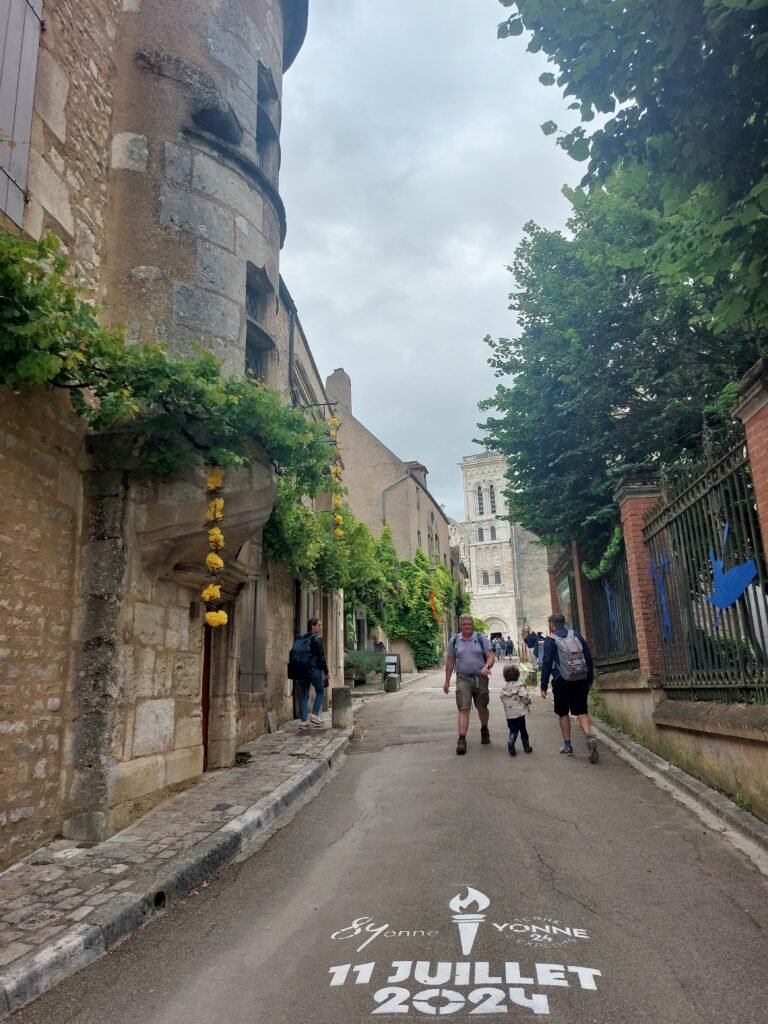
Perched atop Burgundy’s “eternal hill,” the Basilique Sainte-Marie-Madeleine makes Vézelay one of the most beautiful villages in Burgundy. It rises from a former 9th-century Benedictine abbey into one of medieval Christendom’s most magnetic pilgrimage sites, drawn there by the belief that it held the relics of Mary Magdalene and by its position on a key route to Santiago de Compostela. By the 12th century, the hill town swelled to nearly 10,000 inhabitants and became a stage for history: St Bernard preached the Second Crusade here in 1146 before Louis VII and Eleanor of Aquitaine, Richard the Lion-Hearted and Philip Augustus met here in 1190 before departing for the Third Crusade, and Francis of Assisi founded France’s first Franciscan house here in 1217. Beyond its historical weight, the basilica is a high point of Burgundian Romanesque art, its nave defined by bicolored horseshoe arches and a remarkable range of carved capitals, while the sculpted portal between nave and narthex, crowned by a tympanum depicting Christ in Glory commissioning the apostles to convert the nations, remains one of the most celebrated and singular works of the entire Romanesque period.
Meeting the artist: An unexpected encounter
Soon afterwards I reached water-clean-cobblestone-glimmering Varzy. A summer festival was in bloom there, so I decided to cross the town walking slowly, taking in the joy and music. At one of the tables I heard romanian and on the spur of the moment I decided to make my presence known. And so I met Viorel and Maria, a couple of Romanian artists around their 60s, established in France. I told them about my trip and they invited me to rest for the night at their place, situated only 12 km away from where we were. It was one of those moments when I realised how much openness and a friendly attitude can bring.
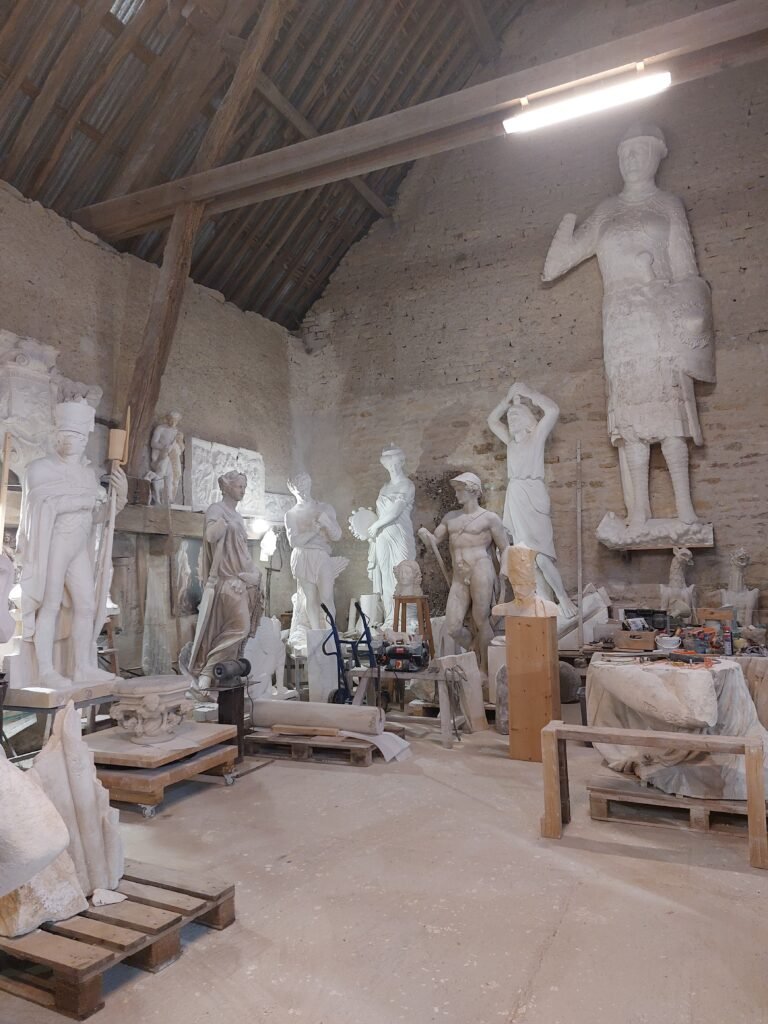
The Enache Ateliers work in stone as restorers of France’s monumental heritage, and the list of sites their hands have touched reads like an itinerary of the country’s grandest facades. They have restored statuary groups from Notre-Dame de Paris and the Louvre, from the Arc de Triomphe du Carrousel and the Église de la Madeleine, the Tuileries Gardens and the Château de Villers-Cotterêts, the church of Saint-Eustache, the Lutetia and The Peninsula hotels, the Court of Appeal of Dijon and the seat of the French Council of State, the chapel of the Hôtel de Cluny and the Gare de Lyon, the cathedral of Saint-Étienne in Meaux and the Château de Chambord, the Notre-Dame cathedrals of Le Havre, Arques-la-Bataille and Reims, the Holy Cross Cathedral of Orléans, and the Porte Saint-Nicolas of Nancy.
One finds an inédite feeling in visiting art ateliers. In the barn, that labour stands assembled in a pale congregation, plaster and marble crowded shoulder to shoulder under a single fluorescent tube. Nearest the door a shako-capped soldier of the Napoleonic line keeps a stiff sentry’s watch, musket grounded, a fragment of carved cartouche behind him. The mythological figures gather at the centre: a draped goddess, Diana-like in her calm, gazing sidelong; a slender youth in the pose of a resting Hermes or Bacchus, half-nude with the fabric slipping from his hip; a graceful woman lifting a tambourine, a bacchante or muse caught mid-dance; and a muscular, helmeted Mercury beside them, the wing of his cap just visible. Presiding over all of it, rising nearly to the rafters, looms a colossal armoured figure: Joan of Arc in mailed skirt and breastplate, hand raised, dwarfing the workbenches, the grinders and the sawdust of a workshop still very much in use. What wonders can one discover by slow travel France.
Their home was a true nest for artists. Blocks of partially finished marbles were spread all over the grass inside of their generous courtyard. There were two huge barns filled with statuary groups, some belonging to the master, some being there for restoration.
The place was a typical French countryside farm before they bought it and transformed it into their summer home.
Greek gods, ancient heroes, French noblemen, one huge Joan of Arc, and a couple of statuary groups from Notre Dame de Paris (that I was not allowed to photograph), not to mention the masters’ own creations. I must have fallen through a secret rabbit hole and ended up in the wonderland of marbles.
Art was their way of life and they made a living from it. Twenty years ago, they started a firm for marble restoration, which slowly grew, and now they have contracts and clients all over France.
Their house itself was an exhibition to be lived in. Her paintings, his marbles shared the space with them. Maria specialised in shadows, plays of light, and the diaphanous aspects of the world: pale representations of a vegetal world, rays of light through unseen foliage. He, too, sometimes searched for forms in the vegetal world. The Fruit seemed to be a recurring motif. Fruit as fruition. The fruition of thought. They were a couple, joined by way of being and by purpose.
“Sometimes it’s more difficult moneywise. But money is not the most important thing in life. Sometimes you have it, sometimes you don’t.”
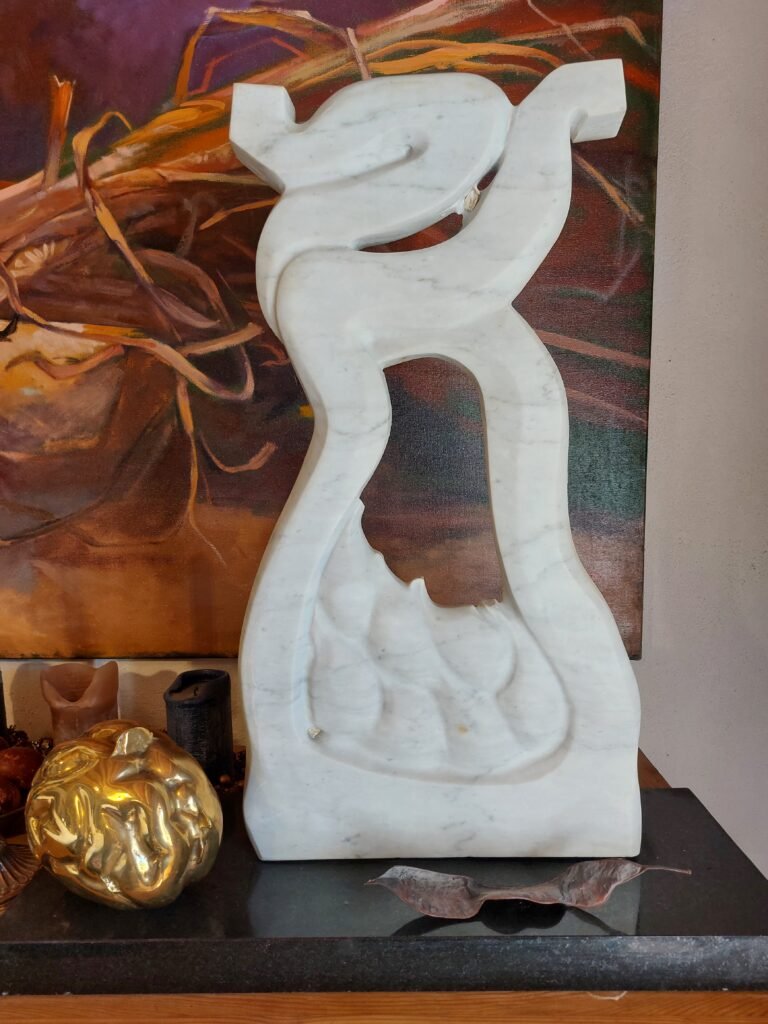
What seem to be the seeds of thought near a golden brain
They left right after the Romanian revolution. It was not easy for them to make a living and a name in Paris in the 90s. They also raised two children, who turned out, at times, more pragmatic than their parents.
One could see that the two possessed well-formed artistic identities, contraries of the same artistic virtues. One dealing with the immutable material, the other with the immaterial. One liking to be seen more than the other. She still looked with tender eyes and amazement every time he drew out another shape from the heart of stone.
After a guided tour through the museum-house, led by the master himself, I went to the room they offered me and took a much-needed shower. I put my head on the quilt, deeply satisfied by this eventful day, and went to sleep almost instantaneously.
The next morning was cold and didn’t tempt you out from under the down quilt. The peasant room hasn’t been heated at all. I raised from the bed and quickly, quickly crossed the creaking floor to the shower. I loved places that were completely new and foreign. Then and there the passion for life turned from smoldering fire into blaze. I could hardly wait for the day to begin, to learn more about the two artists. I opened the magazine they left for me and began reading about the sculptor’s life.
I closed the magazine. Enough with the pain and struggle of the past. I jumped into my clothes, packed the few things I had with me, and left the room. The courtyard full of sculptures was only just beginning to stir under the first rays of morning. A Ulysses watched shyly from beneath a ram’s fleece. A Janus twisted, trying to shield one face from the other.
Stones that had been given life lay scattered across the lawn, like fairy eggs on Calypso’s beach. The sculptor was already bustling about the kitchen: on a wooden board he had set a coffee pot, three cups, and a tray of toast, and beside it a jar of plum jam. Realizing that I was there he asked for help.
They set everything outside on the white marble table and sat down themselves. The smell of the coffee was inviting, though the taste recalled the stovetop it had been brewed on.
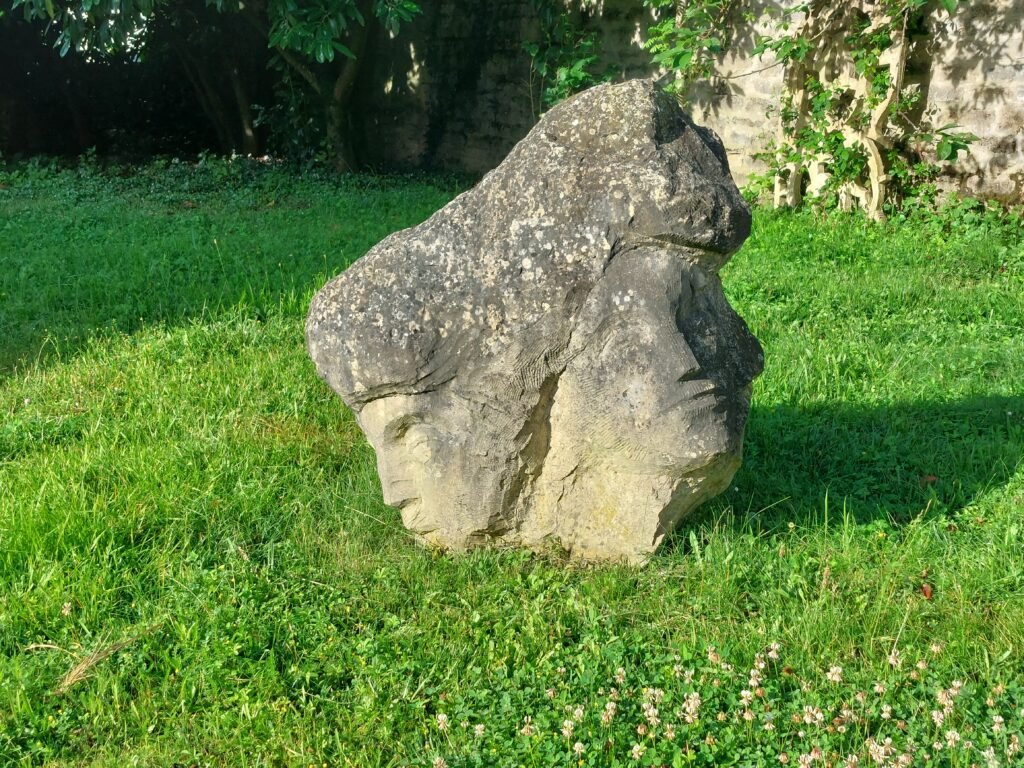
Janus twisted with one face gazing towards future, the other to the past
They wanted to know who I was, but there was a reticence in me, to let everything else that I was to transpire through the travelers’ mantle. I had different sides inside me that I didn’t want to fuse one into another. I told them, like it was not about me, like it was the story of another. I told them because one story from the other side of me was meant for them. So I told them about the man who was a sculpture at the bottom of the ocean for thousands and thousands of years.
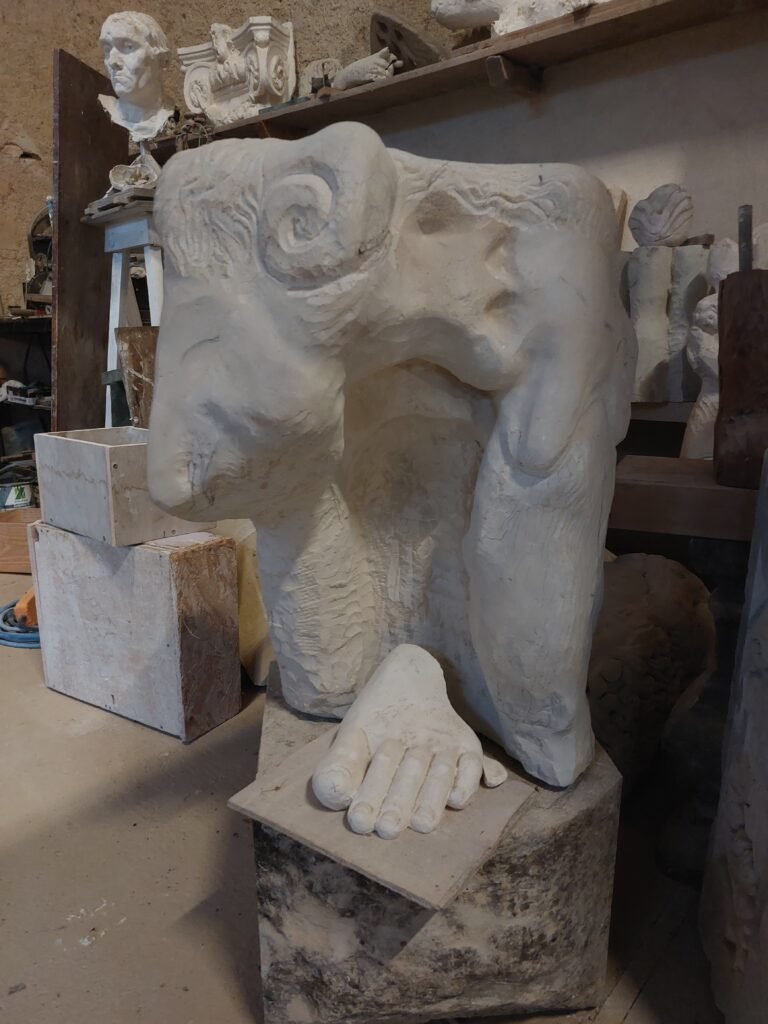
Ulysses hidden beneath a ram’s fleece
I remembered the look into his blue and stormy eyes, our conversation up to that point was peculiar, as far as conversations go, but not so abnormal for alienists. I was just asking my routine questions:
“And what were you, in your life?”
“I was… a sculpture at the bottom of the ocean for thousands of years.”
I wanted to know what one feels and thinks when one gives shapes to marbles. He tried to answer to my countless questions, in the end he succumbed saying:
“I am a sculptor. I say what I have to say through stone.”
Just before leaving, they invited me to their teaching summer camp for sculptors. It was a possibility of becoming that never crossed my mind. It was tempting and I left weighing the thought for the rest of the day.
After the deeply enriching breakfast, I recommenced my cycling through Burgundy. The hills were mellow and I was mostly going downwards towards the Loire valley.
At the next crossroads I stopped to chat with a group of villagers. French elections were going on and, as expected, they were the main topic for chatter. They were supporters of Rassemblement National. I wondered why someone living from agriculture would support a far-right group standing for liberal markets and bans against immigration. Then they asked me why I was traveling in that area, so I told them about the marble sculptor and the barn full of statues.
“Ah, those two…” Their tone was marked with at least a tint of disapproval.
And yet, this was a country where artists were generally valued, the proof was their successful life.
Homage to the artist: Imaginative play on the subjective experience of sculpting
Disclaimer: Everything written in this paragraph is a product of imagination. The first-person voice is supposedly that of the sculptor, depicting his thoughts while he works.
The sculptor picked up the chisel, thoughtfully. He was still under the influence of the conversation just finished with his wife. He had practiced a good part of a lifetime to chase away the unpleasant states some of their conversations left behind. Some he had transferred into stone. And yet, it irritated him that she, even to this day, still nagged him about irrelevant trifles. It was true that he failed to finish half of the sculptures he started. But did she have to remind him constantly? He felt the rough surface he was working on. This one he was sure he would finish. The idea spoke to him in a personal way. He wanted to see it gain substance.
He glanced at the napkin the young doctor had left for him. On it, it was a conversational bit with a mind that was far departed form our mundane world.
“And what were you, in your life?”
“A sculpture at the bottom of the ocean for thousands of years.”
After all, the lived time is something we only know through our mind. He had his own sense of time.
With eyes sunk into the orbit of time. What does stone skin feel like, after being bathed by water for so long? It escapes me! How could I understand or represent that span of time? My lifetime, a thousand times over. If I had lived that long, would I have been wiser? Could I have built a wisdom that was petrified, patient, unshakeable? After how many lifetimes would that have happened? What have I learned about the wisdom of stone, in this life? Sculpting in stone, you are in fact sculpting yourself. I believe I managed to pass that onto two of my apprentices. Setting off from exactly where I left them, will they manage to add another layer of wisdom? And then the next generation, another layer still, and so on? What would wisdom look like, after so many layers?
If he had set off directly from the idea that to sculpt in stone is in fact to sculpt oneself, his first work would have been The Liberation of the Mind, and perhaps by the end of his career he would no longer have been a sculptor.
I have sculpted my own self throughout my life; the essence remained the same, and the surface was a long attempt to reach perfection. In essence I remained a sculptor, and I tried to pass my sculptor’s essence onward.
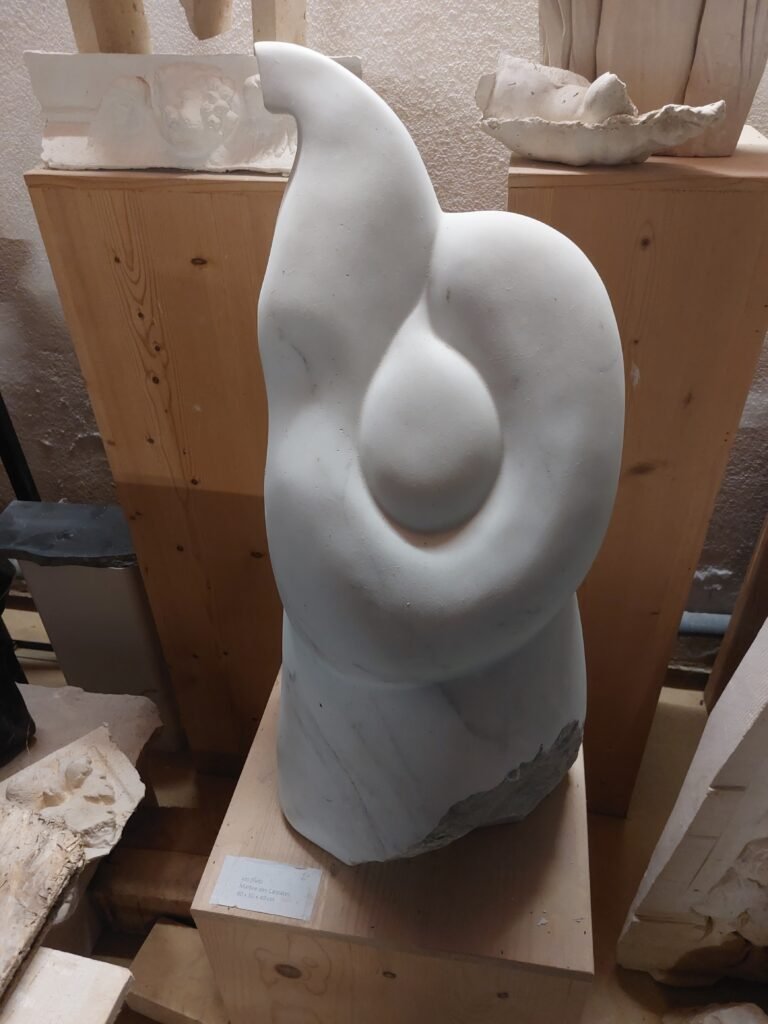
White marble, limestone, wood and bitumen are his chosen materials; the work combines them, takes unexpected forms, and brings mineral, vegetal and organic into a single accord. He tends to leave the tool marks visible, letting the surface record the hand that made it, and his titles reach for continuity rather than a fixed image. One earlier piece he described as an idea of flight and of the infinity of ideas at the origin of any work, a form of elevation above a terrestrial world that catches at us and holds us in. “Matter,” he says, “must be known as well as you try to know yourself.” Les Fruits belongs to that logic: not the depiction of a fruit but the condition of fruiting: mass gathered, surface closed, something waiting inside.
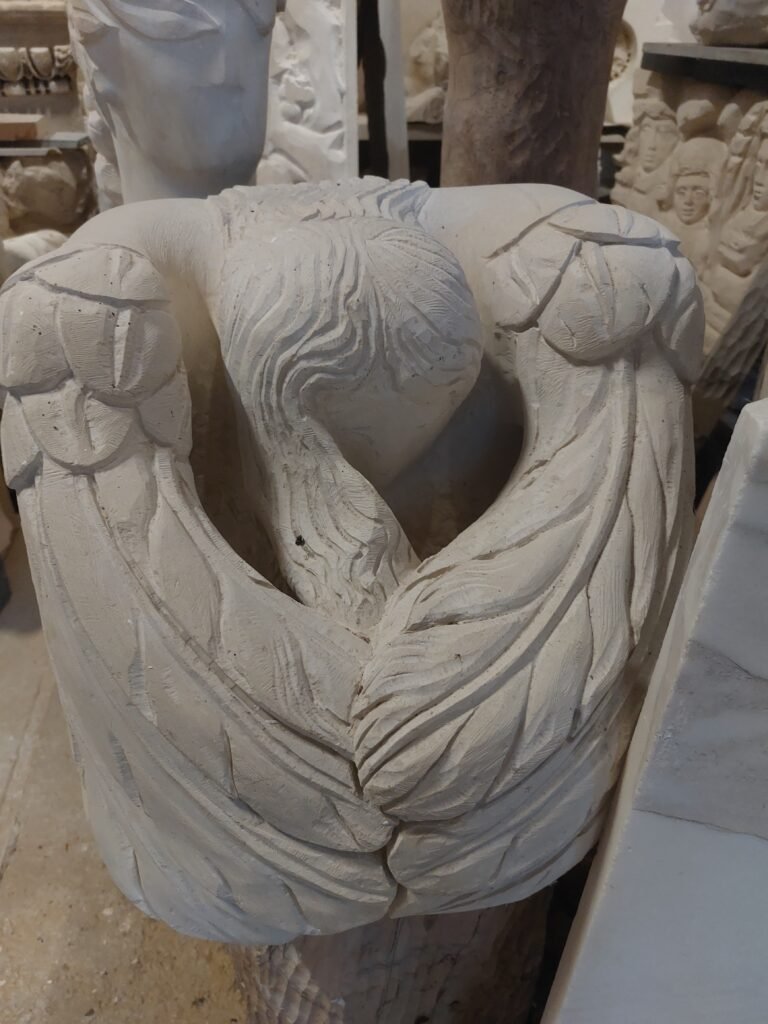
A shy angel hidden behind its wings
That is all I managed to understand about life: how to transform myself by transforming stone. How to put frustration, shortcomings, fear into stone, and have it answer me back with a longing for transcendence.
He remembered how the young woman had wondered how such a clear thought could have come from such a troubled mind. The young woman asked him many questions he didn’t quite know how to answer. As if she thought in other concepts or other terms.
“If I had been a writer I would have had better words to describe my works, but I am a sculptor. I say what I have to say through stone.”
As for myself, they hinted to my still crude understanding of people. Maybe it is so, youthful eyes, regard everything as new. Maybe this is the only chance of the world to renew itself.
Need advice with a France by bike trip?
If you want a personalised bicycle trip, let us guide you with our personality-based travel planning. It will help you find the right route for your bike trip. Whether you want slow travel through the villages of Burgundy, cycling past vineyards and Romanesque stone, visiting beautiful towns like Vézelay, or finding artists’ ateliers and non-touristy things to do outside Paris, your journey can be shaped around who you are. You can make a plan that leaves space for the unexpected. From prehistoric cave paintings to chance meetings with artists in their ateliers, Burgundy rewards a slow pace and an open mind.
TLDR
TL;DR: This is a slow travel journey through Burgundy by bike, one of the best places to visit in France outside of Paris. Starting with what to do in Dijon ( the Owl’s Trail, and Central Asian dances), the route follows the Yonne through French villages and hidden gems: prehistoric cave paintings in Arcy-sur-Cure, hammock sleeping by the river, and one of the most beautiful towns in France, Vézelay, during its Father’s Day pilgrimage. The heart of the story is an unexpected encounter—meeting the artists Viorel and Maria, a Romanian marble sculptor and painter, and visiting their art ateliers full of statues. It closes with an imaginative meditation on the subjective experience of sculpting. A guide to non-touristy things to do in France, blending a travel guide to Burgundy with its hidden artistic gems.
More about France: see all our France travel guides and stories.