The Most Densely Populated Island in the World, right? If you had asked me where the most densely populated island in the world was, I would’ve guessed India, maybe China—somewhere known for impossible crowds and megacities stretching beyond the horizon. But no. It’s here, tucked quietly into the Caribbean Sea, off the coast of Colombia.
It felt almost absurd. The idea of that kind of human density—more than a thousand people squeezed into 1 hectare—in the middle of a tropical postcard. I knew instantly: I had to see it. It wasn’t curiosity. It was compulsion. How could something so extreme be sitting so quietly just off the tourist path? And so the plan was set. A little salt, a lot of sun, and a visit to the mysterious island: Santa Cruz del Islote.
I wasn’t exactly looking for comfort—I just didn’t expect it to be this hard to find. The journey from Cartagena de Indias to the Archipelago of San Bernardo is long, hot, and wet in all the wrong ways. But somewhere beyond the horizon, among a constellation of tiny Caribbean islands – Archipelago San Bernardo,, was a place I couldn’t stop thinking about: Santa Cruz del Islote, the most densely populated island in the world.
Three hours by speedboat might not sound like much—until you’re actually in it. The sea between Cartagena and the Archipelago San Bernardo isn’t particularly gentle. There’s no shade. No snacks. Just salt, sun, and the occasional existential thought. But I held on, chasing a place my curiosity only whispered about: Santa Cruz del Islote, the most densely populated island in the world.
What I found was… a lot. Houses layered like bricks in a Jenga tower. Kids everywhere. Roosters. Concrete. Life packed tighter than I thought possible. The heat and the smell made me think more of India—alive, overwhelming, and unapologetic. It was both fascinating and claustrophobic, beautiful and uncomfortable. But that’s only part of the story. Because beyond the noise, beyond the crush of bodies and buildings, something unexpected happened in my interior universe.
Towards San Bernardo: Waves, Wind, and a Salsa-Dancing Captain
We left at the crack of dawn. I had already been in Cartagena de Indias for a few days—my second time in the city—so I knew my way around. Reaching the port was just a formality. I’d booked this trip to the Archipelago of San Bernardo through a local company I trust, and the price was surprisingly low considering the distance we had to cover by boat—around 30 to 40 U.S. dollars, paid in Colombian pesos.
At the small tourist port, a group of about 15 to 20 of us gathered—mostly Colombian travelers—and we climbed into a small, fast boat that looked more ready for a lake than the open sea. Our captain, somehow wide awake and dancing before sunrise, greeted us with loud salsa music and the kind of cheerfulness that either lifts your spirits or makes you deeply suspicious. He was clearly in his element—smiling, bobbing to the rhythm, shouting jokes over the motor, as if we weren’t about to be flung across open sea for hours.
What followed was nearly three hours of not-so-smooth sailing toward the Archipelago of San Bernardo. The wind was strong, the sea was loud, and the boat seemed to bounce more than it floated. Slowly, the imposing skyline of Cartagena’s Bocagrande district—those tall, shiny towers—shrunk behind us, swallowed by the horizon and replaced by nothing but blue. Blue sky, blue water, and the unknown.
The San Bernardo Archipelago: A Hidden Tropical Paradise
After a few hours of being tossed around like luggage in a speedboat, we made our first stop: Isla Palma. One of the larger islands in the Archipelago of San Bernardo, it’s home to a kind of rustic resort—nothing flashy, but with a beautiful beach and just enough structure to feel semi-civilized.
Most of the passengers got off here, ready to spend a few days in this quiet corner of the Caribbean. I stayed just long enough to crack open a cold beer, feel solid ground under my feet again, and sink into a shady lounge chair.
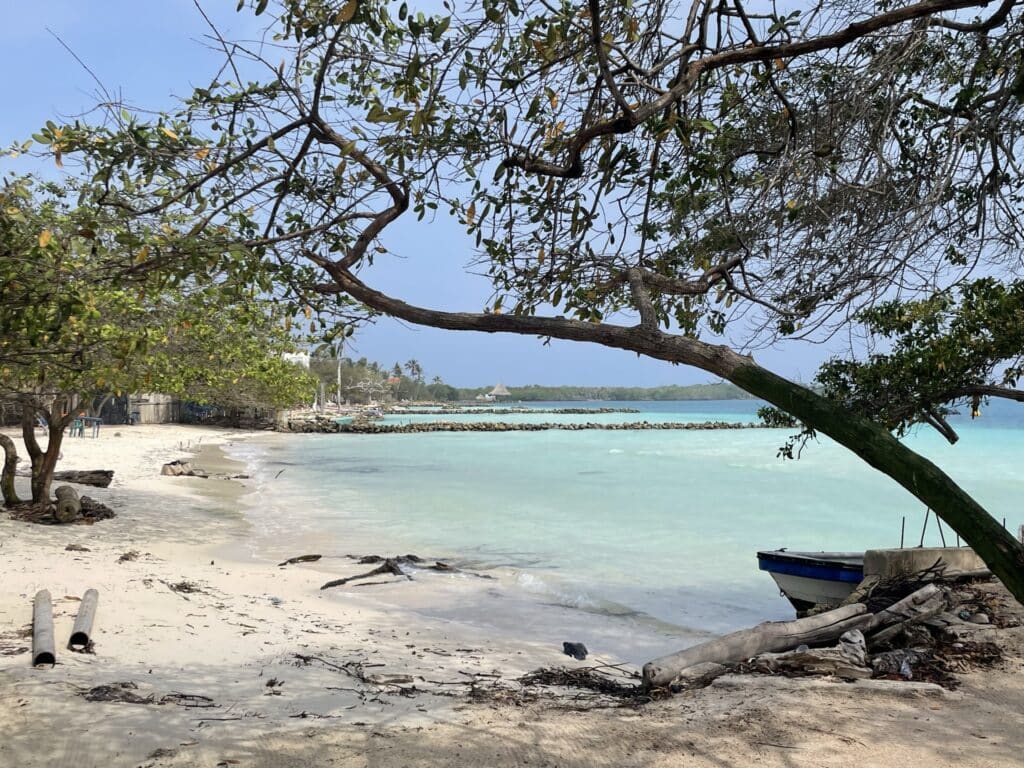
The beach was lovely—white sand, clear water, and a laid-back calm that felt almost untouched. The setup was simple, modest, and refreshingly free of excess. No extravagance, no all-inclusive buffet chaos. Just the basics, done right. A tropical escape that hadn’t yet been swallowed by mass tourism.
Soft Latin music played in the background, the hotel staff laughed and moved slowly, with the kind of ease that only comes from living in constant heat. Two lonely, sunburned trees stood guard over a supply boat, trying their best to shade it from the 40-degree Celsius inferno—so it wouldn’t turn from a delivery vessel into a boiling pot of tropical stew.
My brief moment of rest was coming to an end—slowly but surely—and the journey had to continue. The plan for the day was ambitious: visit Santa Cruz del Islote, the most densely populated island in the world, then have lunch and a swim in the turquoise waters of a private island.
Now, when you hear “private island,” your mind probably goes straight to billionaires and royals, champagne on the beach, and helicopters waiting nearby. I’ll admit, that idea made me a little uneasy at first—it didn’t exactly sound like my scene. But after my stop on Isla Palma, I started to get a better sense of the kind of “luxury” this trip had to offer. And funnily enough, it turned out to be exactly my scene.
The speedboat that had delivered us to this point—while not exactly new or graceful—had one big thing going for it: a tarp roof that offered at least some protection from the merciless sun. And when I say merciless, I mean it. The day I went, even locals were sweating like it was a punishment. Around 42°C at noon, with over 80% humidity. Think sauna, but outdoors, and with no escape.
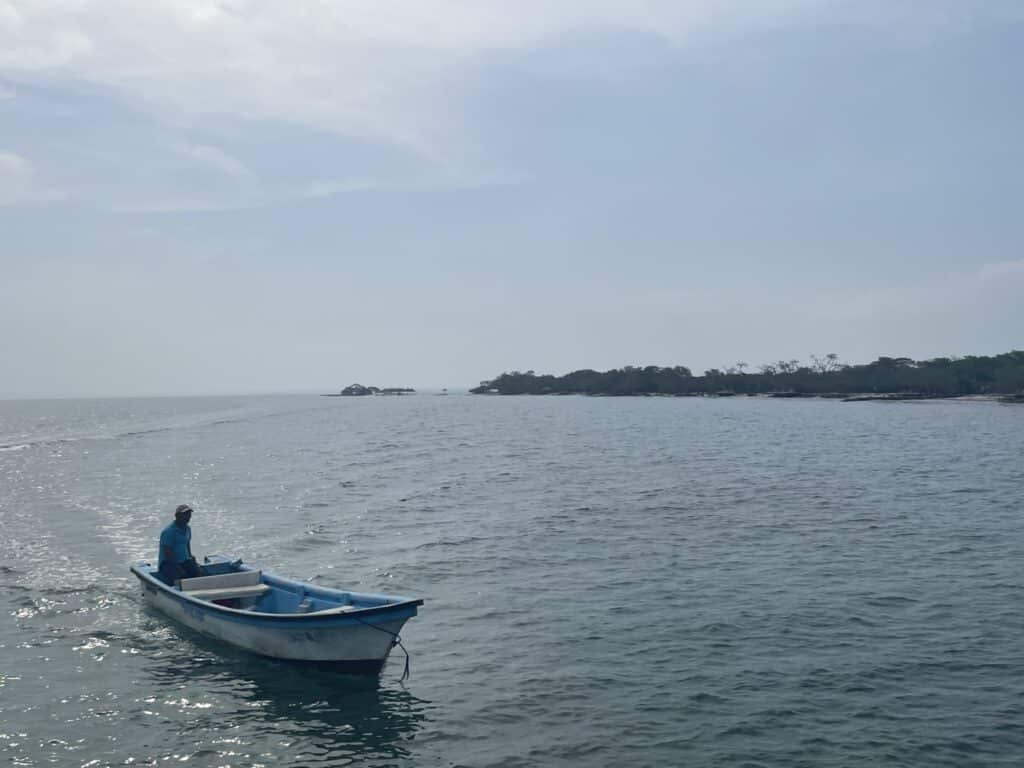
I quickly realized the speedboat wasn’t coming back. And so we greeted our next mode of transport with a mix of enthusiasm and mild panic: a tiny fishing boat, the kind that looks like it’s more used to hauling nets than carrying tourists. There were six of us, crammed in tight. The captain—an actual fisherman who had just wrapped up his morning catch—pulled up to the pier and began clearing out buckets, fish, and equipment to make space for us.
Once his cargo was safely dropped off at the resort, he motioned us aboard. We were headed—slowly, humbly, and a little too closely—to one of the most surreal destinations in the Caribbean: Santa Cruz del Islote, the most densely populated island in the world.
The Most Densely Populated Island in the World: Santa Cruz del Islote
We’d been drifting for about 15 minutes in that tiny fishing boat, winding our way between the tiny Colombian islands scattered across the sea. It was midday, and the sun was—no exaggeration—unbearable. The last weather check had shown over 41°C, and it felt every degree of it. There was no land in sight anymore—just endless blue—and ironically, though I was in the middle of the ocean, a strange, claustrophobic panic started to creep in.
All I could think about was: What happens if this little boat gives up on us right here? It didn’t exactly scream “open-sea-worthy.” We were bobbing in open water, in over 40-degree heat, no cell signal, no shade, no drinking water. I was already mentally preparing for survival mode. And then, as if summoned by the Laws of Murphy, the engine gave out. I didn’t panic. I didn’t even flinch. I’d already lived this moment in my head. My palms had toughened into imaginary oars. I was ready to row if needed.
Luckily, the fisherman was a professional. He tinkered with the motor for less than ten minutes—cool, calm, and entirely unbothered—then gave us the nod. We were back in motion. About twenty minutes later, something odd began to appear on the horizon: a strange shape, like a smudge on the sea. A tiny scrap of land, seemingly tossed carelessly into the middle of the Caribbean. It looked like an anomaly, a glitch in the landscape—a sliver of concrete and tin, rising out of nowhere, ringed by what looked like a shield of floating debris.
We were almost there: Santa Cruz del Islote, the most densely populated island in the world. It was surreal. Like someone had taken a favela from Rio de Janeiro, shrunk it down, and dropped it smack in the middle of the ocean.
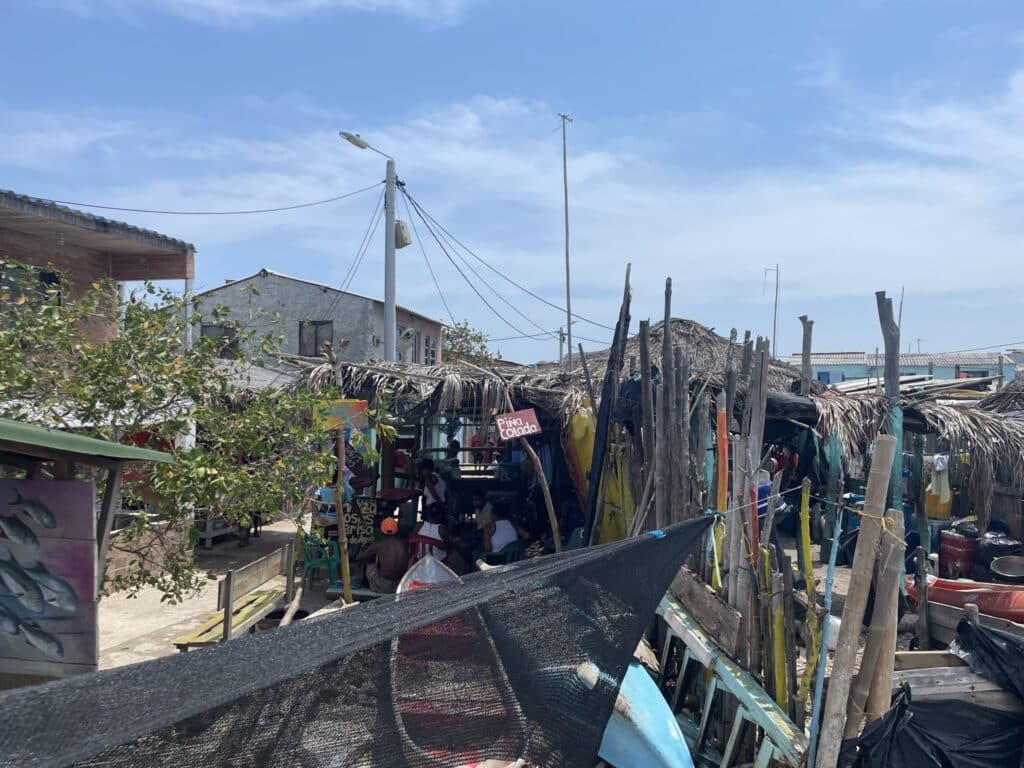
We approached the small wooden dock, gently bobbing with the waves, and stepped off the boat beside a tiny, welcoming bar. Built from uneven planks and topped with a roof of dried palm leaves, it had a handmade charm—simple, but full of character. Locals gathered under its shade, sharing music and conversation in a calm, friendly atmosphere that immediately set the tone of the island: community-first, warm, and unhurried.
But what I noticed first wasn’t the bar—it was the strong smell that hung in the air. With so many people living in such a small space, and the midday sun pressing down at over 40°C, the scent of life—waste, sea, heat—was hard to ignore. It was intense, and it stayed with you. I’m not sure if this is always the case, but at that moment, it felt like a challenge to the senses.
Our group was welcomed right away by a smiling man who radiated friendliness. He introduced himself as Señor Gusto, the island’s guide. Shorter in height, solidly built, and with a few visible physical disabilities, he carried himself with quiet confidence and pride. He seemed genuinely happy to share his home with visitors.
He first brought us to the island’s aquarium—a small, handmade pool where a few species of local marine life are kept: stingrays, small sharks, and colorful fish. Visitors can even swim with them for a small fee. I chose not to join in—not out of fear, but because I wasn’t sure about the cleanliness of the water. Maybe I was being cautious, but the heat and scent had made me more sensitive to these things.
From there, we began our walking tour of the island, which measures around 200 meters in length and 100 in width. And yet, those few square meters are home to a thriving, tightly knit community.
The narrow pathways were alive with energy. Children played soccer in every open space. Women chatted or did laundry near their homes. In one corner, a group of men shared a bottle of rum and laughed over music playing from a speaker. Despite the crowded conditions and the challenging climate, life here moved with rhythm and resilience.
Santa Cruz del Islote isn’t a place filled with typical tourist attractions. It’s home. You’ll find colorful murals, a small church, a school, a shop, and a large water tank—crucial, because freshwater must be delivered by boat from nearby Isla Tintipán. There’s not a lot of space, but there’s a whole world of daily life unfolding here, rich with dignity, creativity, and community spirit.
Tales from the tiny Caribbean islands
Mr. Gusto had more than a few stories to tell. As we wandered the narrow paths of Santa Cruz del Islote, the most densely populated island in the world, he began painting a broader picture of the Archipelago of San Bernardo—a constellation of tiny Caribbean islands, some inhabited, others left to the birds and the sea. Located among the Colombian islands near Cartagena, this archipelago has long depended on one thing for survival: fishing.
That’s when he told us how he lost his hands—not in a shark accident, as my imagination first jumped to, but in a fishing mishap. When he was just ten years old, he went out to sea with his father. They were fishing with dynamite, and it exploded in his hands. Yes, dynamite. At ten years old. As surreal as that sounds, it’s not the only adrenaline-fueled activity on the island. He also mentioned the controversial, and technically illegal, cockfighting matches held here. With few alternatives for entertainment, this tradition has persisted, though it’s not without its critics.
But what truly stayed with me was the story of the island itself. Santa Cruz del Islote didn’t exist in its current form until the 1860s. Originally, it was just a sliver of land—a safe haven where fishermen from nearby tiny Caribbean islands could take shelter during storms, protected by a coral reef. Over time, they began to expand the island, adding everything they could find: coconut husks, logs, seashells, debris, and yes, even garbage. It’s a partially artificial island, born of necessity and persistence.
Back then, it didn’t even have a name. But legend has it that a wooden cross washed ashore one day, and from that moment, it became known as Santa Cruz del Islote. Over the decades, some residents moved to nearby islands like Tintipán and Múcura, while others stayed, slowly building a tight-knit, overgrown village on the sea. Today, the island has a school (which even children from other Colombian islands near Cartagena attend), a local council formed in 2013, and since 2020, access to the internet.
I wouldn’t call it the most beautiful place I’ve ever visited. But it’s certainly one of the most extraordinary, a place with a soul, a history, and a rhythm all its own.
I, too, once fished with dynamite…
Every time I longed for something, I wanted more, wanted it easier, faster. Instead of being a better fisherman. I dreamed of blowing the sea wide open.
One day, the thought came to me— “Why not fish with dynamite?”
Lucky me, it blew up in my hands— before it could shatter the reef, that silent wall holding back the deadly waves, the only thing standing between me and disaster.
Luxury through simplicity in Archipelago of San Bernardo
We left Santa Cruz del Islote the same way we came—rocking gently in the small fisherman’s boat, its wooden frame creaking as it cut through the water. As the island faded behind us, I turned for one last look. From a distance, it looked like a floating village stitched together from stories and cement, clinging to the sea like it refused to be forgotten.
Just as we drifted away, I noticed the fisherman pull something from a net with practiced ease: a large, bright-red lobster, still writhing. I asked how much. “50 000 pesos” he said, with a shrug. Around 12 dollars for the freshest seafood imaginable—less a transaction, more a passing of good fortune between strangers.
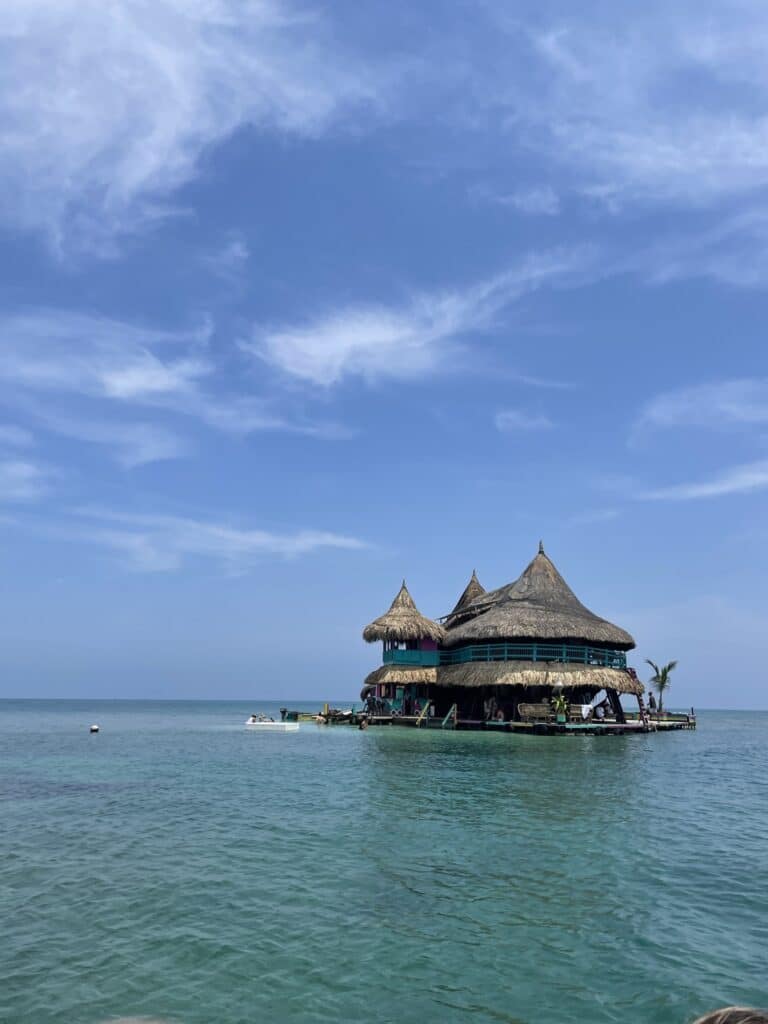
We weren’t headed back to the mainland just yet. Our next stop was what the locals called a “private island”—a phrase that sounds like luxury, but here simply means quieter, emptier, untouched. On the way, we passed a scatter of floating houses and makeshift bars resting gently on the water. They looked like dreams suspended between sky and sea—shacks on stilts painted in faded blues and yellows, pulsing with slow music and slow life. I couldn’t stop staring. It was all so simple, so barebones—and so beautiful.
When we docked, the island revealed itself for what it was: a quiet stretch of sand, hammocks swinging lazily between palms, and a small outdoor kitchen tucked under a thatched roof. It wasn’t much, but it didn’t need to be. The sea did the rest.
The fishermen got to work right away. In that humble kitchen, they grilled the lobster over open flames, serving it with rice and crispy patacones—slices of fried plantain, golden and salty. I ate with my hands, sitting barefoot at a plastic table in the shade, the ocean breeze cutting through the midday heat.
That meal wasn’t fancy, but it was unforgettable. The lobster was smoky and sweet, the rice fluffy, the patacones crunchy and perfect. Everything tasted like the day itself—wild, warm, and generous in ways I didn’t expect.
The Long Ride Home (and a Bit of Salt in the Wounds)
The return to Cartagena was… something else. If the way out had been rough, the way back was a battle. This time, we were riding against the waves—three solid hours of white-knuckle grip, trying not to be tossed into the Caribbean. The sea, once playful and warm, had turned into a relentless force, slapping the boat with every surge like it had something personal against us.
By the time we reached the coast, my arms felt like they’d wrestled Poseidon himself. Two days later, I still had muscular fever. It hurt to lift my backpack, to hold a cup of coffee—hell, it hurt to breathe too deeply. My body had taken the brunt of the ocean’s mood, and it wasn’t shy about reminding me.
As if the ride wasn’t enough of an experience, there was also the Venezuelan guy on board. You know the type—shirt unbuttoned, sunglasses even in the shade, and a deep need to be heard. “Déjame que te lo explico, papi,” he kept saying, trying to lecture the rest of us on how to relax so we wouldn’t feel the pain. Then he promptly lost his balance on a wave and nearly flew overboard. The irony didn’t go unnoticed, though we all pretended to care deeply for a moment or two. Still, the chaos and discomfort of the journey didn’t erase what came before.
The Archipelago of San Bernardo, the tiny Caribbean islands near Cartagena, the strange wonder of Santa Cruz del Islote—the most densely populated island in the world—they left a mark. Not just on my skin, sunburned and salted, but deeper.
Conclusion
If you’ve made it this far through my story, thank you. And if this place sparked something in you—curiosity, a craving, a question—know that I’m happy to help. You can check out more of mytravel articles, reach out if you’re planning a similar trip yourself, or justfollow along on Instagram for more stories, scenes, and surprises from places like this.
Sometimes the best parts of the world are the hardest to reach. But trust me—they’re always worth the ride.
A Cheap Workation in Northern Greece: Exploring Off the Beaten Path Destinations
It’s quite strange how, in a world obsessed with “the biggest,” “the most beautiful,” “the most expensive,” and basically “the most everything,” there’s still a place of immense significance that remains almost untouched by most people. I’m talking, of course, about the highest mountains in Europe—the mighty Caucasus.
In the winter of 2024, during my trip to Georgia, I decided to timidly dip my toes into exploring these colossal peaks. I started with a short visit to Kazbegi, where I got a glimpse of their sheer grandeur. But what truly captured my imagination was Svaneti—a land far more remote, far less known. One of the hidden gems in Europe, fiercely guarded by the Caucasus Mountains, where time itself seems to slow down, protecting a small but extraordinary ethnic group—the Svans. With their own language, traditions, and way of life, they have remained remarkably untouched by the outside world.
My curiosity burned like a winter fire, but getting there—especially in January—was no smooth ride. The journey was an adventure in itself, filled with unexpected twists, turns, and a fair share of challenges. In this article, I’ll share my brief but unforgettable experience in Mestia, the heart of Svaneti, and the wild road that led me there. Buckle up—it’s going to be a bumpy ride!
LOST IN the Highest Mountains in Europe: A good story starts with a good pie and a rifle
I had been driving on Georgia’s far-from-perfect roads for quite some time, leaving behind me the last villages and the last soviet remains, being fully aware that the real challenge was about to begin—a grueling 130-kilometer stretch through the highest mountains in Europe to reach Mestia, the heart of Svaneti. I was in a bit of a hurry, knowing the road would be tough, daylight was short, and driving at night was absolutely out of the question.
Still, my stomach had its own plans. I needed a break—some rest, a quick bite—so I stopped at what the map claimed was the last roadside stop (and indeed, it was the last one). A tiny wooden hut, standing precariously on the edge of a curve, nestled deep in the mountains. There, they sold Georgia’s legendary khachapuri, a pastry overflowing with rich, local cheese—the kind that melts your worries away.
Behind the counter stood a young woman, probably in her early twenties, dressed simply but with an expression that quickly shifted from neutral to deeply confused as she realized I spoke neither Svan nor Georgian. For a brief moment, we just stared at each other—me, hungry; her, puzzled. Then, like a lightbulb flickering on, she figured it out: if I had stopped there, of course, I wanted exactly what everyone else did—a hot drink and a warm, cheesy pie. With the help of some dramatic hand gestures and an intense game of charades, I finally got my hands on the much-desired khachapuri. And it was divine.
As I sat inside the tiny cabin, savoring every bite, something outside caught my eye—something equal parts hilarious and mildly alarming. A group of men, clearly locals, were gathered right in the middle of the icy road, playing with a shotgun. Their flushed faces and swaying movements gave away their intoxication, but what truly sealed the deal was their choice of entertainment: making snowballs, tossing them into the air, and trying to shoot them mid-flight. There they were—wobbling, tipsy, waving around a loaded shotgun—on a frozen mountain road, right in a curve. What could possibly go wrong?
From my experience, people engage in dangerous activities for one of two reasons:
They are completely unaware of the risk (which seemed unlikely, as no one from the roadside stop was running out to stop them).
They live with constantdanger, to the point where things that seem insane to the rest of us feel perfectly normal to them.
That last thought sat uneasily with me as I got back in my car, ready to continue my journey.
I knew driving through the highest mountains in Europe in January would be tough—but I hadn’t expected it to turn into an extreme driving experience.
LOST IN the Highest Mountains in Europe: A portal to a mystical land
I have to admit, the road to Mestia, Georgia can be summed up in just two words: exhausting and nerve-wracking. Over 100 kilometers of endless switchbacks, winding through dark valleys and towering mountains, on a road that looked like it had survived a bombing raid. And in a way, it had—only the bombardment here was entirely natural, caused by landslides and avalanches. These are the obstacles that putting out of sight one of the hidden gems in Europe.
In many places, the remnants of what once was asphalt were more of a hindrance than a help—more craters than road, really. Luckily, my high-clearance 4×4 allowed me to crawl along at a daring 20, sometimes even 30 km/h. For about three, maybe three and a half hours, I drove through the same haunting scenery—a sheer rock face on the left, a dizzying abyss on the right, endless switchbacks, and a game of “choose the smallest crater” to keep things interesting. So far, not such an extreme winter driving experience.
But what made the drive truly unsettling was the mountain itself, which—with infuriating consistency—sent down hundreds, sometimes thousands, of small rocks tumbling onto the road. Sometimes they were harmless little pebbles, but other times, they grew into ominously large stones, dropping just 5–10 meters in front of me, forcing me to exhale in relief every single time they didn’t land on my car.
Every now and then, the road would tease me with a stretch of “good asphalt” (a term that, after this journey, had become extremely relative). Just as I’d allow myself to speed up a little, I’d be slammed back into reality—forced to brake hard as yet another crater field appeared, as if the aftermath of a meteor shower had just materialized in front of me.
And then, the real surprise. On one of these rare “clean” sections, I pressed the gas a bit more confidently. Coming out of a curve, I suddenly discovered my lane was gone. No signs, no warnings—justa void where the road should have been. A massive chunk had simply collapsed into nothingness, forcing me to yank the steering wheel hard to the left. Luck was on my side—no one was coming from the opposite direction.
This delightful near-death experience happened just past the halfway point. And weirdly enough, it was exactly the adrenaline injection I needed to power through the rest of the journey.
Then, suddenly, it felt like I had emerged from an endless tunnel of cliffs, abyss, and despair into a world that finally opened up. A small clearing appeared, and with it—the first house I had seen in what felt like an eternity. The first sign of human life after 100 kilometers of untamed wilderness.
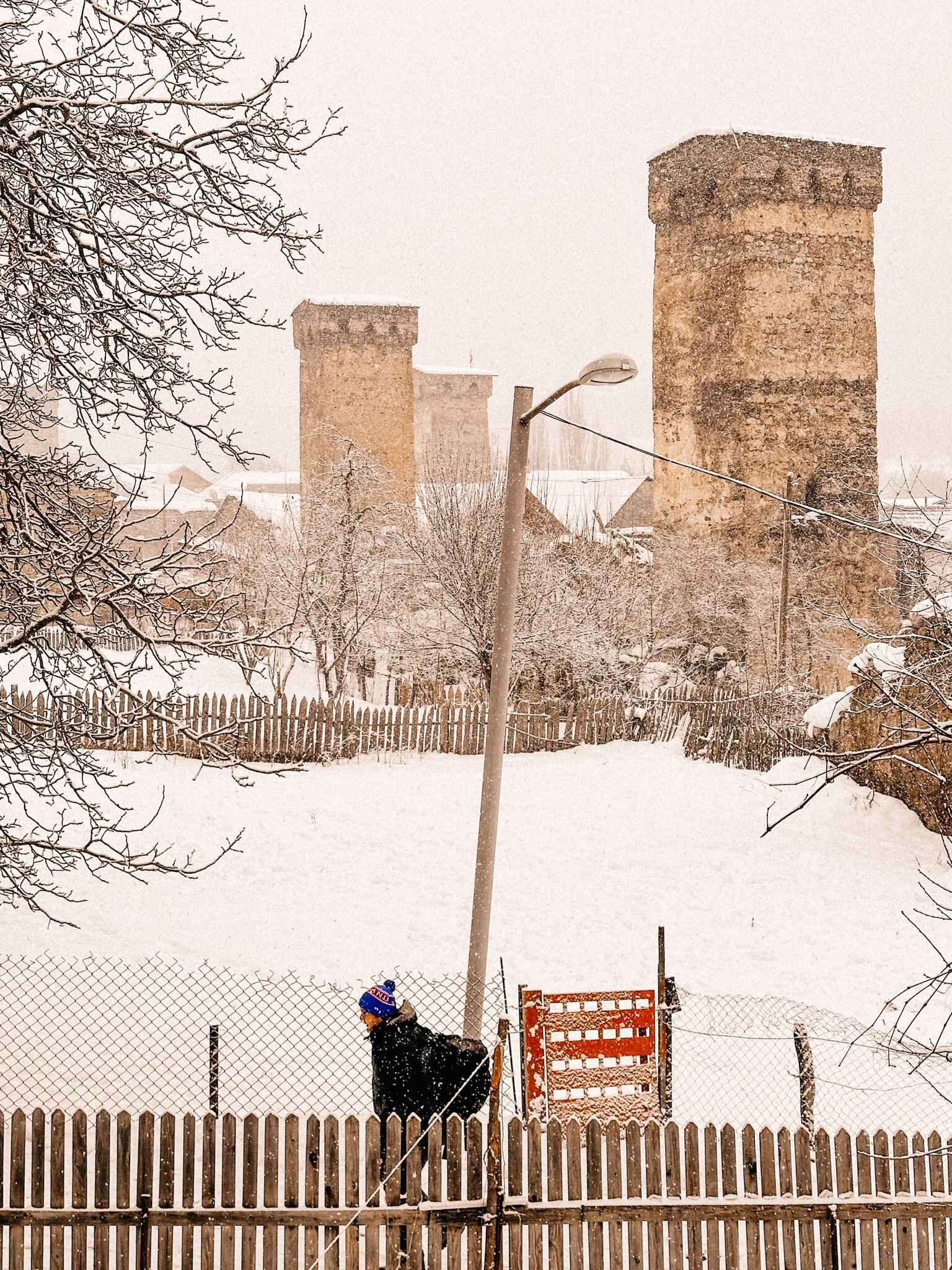
And then, as if on cue, the snow began to fall. Not a blizzard, not a violent storm—just a soft, gentle snowfall. Large, lazy flakes drifted down, almost like a holy water blessing, washing away my tension, my stress, my anxiety. It felt like a divine sign whispering, You made it. You’re safe now. At that moment, in the distance, I saw them—dozens of ancient stone towers rising against the snowy landscape, announcing my arrival in MestiaGeorgia. The majestic Svan Towers.
That moment—the peaceful snowfall wrapping around the legendary Svan towers—is forever burned into my memory. I felt as light as the falling snowflakes, as happy as a child on Christmas Eve, and as proud as a mountaineer reaching the summit. I had conquered this monstrous road. I had passed through a twisted, merciless portal of stress, chaos, and anxiety. I had suffered enough, and in return, I had been transported into a breathtaking winter painting, straight out of Monet’s imagination.
I had endured. And now, I could finally enjoy my reward. Or at least, that’s what I thought…
They say heaven hides in the skies, But it’s more hidden where our feet lie. One heaven shines in joy and grace, Another’s cloaked in dark disgrace. One heaven lives within me, too, And another’s found in the heart of you.
Yet from one heaven to another, a tunnel we must tread, A tunnel through the moon, the sun, and Saturn’s thread. A tunnel built from Mars to skies so vast, A purifying road to cleanse the past.
Wherever, whenever, heaven may be, It greets you at the door, and sets you free. It washes your feet, your hands, your mind, Your thoughts, your dreams, leaving none behind.
LOST IN the Highest Mountains in Europe: The Svan Towers of Mestia Georgia
Arriving in Mestia during the winter felt like stepping into a dream. The snow fell gently, blanketing the town in a soft, ethereal glow, creating a landscape that seemed pulled from a fairytale.
I stayed in a cozy guesthouse run by a warm and welcoming family, and the memory of the elderly grandmother remains etched in my mind. I can still see her, with practiced hands, adding logs to the old Soviet wood stove, battling the bitter cold as the fire crackled to life. As I set out to explore the town, the atmosphere was nothing short of magical. The snow, the iconic Svan towers rising proudly against the white landscape, and the only sound breaking the stillness was the distant bells of cows echoing through the crisp air.
Talking a bit about this place, Mestia is the heart of Svaneti, a remote and ancient region nestled in the towering Caucasus Mountains, known for its rugged beauty and unique culture. The Svan people, a subgroup of Georgians, have lived here for centuries, preserving their distinct language, customs, and traditions.
The Svaneti region is also home to the Svan towers, striking defensive structures that date back to the 9th century. These towers were once used by families to protect themselves from invaders and the harsh mountain elements. Made of stone and towering above the landscape, they have stood as silent witnesses to centuries of history, from medieval wars to more recent challenges of isolation. Entering one of these ancient towers, I could feel the weight of the past in every creaking floorboard and weathered stone.
The Svan people lived in near total isolation for centuries, nestled in the remote valleys of the Caucasus Mountains. Surrounded by towering peaks, their lives remained untouched by the outside world until the last century. This natural barrier kept them safe and allowed their unique language, customs, and traditions to thrive without external interference.
However, while they may have lived in solitude, their lives weren’t exactly the peaceful, idyllic existence you might imagine. The famous Svan towers, which still stand proudly today, were not just for show—they were designed as fortifications to protect families during the numerous vendettas that often flared up between them. So, even though the Svan people lived in their own little world, it wasn’t exactly a “happy, peaceful paradise.”
Rather than sipping tea and singing around the fire, they were more likely to be defending their honor or family name, with a few heated arguments thrown in. It turns out that even when you live without outside interference, you still find ways to keep things interesting—just ask any of the Svan families with a tower!
Going forward in our current days, being a town in the highest mountains in Europe has its own perks. Mestia is highly appreciated by the locals as a prime destination for skiing, especially during the winter months. The region’s mountainous terrain offers excellent slopes, attracting both beginners and experienced skiers alike.
However, when summer arrives, the focus shifts to hiking, as the region becomes a paradise for outdoor enthusiasts. With its breathtaking views, lush greenery, and well-marked trails, Mestia is an ideal location for trekking and exploring the stunning natural beauty of the Caucasus mountains. The locals take pride in the diversity of activities their town offers throughout the year. In any case, if you are interested to read more about this place from a touristic perspective you can check this travel guide or this CNN article.
The sense of history and timelessness was overwhelming as I walked through the snow-covered streets. However, as I explored, the weather began to shift. What had started as a gentle snowfall soon escalated into a full-blown snowstorm. The wind howled, and the snow swirled around us, transforming the town into a white-out. The road to Mestia, already a challenge with its narrow and winding paths, became nearly invisible beneath the relentless storm.
Would the road even be passable when I left? The thought lingered, unanswered, as the blizzard raged on, and I realized that the mountains were not just a backdrop to this place—they were its fierce protector, and I was at their mercy.
LOST IN the Highest Mountains in Europe: Extreme driving experience
The morning had come, and the snowstorm had been raging nonstop for over 24 hours. I drove to the city center, where I patiently waited in a parking lot for the weather to improve so I could continue my journey. I enjoyed a Georgian pie, this time filled with meat, followed by one more coffee, and then another.
I moved to a different parking spot to check the car. I had something that was supposed to act as snow chains—12 plastic beads, which, placed around each tire, were supposed to increase traction. While I was checking the car, a mysterious local approached with curiosity. A tall, skinny man with a rugged face and a missing eye tried to warn me in Russian that it wasn’t safe to travel in such weather. I knew that, of course, but I had to reach Zugdidi (a town at the foot of the highest mountains in Europe) that evening. Realizing we couldn’t communicate effectively because of the language barrier, he finally left me alone.
With my “chains” on the tires, I waited for a moment when the snowfall seemed to calm down, and off I went leaving slowly the Svan towers behind. The road—absolute horror.
The journey alternated between light snow and fierce blizzards with zero visibility. The road was completely covered in snow, and I knew that parts of it had collapsed. I drove as close as I could to the rocky cliffs, where boulders and chunks of snow and ice were falling. At first, the plastic beads gave me a bit of traction, but within 30 minutes, I had lost them all. Why? Well, the soft snow had covered all the craters in the road, making them undetectable. I hit them all, and slowly, the plastic chains broke. With the loss of the chains, I also lost traction.
The road was just as bad as on the way there, but now I was the only car on it. Visibility was almost zero, the craters were invisible, and with every turn, I was losing control of the car in a horrible drift. For over 100 kilometers, it felt like I was on a sled, barely in control, with no visibility, and rocks falling from the slopes of the highest mountains in Europe. I tried to control the skids as best as I could, but honestly, I think fate and luck were the only things keeping me going. It was terrifying. By the time I reached each curve, I was laughing neurotically. It was bad. Really bad.
Just when I thought I had made it through this nightmarish road, after 3-4 hours of torture, what I had feared from the start happened—there was a giant boulder blocking the road. In front of it, the authorities were waiting for me, probably expecting me. When I saw the boulder, I slammed my head against the wheel, thinking, “What if I have to turn back to Mestia now?” Yet, by some miracle, I squeezed past it and continued forward. After passing that obstacle, I saw the authorities had closed the road. Police crews were turning all the cars around that were heading toward Mestia.
Then, the road improved slightly, becoming a little gentler, and I could see traces of asphalt again. The extreme driving experience, in January, through the Caucasus mountains was over. All that was on my mind was the magnificent pie from the famous stop I had visited on my way there.
I have also taken some shorts videos of this road, captures that you can explore on myInstagram page.
Conclusion: An Epic Georgian Finale
At the famous stop by the side of the road, there was a lively party going on. A man, along with his family, was enjoying Georgian music, dancing, and drinking. As soon as I entered, I was greeted with a glass of whiskey (which I politely declined, as I still had to drive) and invited to join the dance. The atmosphere was warm and full of joy, like a break from the harsh road outside.
But the highlight of the moment was the man at the center of the celebration. He was quite tipsy, swaying to the rhythm with an uncoordinated but enthusiastic energy. His face was flushed with the warmth of the drink, and his smile was as wide as the mountains around us. As he danced, his movements were wild, occasionally veering into an exaggerated twirl or a misstep, which only made his family laugh louder.
He was the kind of person who would suddenly grab anyone nearby, tugging them into the circle, trying to get them to join in, even though they had just walked in from a snowstorm and probably weren’t prepared for an impromptu Georgian dance. But his carefree spirit was contagious, and for a moment, all the exhaustion and tension of the road disappeared. This, I realized, was how this “mystical tunnel” of a journey ended—filled with good vibes, food, and laughter.
If you enjoyed this winter adventure and want to read more about my travels, don’t forget to comment below and read my other articles! If this icy journey through the highest mountains in Europe was a bit too chilly for your taste, check out my Amazon jungle article for some much-needed warmth and tropical vibes. And if you’re into ex-Soviet adventures, don’t miss my article on the Aral Seafor a deep dive into a fascinating and surreal landscape. Stay tuned for more adventures by following my Instagram page and feel free to contact me if you need help in crafting your own adventures.
After an exhausting train journey across Uzbekistan—stretching from the capital, Tashkent, all the way to the mesmerizing desert town of Khiva, near the Turkmenistan border—we were about to embark on the most intense and fascinating adventure of our trip: a small expedition into Karakalpakstan, the autonomous Uzbek region that cradles the ghost of a great body of water, once known as the Aral Sea lake. Or rather, what little remains of it. Worn out but still buzzing with excitement (and a touch of unease), we climbed into a car at the crack of dawn on a chilly November morning in 2024. Our mission: to reach Nukus, the capital of Karakalpakstan, where our journey to the vanishing sea would truly begin. Our driver, a stocky Uzbek man with a quiet demeanor, was waiting for us outside our guesthouse in Khiva at 5 AM. Under the cover of darkness, we set off on a three-hour drive through an eerie, barren landscape—a desert littered with Soviet era remains, from crumbling factories to rusting infrastructure, relics of a lost industrial dream. The emptiness stretched endlessly in every direction, and the silence in the car, deepened by the fact that our driver spoke only Russian, made the whole experience feel surreal, like we were slipping into another dimension. Then, just as the first golden streaks of sunlight began to break the horizon, our driver suddenly swerved to the side of the road. We tensed—what was happening? Without a word, he stepped out, unrolled his prayer mat, and knelt down, his silhouette bathed in the soft glow of dawn. A devoted Muslim, he marked the beginning of our journey with a solemn prayer, as if seeking divine guidance for our passage through this forsaken land.
Aral Sea Lake: The End, unlike the Beginning, Is Known
After a brief stop at the ruins of a Zoroastrian temple—a relic of the ancient Persian faith—we rolled into Nukus, the capital of Uzbekistan’s autonomous republic: Karakalpakstan. Now, if you’ve never heard of Karakalpakstan, don’t worry—you’re not alone. But make no mistake: the Karakalpaks are a nation unto themselves, with their own language, history, and traditions. Nukus, despite its remote location (seriously, it’s practically off the edge of the map), left me pleasantly surprised. A beautiful, clean city, with stylish people striding confidently through its streets. Billboards, cultural events, and lively cafés hinted at a place bursting with an unexpected thirst for art, literature, and music. No, the Karakalpaks are far from forgotten desert wanderers—they’re cultured, curious, and very much connected to the world. Looking at Google Maps, you’d be forgiven for thinking this entire region is just one big, empty wasteland. A vast nothingness. A desert. But in reality? This land has been walked, shaped, and ruled by countless civilizations since the dawn of time. Prehistoric tribes once called it home. The Persian Empire laid claim to it. Alexander the Great marched his armies through here. It became a crucial stop on the legendary Silk Road and, later, part of the mighty Soviet Union. Karakalpakstan has always been alive—a crossroads of ideas, culture, and history. Even today, its spirit refuses to fade, standing strong like the desert itself: vast, mysterious, and full of stories waiting to be told.
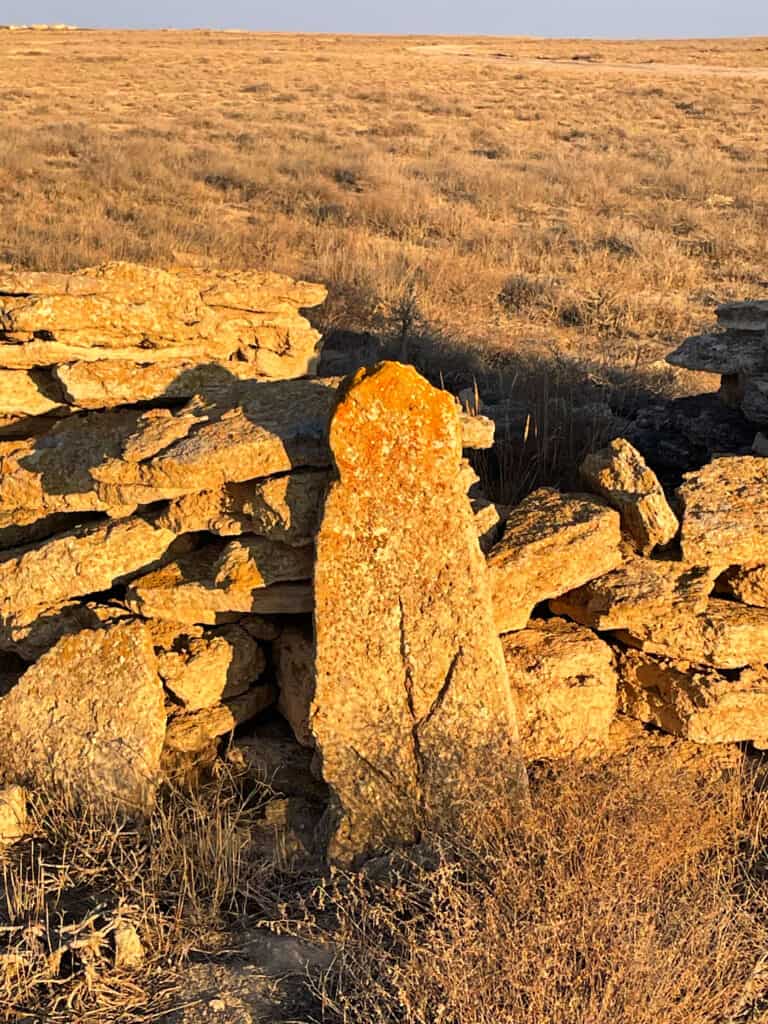
Here in Nukus, our journey to the Aral Sea Lake took an exciting turn. A Mongol-featured gentleman, driving a rugged off-road vehicle, arrived to pick us up. Communication? Well, let’s just say it was an adventure of its own. Despite being a born polyglot, fluent in Karakalpak, Uzbek, and Russian, our linguistic overlap was… minimal. So, we resorted to the universal language of gestures, confused looks, and my embarrassingly basic Russian skills. As long as we had phone signal (and the sacred power of Google Translate), we managed. But soon, we lost both. Our first stop was the Mizdakhkan Necropolis, a place as mysterious as its name. Our guide, whose name I couldn’t even attempt to pronounce, began to unravel its rich history. What looks to us today like a barren, lifeless desert was once the heart of an ancient kingdom. This was Khwarazm—or, as it appears in Persian literature, Kat. A land so ancient that even the Persians themselves had lost track of its origins. Centuries later, the Muslim rulers who inherited this territory saw ruins far older than the Persian ones. This led to an astonishing belief: somewhere in this very land lay the tomb of Adam himself. Of course, where history fades, legends thrive. To this day, some Muslims believe that Adam’s grave lies among the thousands of stones scattered across Mizdakhkan. Others dismiss this idea, but insist that his real tomb must be nearby—because where else would it be? One thing is certain: a tradition has emerged. When visiting Adam’s supposed grave, pilgrims must place one stone on top of another. Why? Because legend says that when the grave is completely destroyed, it will signal the end of the world. So, in a way, these travelers—stone by stone—are buying humanity a little more time. A few extra weeks. Maybe a few extra months. A small, quiet pilgrimage to keep the universe running just a little longer. One thing kept nagging at me. How could a place once so important, so full of life, end up like this—crumbling, deserted, almost erased from time? I asked our guide, hoping for a historical explanation. Instead, in true native Slavic-speaker fashion, he launched into a passionate monologue about corruption, neglect, politicians, and oligarchs. For decades, he said, they had bled this land dry. The people suffered, poverty grew, and nothing changed. The same old story. And sure, poverty is poverty—a tale familiar across the post-Soviet world. But that still didn’t explain the dystopian wasteland stretching endlessly around us. Was it always like this?
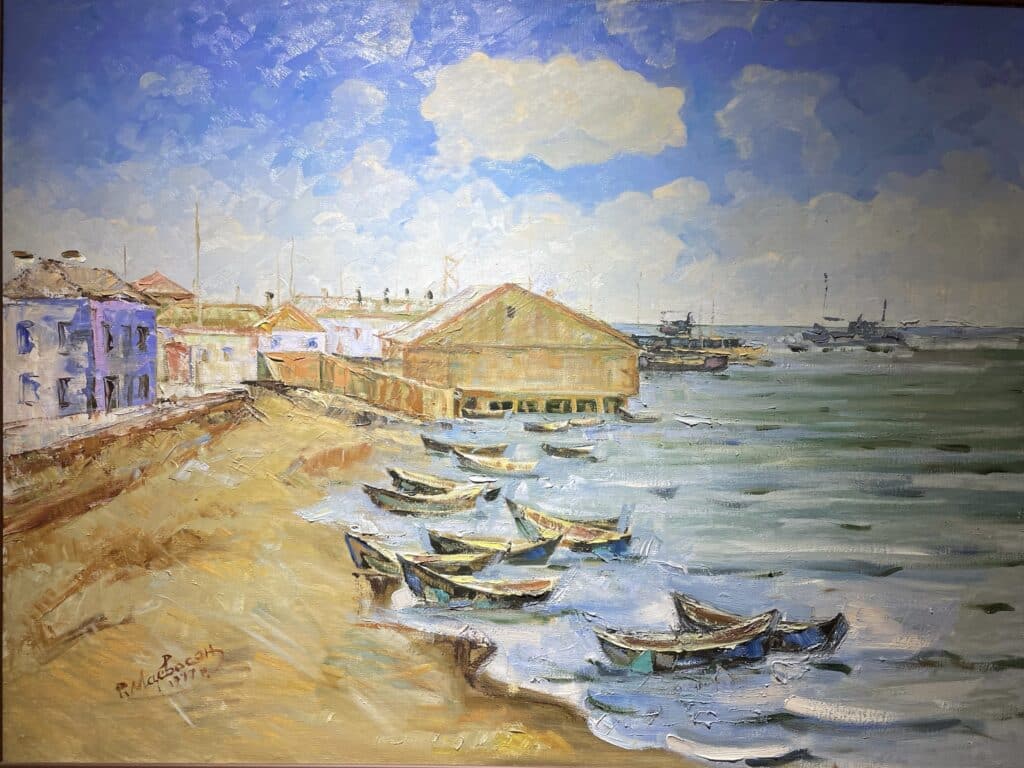
Aral Sea Before and After
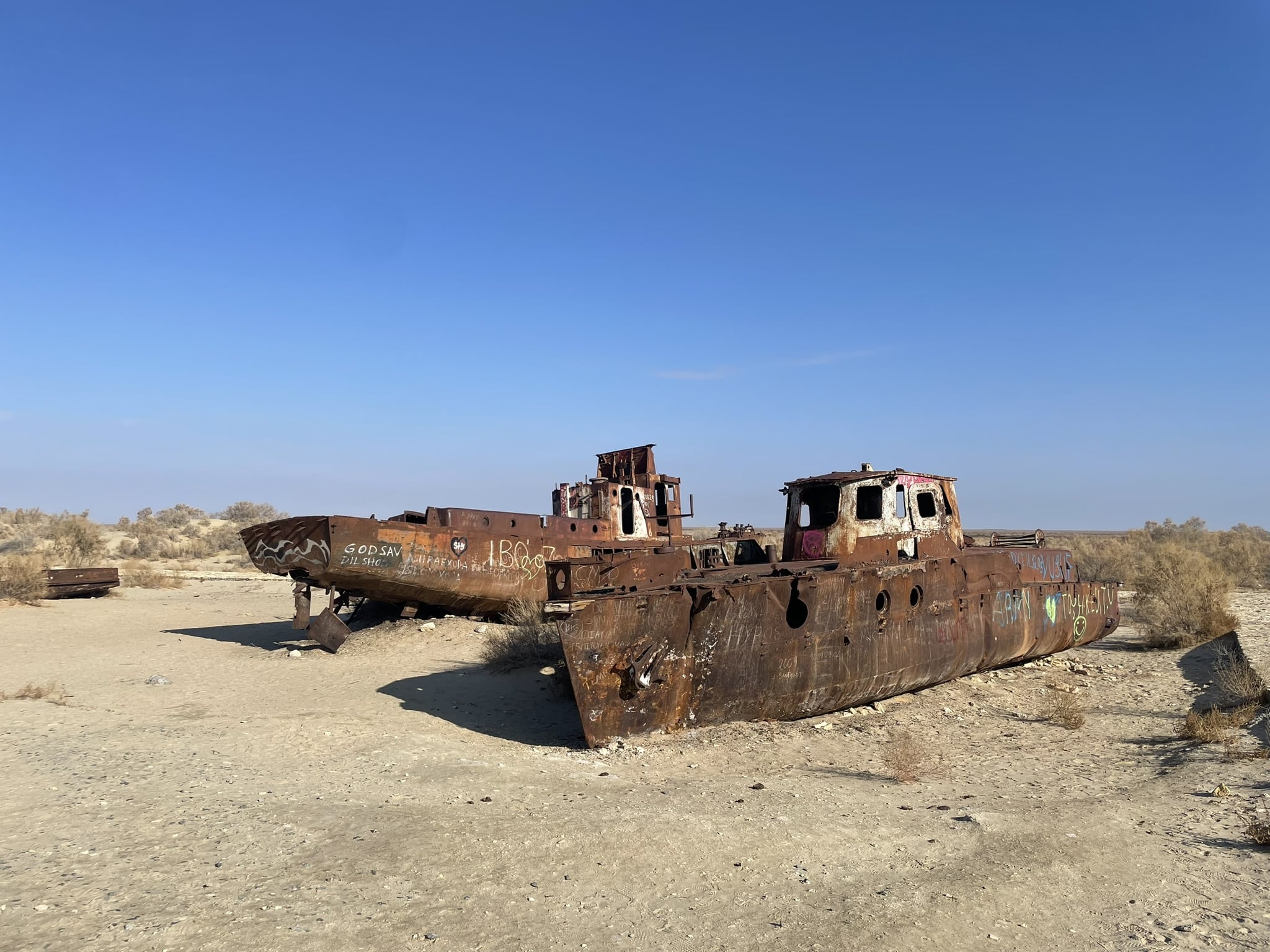
We drove on, the road stretching endlessly ahead, swallowed by a landscape of dust and silence. And then, we arrived in Moynaq. Once upon a time, Moynaq was alive—a thriving port city, bustling with fishermen, traders, and families who built their lives around the Aral Sea lake. The air smelled of salt and fresh fish, boats lined the shores, and factories hummed with industry. Caviar from Moynaq? A delicacy known far beyond these lands. But today? The sea is gone, and Moynaq stands as a ghost of itself. Instead of waves lapping at the shore, there’s cracked earth and rusting shipwrecks, stranded like giant bones of a long-dead beast. What happened here wasn’t war. It wasn’t an earthquake, a plague, or an invasion. It was something worse—something slow, invisible, and entirely man-made. The Aral Sea, once the fourth-largest lake in the world, simply… vanished. It started in the 1960s, when Soviet planners—armed with ambition but not much foresight—decided to divert the rivers feeding the sea. The goal? Cotton fields, irrigation, economic glory. The result? One of the worst environmental disasters in human history. Year by year, the water receded. Towns that once sat on the coast found themselves miles away from the nearest shore. The fish died, the industry collapsed, and the wind began to whip up toxic dust storms, laced with salt and pesticides, poisoning the land and the people who remained. Today, Moynaq is both a tragedy and a warning. A place where ships lie in the desert, where the air carries not the scent of the sea, but the ghost of what once was. And as we stood there, staring at the empty horizon where water should have been, I couldn’t help but wonder: How do you grieve a sea?
It didn’t take long for me to feel the Aral Sea’s absence in my own body. After just a few hours in the region, my throat started to burn—a dry, scratchy soreness that no amount of water could fix. At first, I thought it was just the desert air, but then I remembered: this wasn’t just dust. This was the ghost of a vanished sea, lifted by the wind and carried into my lungs. Salt, pesticides, industrial waste—decades of toxins, now part of the very air. The tragedy of the Aral Sea lake didn’t just leave behind an empty desert—it left behind sick people, poisoned lands, and a silent killer lurking in the air. With the sea gone, the wind took over, sweeping across the dry seabed, lifting salt, sand, and toxic chemicals into the sky. These weren’t just ordinary dust storms; they were storms laced with fertilizers, pesticides, and industrial waste that had settled on the seabed over decades. And where did all of that go? Into the lungs of the people. Moynaq and the surrounding areas became hotspots for disease. Rates of respiratory illnesses—chronic bronchitis, asthma, tuberculosis—skyrocketed. Babies were born with weakened immune systems, and children grew up coughing. Kidney disease, liver problems, cancer—all became disturbingly common. The lack of fresh water only made things worse. With rivers running dry and groundwater contaminated with salt and chemicals, people were left drinking polluted water. Typhoid, hepatitis, and digestive disorders became everyday struggles. And then there were the birth defects. With so many toxins in the environment, doctors started noticing an alarming rise in congenital disabilities and miscarriages. Women in Karakalpakstan have some of the highest infant mortality rates in the region. Some blame fate, others blame politics—but the truth is clear: When the Aral Sea died, it didn’t just take the fish with it. It took the health of generations and there are numerous studies to prove that. Now, Moynaq stands not just as a graveyard of ships, but as a place where the very air and water have turned against its people. The sea disappeared, but its ghosts linger—not in the waves, but in the bodies of those who still call this land home.
Aral Sea Lake: A Journey Through the Forgotten Desert
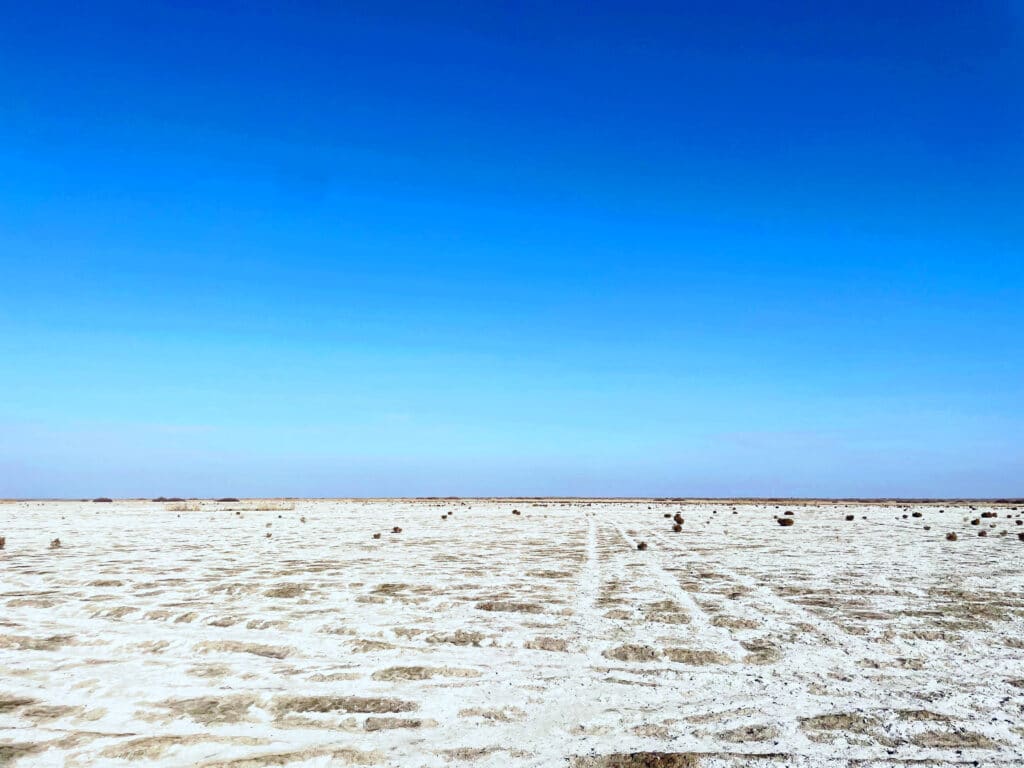
We drove for hours through a vast salt desert, swallowed by a landscape that felt utterly alien. No roads, no villages, no sign of life—just an endless expanse of white and dust, stretching as far as the eye could see. No phone signal, no internet, nothing. If something happened out here, there would be no calling for help, no passing stranger to offer assistance. It was just us, the jeep, and the howling wind. The realization settled in slowly, creeping in with the silence. We were driving across what used to be the bottom of the Aral Sea lake, a place that once lay beneath deep blue waters, now turned into a bone-dry, forgotten world. The cracked earth beneath us had not seen the sea for decades, yet it still bore the scars of long-lost currents, dried-up riverbeds, and the skeletons of an ecosystem that had simply vanished. Our guide, seemingly unfazed by the emptiness, had packed the back of the jeep with thick blankets—”just in case,” he had said with a half-smile. At first, we laughed, but then the thought settled in: what if the car broke down here? The vast nothingness around us suddenly felt heavier. The blankets, once a quirky detail, now seemed like a lifeline. It was both a comforting and an unsettling sight—a reminder that in this place, nature was merciless, and survival depended on preparedness, not luck. Along the way, we passed through stunning submarine valleys, their jagged walls once carved by currents but now left exposed to the sky—desert valleys that had never been meant to see the sun. Ancient caravanserai ruins, remnants of the Silk Road, stood stubbornly against the winds, their stones whispering tales of traders and travelers who once rested here, never imagining that one day, their stopover would sit in the middle of a lifeless salt plain.
That night, we found shelter in a yurt camp, a small cluster of round, felt-covered tents set up in the middle of nowhere, as though placed there by the hand of time itself. The air was thick with a sense of history—a strange echo of Genghis Khan’s era, when nomads wandered these endless plains and nights in a yurt were the only refuge. But now, there were no people, no laughter, no movement. We were completely alone, approximately 300 kilometers away from the nearest road—a place so isolated that the very concept of time seemed to blur. The Soviet-era metal stove inside our yurt was the only thing that gave us a sliver of comfort, but even it demanded constant attention. The cold was relentless, creeping under every layer of clothing, seeping into our bones, and making the night feel endless. Our guide, with a knowing grin, had warned us that -5°C here feels like -20°C in Moscow. He was absolutely right. The wind, like some ancient spirit, howled outside, cutting through the thin walls of the yurt. The silence was almost unnerving, broken only by the occasional crackle of the stove. Every two hours, we were jolted awake by the biting cold, forced to feed the stove with wood, our only defense against the frost. And with each refill, we found ourselves more grateful for its glowing embers, as if the warmth was a small blessing, a connection to the world beyond this frozen wilderness. In that moment, time seemed to stand still. With no one around, no signs of life, and nothing but the vast, empty landscape outside, it felt as though we had stepped into a different age, one where the world hadn’t changed in centuries. The silence was suffocating, and yet it was also a reminder of the resilience of those who once called this land home.
When the harsh winds cracks your broken lips,
And your soul is nothing but a wreck on land,
Remember, it’s not the sinking ships that hurts the most,
But the day you have no sea to command
Aral Sea Lake: Sunrise at the shore
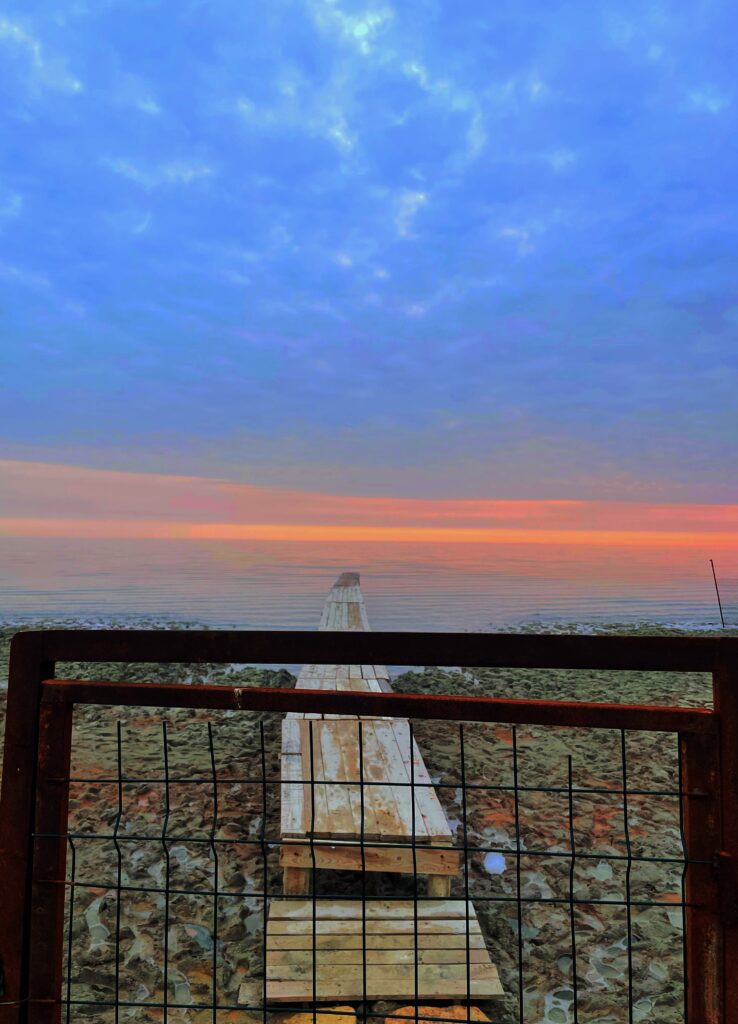
And then, finally—morning. We arrived at what remained of the Aral Sea, just in time to see the sunrise over its still, shrinking waters. The air was crisp, the silence absolute. Along the shore, enormous salt crystals glittered in the golden light, growing larger as the water continued its slow retreat, leaving behind a sea that was more memory than reality.
On our way back, after driving for a couple of hundred kilometers away from the shore, we passed through ghost villages, their empty, crumbling buildings standing as silent witnesses to a lost era. The atmosphere was suffocating, thick with the weight of abandonment, like the land itself had been forgotten. Windows were shattered, doors hung ajar, and dust-covered streets echoed only the whispers of a time when these places were alive. Now, they were nothing more than forgotten ruins in a desolate landscape. The saddest part? There are still a few hundred people living between those ruins. We took a brief stop at an abandoned airport, its rusting tarmac and derelict control towers frozen in time, a stark reminder of the area’s once vital connections to the outside world. The eerie quiet of the place was punctuated only by the occasional howl of the wind. It felt like a world out of sync with the present, stuck between the past and an uncertain future. As we continued on, the landscape shifted into a nightmarish industrial scene. We came upon oil wells, their towering structures groaning and creaking, hungry for resources, leaking a steady stream of black gold into the air. The oil-rich land, still pumping life out of the earth, felt like a dark parody of progress. Old Soviet trucks raced wildly between the wells and nearby petrochemical factories, spewing black smoke as they made their erratic journeys, their tires screeching on the cracked, forgotten roads. The whole scene felt chaotic and desperate—a strange, disjointed dance between decay and industry, a disturbing reminder of the unsustainable force that had shaped this land.
Conclusion
As we neared the capital of Karakalpakstan, Nukus, I couldn’t help but think of the legend of Adam’s tomb. The story said that when all the stones from Adam’s grave would fall, the end would come. To me, the Aral Sea itself feels like a living embodiment of disaster and the end of times . As we neared the capital of Karakalpakstan, Nukus, I couldn’t help but think of the legend of Adam’s tomb. The story said that when all the stones from Adam’s grave would fall, the end would come. To me, the Aral Sea itself feels like a living embodiment of disaster and the end of times.
If you enjoyed reading about our expedition to Aral Sea lake, don’t forget to leave a comment below with your thoughts or questions! Also, be sure to check out more of our travel stories by visiting the rest of our blog and more photos from this adventure by following my Instagram page. And if you’re planning your own trip to the Amazon please feel free to contact me and start your own journey as soon as you can!
As a child, I never found joy in playing with soldiers, figurines, or toy cars. My heart was always drawn to encyclopedias and geographical atlases. Whenever I stumbled upon a grand and charming book at the bookstore, I implored my grandmother to purchase it for me. Among my most cherished books, when I was merely five or six, was a zoology atlas that depicted the majority of animal species discovered at the time, many of which hailed from the heart of the Amazon jungle. I longed to journey there and behold them all. How wondrous and fertile such a land must be to cradle so many magnificent creatures. Now, as I reflect on the adventure of a lifetime, my dream has taken shape in the form of the Leticia Amazon Expedition
Leticia – The Gateway to the Amazon
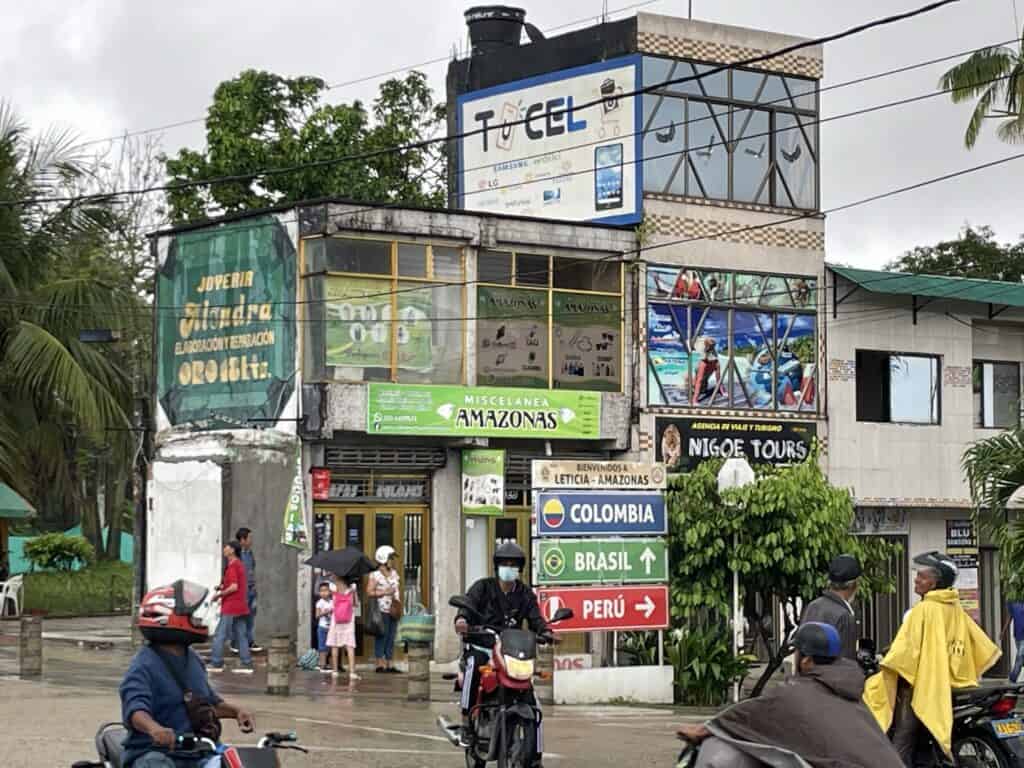
After a smooth and almost meditative flight over the endless green waves of the jungle, my friend and I. finally descended into Leticia—the tiny Colombian town that clings to the banks of the world’s mightiest river, the Amazon. Our journey was a direct three-hour flight from Bogotá with Latam Airlines, and as soon as we stepped off the plane, we were met with a wall of humidity so thick it felt like walking into a steaming cup of herbal tea. The air embraced us like an overenthusiastic relative, and the drizzle, which seemed to have no intention of ever stopping, made sure we felt truly welcomed.
At the airport, a kind and cheerful lady awaited us—the owner of the guesthouse where we had booked our stay. She greeted us with a warm smile and an even warmer car: an American relic from the 1980s that had clearly seen many stories. From its aged speakers, the most popular local station, Radio Policía Nacional, filled the air. A rather unique choice of entertainment, it alternated between somber police reports, curious local news, and the occasional burst of Latin music, as if the radio itself couldn’t decide whether to dance or deliver bad news.
Our ride to the guesthouse took no more than 10 minutes, enough time to pass several military outposts, army checkpoints, and police stations—just in case we had any doubts about the town’s security measures. What were all these people doing there? Protecting us? I doubt it. Despite this, Leticia appeared peaceful, almost sleepy, as if the jungle’s endless hum had lulled it into a permanent state of tranquility.
Our accommodation was simple but clean, a small house with everything we needed. However, what stood out the most—both here and everywhere else—were the enormous water tanks perched on rooftops, silently collecting rain. Strangely enough, in a place where humidity suffocates at 95% and rain is as constant as the Amazon itself, clean water was a rare treasure. The river, vast and all-powerful, was not to be trusted for drinking unless you fancied an unplanned adventure of a very different kind.
Though the true heart of our journey lay in the days ahead—the grand jungle expedition—we seized the first day in Leticia with open arms. We explored the small town, sticking mostly to the places recommended by our host (no reckless wanderings just yet), admired the lively fish market, took in the sights of the central park, and watched the people around us. We observed their rhythm, their interactions, and their daily rituals. Leticia had its own quiet charm, a slow but steady heartbeat, pulsing in time with the great river that embraced it.
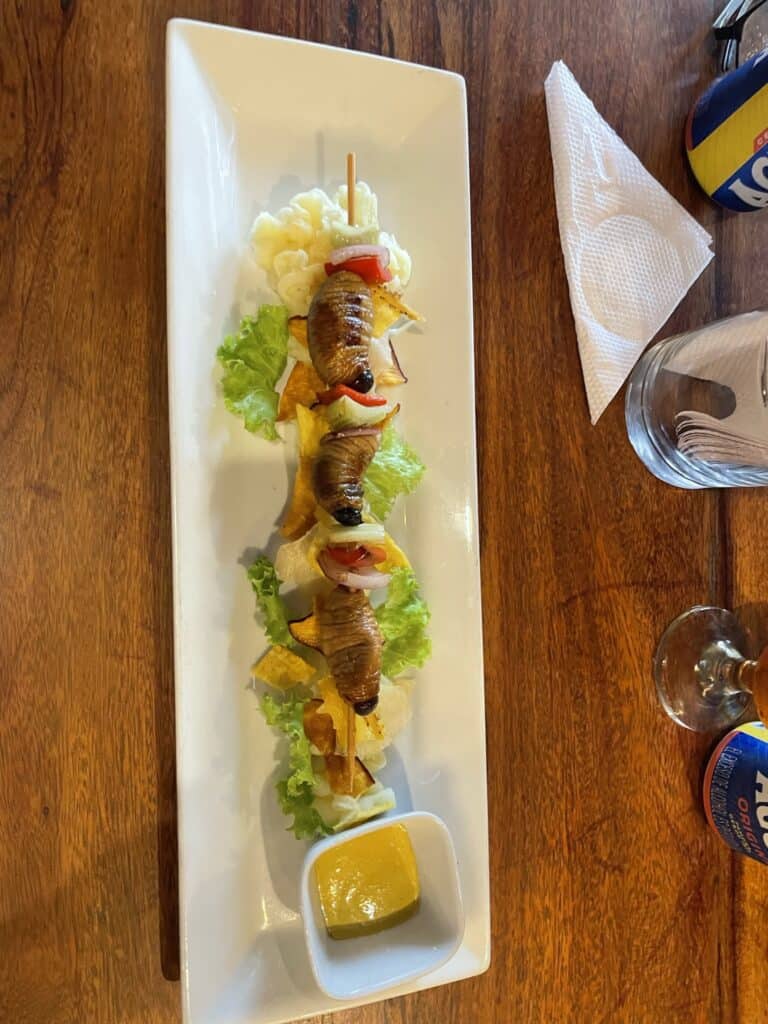
We didn’t shy away from indulging in the local delicacies—starting with the famous yucca pizza, moving on to the protein-packed tree bark worm, known by the locals as mojojoy, and finishing with a remarkable dessert: coca leaf ice cream with an extra topping of crunchy ants. A true Amazonian feast.
We ended the day at sunset in Leticia’s central square, where we witnessed an incredible spectacle—tens of thousands of birds returning from the jungle after a long day, seeking refuge in the trees of the city. The deafening noise and near-demonic frenzy of their arrival made me wonder where I would be sleeping in the coming nights. Why were these birds so desperate, so restless, fighting with all their might for a single sliver of branch in this tiny town of Leticia?
The Amazon Expedition Begins
After a night where I spent more time awake than asleep—thanks to a mix of excitement and the relentless sound of torrential rain—the kind lady at our guesthouse prepared a simple breakfast for us: eggs with fried patacón. With a hot cup of coffee in hand, we waited for Golbert, our guide.
Around 8:30 in the morning, a man in his early thirties with distinct indigenous features pulled up in front of our guesthouse, ready to take us to their headquarters for a quick briefing. The ride was quiet—until Golbert himself broke the silence with an unexpected question: “Are you ready to swim?” My companion and I exchanged confused glances. Swimming? That hadn’t been part of the plan. Our itinerary had been carefully set in advance, and nowhere on it was there any mention of swimming. Seeing our puzzled expressions, Golbert quickly explained: the torrential rains had flooded large sections of the forest trails, and if we wanted to stick to our original route, we’d have to wade through chest-deep water—or possibly even deeper. Before the trip, my companion and I had made a pact: we were ready for any kind of adventure, but we absolutely would not swim in the waters of the Amazon, for one simple reason—parasites. So naturally, we asked Golbert the all-important question: Is it dangerous? He hesitated for a moment before replying, rather unconvincingly, that yes, it was pretty dangerous. We had about ten minutes to think things over as we drove to the agency’s headquarters, trying to weigh our thirst for adventure against the risk of becoming an unwilling host to Amazonian parasites. Once we arrived, we sat down with Golbert to see if there was any way to avoid the whole “swimming” part of the journey. Thankfully, a compromise was found. One of the planned highlights of our expedition was spending a night with a local tribe. However, the flooding had completely cut off access to their village. The alternative? We would visit a different tribe, but since our arrival would be unannounced—because, unsurprisingly, the tribal chief didn’t have a phone or an email address—we wouldn’t be able to stay overnight. Instead, we’d sleep in a jungle refuge. With the plan settled, we packed our bags, grabbed our mosquito repellent, flashlights, rain ponchos, and rubber boots, then hopped back into the Jeep, heading towards the very edge of the forest—where the road ended, and the true adventure began.
We started on relatively decent trails, flanked on both sides by modernizing indigenous communities—almost like the “suburbs” of Leticia. These were tribes in transition, where smartphones weren’t unheard of, parents sent their children to school, and Spanish had become the dominant language. As we ventured deeper, the well-trodden path began to fade, swallowed by the jungle, until eventually, we were forging ahead with no trail at all. Before long, the ground beneath us turned into something else entirely—pools of murky water rising past our knees. The smell? Vile. A pungent, sickly scent, like a dentist’s office filled with untreated cavities and infections. I silently thanked past-me for refusing to swim in these waters. For three to four hours, we trudged through the jungle, our world reduced to towering trees, relentless mosquitoes, an array of bizarre insects, the occasional lost monkey, and tiny, brilliantly colored frogs. They looked adorable—like something straight out of a cartoon—but were among the most poisonous creatures on Earth. Their venom was lethal, and no, there was no antidote. Thankfully, unless you had a sudden urge to hunt them down (which I strongly advise against), they would much rather avoid you altogether. The heat was intense, the humidity suffocating, and we were permanently drenched—as if we had just stepped out of a shower. Oddly enough, this worked in our favor. The constant warm drizzle, which would have been annoying in any other situation, had become just another part of the experience. We didn’t even notice it anymore.
The Amazon Expedition: The Ticuna Tribes
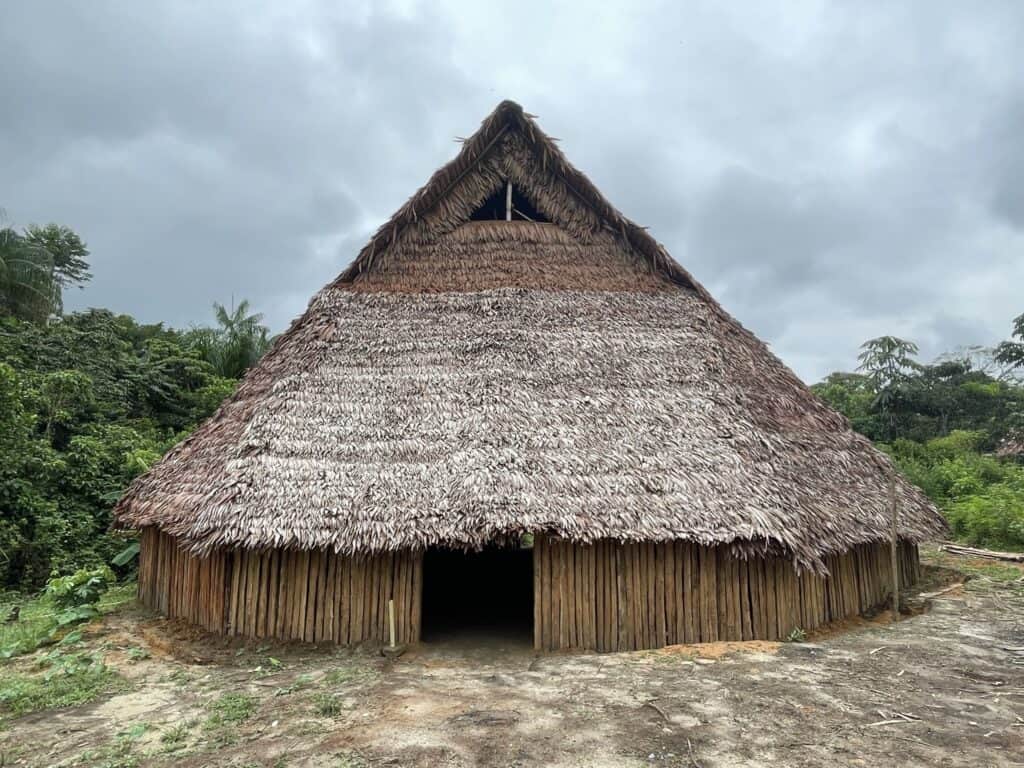
After hours of trekking through the flooded jungle, a clearing began to emerge in the distance. I suddenly realized where we were—this was it. We were about to have our first encounter with an Amazonian tribe. Stepping cautiously among the wooden and thatched huts, we observed the daily life unfolding around us—some people dressed in simple clothing, others wearing considerably less. But what immediately caught our eye was a massive structure towering over the rest of the village—the maloca. Golbert explained that for the Ticuna people (one of the many tribal families in the Amazon), the maloca was once the heart of the community. In the past, the entire tribe lived, ate, and slept under its roof. Over time, families had moved into their own huts, and the maloca had become a communal space for gatherings, ceremonies, and celebrations. Just as we were absorbing this information, the main figure of the village appeared—the tribal chief. A man seemingly in his early sixties, dressed in simple sweatpants and an open button-down shirt, he radiated warmth and an undeniable presence. His energy was calm and welcoming. In surprisingly clear Spanish, he invited us into his maloca to share more about his people, their traditions, and their way of life. Settling onto a small wooden stool, the chief offered us our first taste of tribal hospitality—a ball of tobacco clay and a fine powder made from coca leaves, which they traditionally place under their tongues. As we hesitated for a brief moment, he began to speak, revealing the core of their existence—hunting, and the cultivation of tobacco and coca.
The old man began to speak, his voice carrying the weight of centuries. He described their peaceful way of life, their rituals, their dances—each one a celebration of their deep connection with nature. To him, the jungle was more than just a home; it was a mother, a provider, a guardian that nurtured them, and in return, it had to be protected. The forest and the Amazon gave them everything they needed to survive: shelter, water, food, even medicine and entertainment. As he spoke, I couldn’t help but notice a growing discomfort in my stomach—my all-too-familiar battle with acid reflux. I mentioned it to him in passing, and without hesitation, he walked over to a nearby tree, made a small incision with his knife, and handed me a few drops of its sap. I drank it, and within moments, the burning sensation in my chest vanished as if by magic. But of course, it wasn’t magic—just nature, the same nature that modern medicine bottles up, dilutes, and sells back to us. Speaking of natural remedies, he eventually arrived at what he called the ultimate medicine—ayahuasca. Not just a treatment for the body, but for the soul. But, he warned, ayahuasca isn’t for everyone. You cannot simply decide to take it; you must be chosen by the shaman. Only those deemed special, those with the potential to open their third eye, are granted access to its secrets. And who, exactly, is this shaman who holds such power? How does one become the gatekeeper of the spirit world? Simple—spend an entire year alone in the jungle, consuming every known poison from every known creature. If you survive—and if you return with your sanity intact—only then can you call yourself a shaman. The conversation shifted to the tribe’s history, a tale intertwined with Colombia’s darker past. He confessed that his people once lived hundreds of kilometers deeper into the jungle, far from the main branch of the Amazon. But in the 1970s, they were forced to relocate closer to Leticia, seeking refuge from the guerrilla factions that controlled the jungle—and, in many ways, still do. These groups would raid villages, taking young boys and forcing them into wars that were never theirs to fight. Moving closer to Leticia meant greater security, with the Colombian military nearby. But not all tribes were as fortunate. The Amazon is home to thousands of distinct tribes, each with its own fate. Some have become recruitment grounds for guerrilla armies like the FARC. Others remain untouched by modern civilization, living as they have for centuries. And then, there are the warrior tribes—the ones few outsiders have ever encountered. According to the old man, some of these tribes still practice ancient rituals, including one that outsiders whisper about with both fear and fascination—cannibalism.
After discussing broader topics like history, the jungle, and their cultural traditions, the chief’s tone shifted. He began to share his deepest concerns—the kind that weighed heavily on his heart. He was acutely aware that time was slipping away, and with it, his people. More and more families were leaving the village, drawn to the modern comforts of Leticia. Parents sent their children to school in the city, and before long, they moved there altogether. Each year, the tribe grew smaller, its presence fading like footprints washed away by the Amazon’s endless rain. The old man knew that one day, perhaps sooner than he’d like to admit, his tribe would cease to exist. Their language, which had never been put into writing, would vanish with them. Their traditions, their stories—gone, as if they had never been. Yet, he did not fight this inevitable tide. Instead, whenever visitors arrived, he made it his mission to share as much as he could. He spoke not out of desperation, but out of hope—hope that someone, somewhere, would remember them. That long after they were gone, their existence would still echo in words, in stories, in history. That the world would know they were here once too.
The Amazon Expedition: Golbert’s fears
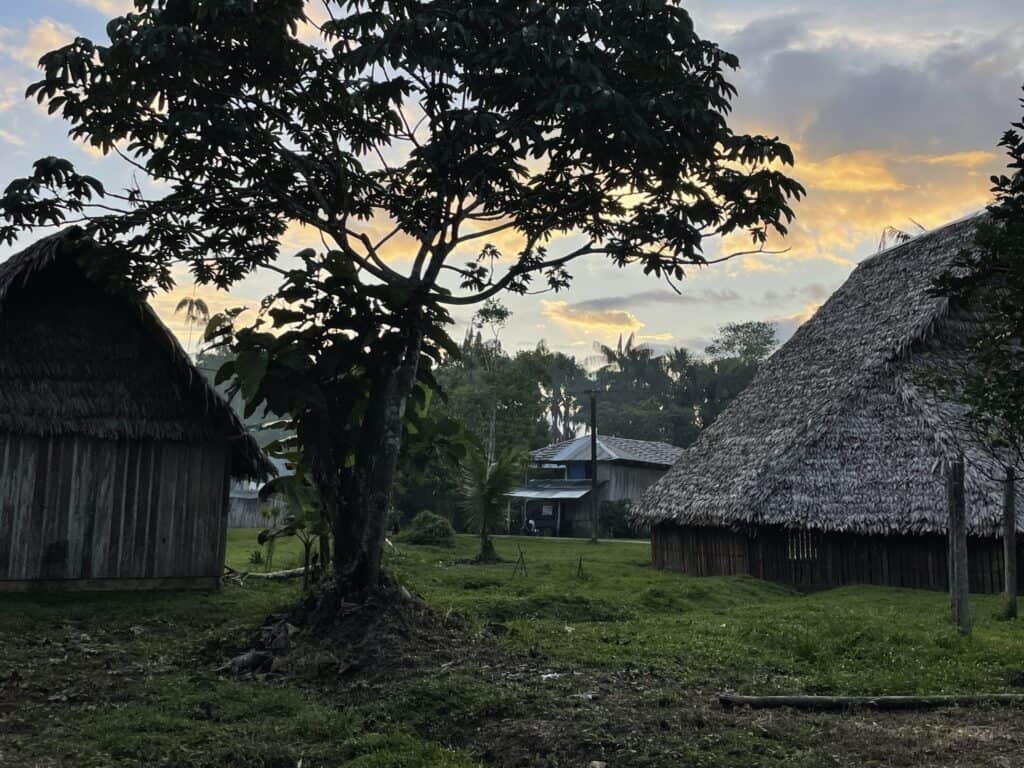
As the sun dipped below the horizon, painting the sky in rich oranges and purples, we said our goodbyes to the Ticuna tribe and set off toward our resting place for the night. But little did we know, the day wasn’t quite finished with us yet. A night-time jungle exploration awaited, led by one of the tribe members. On our way to the cabin, Golbert, our guide from Leticia, let out a relieved sigh. “Good call on changing the plan, guys,” he said with a chuckle. “Can you imagine if we’d been swimming now?”
Curious, we pressed him—would he have been afraid to swim, worried about parasites lurking in the Amazon’s waters? Golbert paused, a mischievous glint in his eye, before revealing it wasn’t the parasites that had him worried. Oh no. His true fear? The electric eel. He explained that when the Amazon floods, it brings in all sorts of creatures—and the electric eel, in particular, had a special place in his nightmares. “Imagine one of those things bumping into you while you’re swimming,” he said, “you’d get an electric shock that could fry you all in the water.” He’d seen it happen before. Well, that certainly put our fears of parasites in perspective. We arrived at the “cabin” (a floor and roof surrounded by nets to keep out the more enthusiastic insects) and Golbert suggested we wait until it was pitch dark before heading out again. Why? Because, according to him, dusk is when the venomous snakes like to get their groove on. And, of course, we’d had a similar night-time adventure in Costa Rica, where the snakes were out in full force, but at least we were a stone’s throw away from an anti-venom stash. After a quick rest, we set off into the jungle—plunging into total darkness, with flashlights that barely lit up the ground in front of us. The jungle felt alive like it was waiting for something… but what? We marched on, following the young man from the tribe at the front, with Golbert behind us, and our nerves slowly creeping up. Our first fear? Jaguars, of course, Golbert seemed to sense our concern. “Oh, the jaguars aren’t a big deal,” he said like it was just another walk in the park. “They’re around, but they’re not dangerous. Not like you think.” He went on to explain that, in this region, the jaguars were not only hunted by the local tribes but were also part of an ancient rite of passage. When a boy turns 14, he goes out with his father to hunt a jaguar—just the two of them. You know, standard father-son bonding. “The jaguars know humans are their only predator,” Golbert continued. “You may never see one, but they always know you’re there. They’ll keep their distance.”As we continued deeper into the jungle, we encountered frogs with colors that could only be described as “alien chic,” and insects that looked like they’d taken design cues from a science fiction film. But the real stars of the show were the spiders—so many spiders. Enormous tarantulas, the size of dinner plates, scuttled across our path, looking like they’d just stepped out of a horror movie. Golbert, however, wasn’t fazed. But when it came to the banana and wolf spiders, he got a little more serious. “Those guys are trouble,” he warned. “Their bite? Neurotoxic venom. If you’re unlucky enough to get bitten, well… good luck with that.”The spiders, much smaller and sneakier, were everywhere. In the dim glow of our lanterns, they popped up like unwelcome party guests—probably hundreds of them, though who could tell in the darkness? Every time we took a step, we had to remind ourselves, “It’s fine, it’s just a tiny little spider… that could possibly kill you.” But, hey, who’s counting?
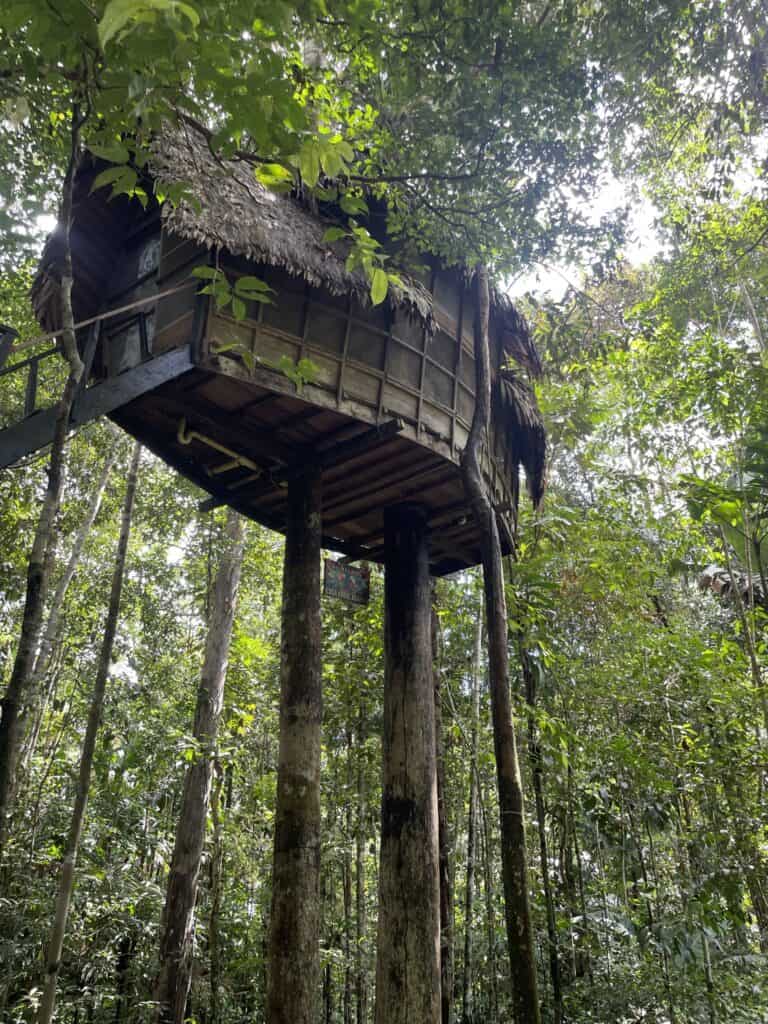
After that rather fascinating little stroll, guided by our dim lanterns, we made our way back to our cabin in the forest. We had a small rainwater reservoir that was just enough to wash off a bit of the grime. As for electricity… well, I’m sure you can guess that was never a consideration. Before heading to our makeshift cabin, Golbert handed us a gas lamp. The lamp proved to be quite useful, primarily for spotting a bullet ant that had sneaked into our cabin. Legend has it that its sting is excruciatingly painful, and honestly, I preferred to take that as fact rather than testing it for myself. Once we successfully eliminated the dangerous little invader, we climbed into our stacked beds, utterly exhausted, and turned off the small gas lamp we’d been given. This is where things got a bit more interesting. Have you ever experienced “nothingness,”or “emptiness”? Normally, when you turn off the lights, your eyes need a few minutes to adjust, and soon you start to see something. Here, though? Absolutely nothing. For a while, I understood what it means to be practically blind—to see absolutely nothing. And, of course, nothing could be seen. The nearest light source was probably miles away. Not only was it pitch-black, but everything around us was so incredibly noisy: the jungle was alive with rustling, cracking, the shrieks of nocturnal monkeys, and other sounds we couldn’t comprehend or recognize. After a short while, I began to see something, but not exactly what I hoped: many pairs of eyes, of various shapes and sizes, far too close to our “cabin.” Wait—let’s not even call it a cabin; we were practically sleeping outside. Although I knew, in theory, that we were perfectly safe, and nothing would go wrong, for a few minutes, a primal instinct was awakened in me—a surge of fear and insecurity. I quickly calmed myself down, though, and managed to appreciate the beauty of this night spent immersed in nature. I felt peaceful, secure, and almost on the verge of falling asleep from sheer exhaustion when, not even two minutes later, I was jolted awake by more sounds—this time, much less natural. Gunshots. I heard the unmistakable sound of gunfire nearby. Every few minutes, a shot rang out. Now, knowing that it was a heavily militarized area, I peacefully lay down, convinced that the gunshots were just some nocturnal military exercises.
The next morning, as we discussed the gunshots we’d heard, we learned about Golbert’s second greatest fear, of course, right after the electric eel—sicarios. He explained that the gunfire had come from the numerous cocaine labs hidden deep in the jungle. This region produces the largest share of the world’s total cocaine supply. Do you think the drug lords built their labs far from the airport? No. These labs are guarded by armed guards, and at night, the guards see exactly what we saw—nothing but eyes. And if a pair of eyes gets too close, they fire warning shots to scare them off. Golbert then launched into a dramatic monologue about how dangerous Leticia was. He warned us that when we returned to the city, we should stay only within the central area, between the military bases, because the law does not have a foothold there. People are killed every day, and their bodies, still warm, vanish into the dense jungle within hours, with no one even questioning their disappearance. Leticia is full of sicarios—hitmen sent from Medellín, Cali, or Bogotá to oversee the cocaine business right from the point of production. With a voice filled with desperation and fear, Golbert told us that there are many bad, wicked people on the streets of Leticia, and that he often feels afraid to leave his house. It’s not a place where human life holds much value. He wrapped up his story with a chilling tale that had happened just a few days before our arrival, just two streets away from where we were staying in Leticia. A man involved in the business had lost a few cocaine packages in the jungle, but he soon bought new clothes and a new phone. A few days after making these purchases, two men on scooters, armed with automatic rifles, massacred his entire family while they were sitting in the yard—him, his wife, her parents, and the two small children they had.
Lost light
When we’re sunk in our blind dark, And can’t see we’ve lost our spark, We see pairs of eyes that silently fly, Judging us with their quiet sigh.
I’ll shoot them all beneath the wing, in the side, Waiting to see the smell of carrion at dawn’s tide.
The Amazon Expedition: The flood
After the morning had started perfectly, with a bloody story, a torrential rain began to rage, transforming the world below into a chaotic battlefield. And of course, this wasn’t exactly ideal for us, because we had a few hours of trekking ahead—through the forest, toward the next tribe, a Witoto tribe. In this wild downpour, the forest path became a battle of its own. The water rose, creeping up our legs, until it reached our knees, then our thighs… and we were still walking. Honestly, the journey to the Witoto tribe felt like a survival test. Golbert, in a state of absolute panic, started running, yelling at us to hurry. I swear, he looked like he might sprout wings and fly away. He was seriously worried. Besides the fact that massive trees were falling one after another around us because of the rain’s power, from the trees that didn’t fall, wolf spiders and banana spiders were being shaken directly onto us, and we were running with the water up to almost our waists, occasionally getting stuck in quicksand. Various parts of the trail that Golbert knew were blocked either by massive trees or by strong torrents of water flowing out of the Amazon, so there were many improvisations, emotions, and dangerous crossings over makeshift bridges made from tree trunks. This is what I call away from the beaten path! After two hours of adrenaline, running like we were being chased by the Amazon itself, we finally reached the Witoto tribe.
Now, I’ll be honest—I was so shaken, so full of adrenaline, I barely remember anything about the tribe. What do I recall? They hunted. They made yucca flour. That’s about it. Oh, and I saw how they made the flour, which, for some reason, felt like a secret ritual to me at that moment. Before we left, I looked back at the path we had come from, and the water had risen disturbingly—what had once been a road was now a canal, a canal full of electric eels. I understand now why Golbert urged us to hurry so much.
We left the Witoto tribe in a tiny boat, gliding through winding canals. The rain had slowed down a bit, but we still had to scoop out water from the boat every now and then with a cup. As we drifted through the waterways, we passed countless canals, spotting dozens of interesting bird species and lotus flowers. The landscapes were utterly enchanting, so much so that they reminded me of the Danube Delta back home in Romania. It was a delightful journey. Our destination, however, was where we’d spend the night. I’m not quite sure how to describe it—maybe a mini-farm run by a local family? They had a house, and a few little “rooms” with no walls, of course, that they rented out. The place was accessible only by boat, sitting on a small hill between the winding channels and the mighty Amazon River. It was quite a charming spot where we could unwind with a few Brazilian beers. We even went fishing for piranhas, caught a couple, and fed them to the family’s pet—a massive arapaima. The family also had cows, peacefully grazing on the only patch of land that had escaped the flood, with a few of them actually swimming in the Amazon. Seeing these cows swimming, I asked the owners if they weren’t worried about caimans. Laughing, they said the caimans were “calm,” but they had had issues with boa constrictors eating their cows. That left me speechless. How does a snake eat a cow? How big does the snake have to be? I was going to find out soon.
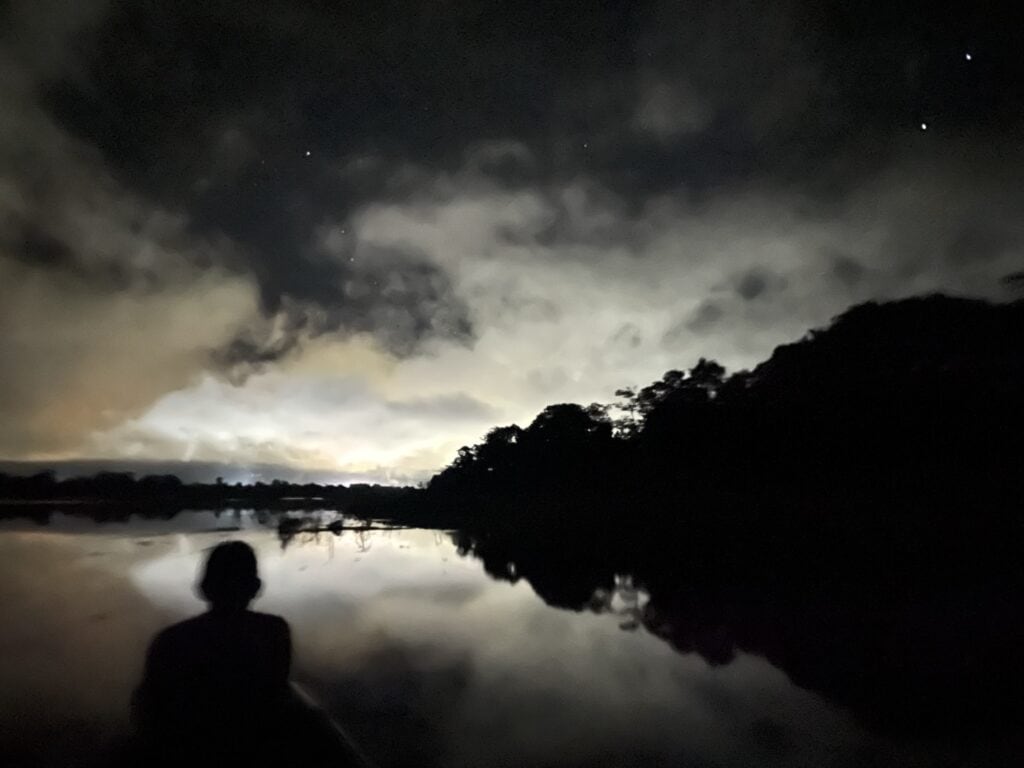
As soon as the sun dipped below the horizon, we set off with Golbert and a man from the shack family, plunging into the jungle, winding through canals, all in pursuit of boa snakes. The rain had finally relented, and the clouds scattered like an overzealous painter clearing the canvas. But before we could enter the canals, we had to cross a lake. The minutes spent gliding across the serene waters felt indescribable. It was a dreamlike night on the Amazon! The chaotic noises of the forest from the previous evening gave way to the soft, timid songs of birds, and the stench of decay was replaced by the fresh perfume of flowers. The best part? The darkness was still deep and soothing, but it was transformed by a sky so dazzling, it could make even the stars jealous. A sky richer than Van Gogh ever imagined, a sky that echoed those of the Sahara desert. For a few blissful minutes, I slipped into a state of deep relaxation—calm, meditation, and awareness. Gratefulness and joy bloomed in my heart because, at that moment, I was there. But, as all good things do, my delirium was brief. No sooner had I settled into the peace of the night than the farm man spotted a boa. Golbert, in his infinite wisdom and bravery, steered the boat through the reeds, trying to capture the snake to prove his courage. He failed. So, we spun around, for another hour, in the darkened canals of the jungle, dodging falling things from the trees—things we couldn’t name, which fell into our boat… and onto us. A proper Amazonian adventure!
Silent nights
In the dark, no light to find, Whispers close, a restless mind. Eyes that watch, the jungle speaks, A peaceful fear, the night it leaks.
Gunshots pierce the silent air, Yet in the stillness, I don’t care. No light, no sound, just space to roam, In emptiness, I’m safe, I’m home.
Luxury Cruise on the Amazon: Brazil!
Spoiler alert – it wasn’t a luxury cruise down the Amazon, but it sure felt like one. After a lavish breakfast at the farm, complete with coffee, omelets, and patacones, a boat that could comfortably fit 7-8 people (and, unbelievably, had a motor) was waiting for us at a nearby dock. The entire day was nothing short of magnificent—relaxing, sunny, and entirely devoid of adrenaline. We spent the day listening to music on that boat, and I’m happy to report it wasn’t “Radio Policia Nacional” this time. We stopped at various key ports in three different countries: Peru, Brazil, and, of course, Colombia. The first stop was Santa Rosa Island in Peru, where we sipped some fantastic coffee and watched locals go about their business—fishermen prepping their nets, kids dressed in the neatly embroidered uniforms of Peru, heading off to school. The highlight of the day came in Tabatinga, where we stopped at a bar, knocked back a few Caipirinhas, sang, and danced to the sounds of Brazil. By the end of the day, our adventure had come full circle, and we found ourselves back “home” in Leticia.
An Angel with an Assault Rifle
On our final day, we wandered around Leticia for most of the day, revisiting our favorite spots—the fish market, and the central park. We tried another local restaurant—this time, no yucca, no worms, no ants. Instead, we had a proper steak, which, especially while listening to Radio Policia Nacional, seemed to melt in our mouths like it was made of clouds. We’d pretty much-seen everything there was to see in Leticia, or at least everything within the “safe zone.” On our way back to the house, we picked up a bottle of local rum, which we proceeded to drink well into the late hours of the night. Slightly tipsy and curious about what Leticia’s nightlife was like, we decided to ignore Golbert’s advice and venture beyond the safe zone which was marked with a military checkpost, heading toward a nightclub we’d heard about earlier that day from the locals. We stepped into the club, and surprise—there was not a single local in sight. The place was packed with attractive women and white Colombians, dressed in expensive yet questionable taste and dripping in gold jewelry. As soon as we entered, everyone turned to stare at us—suspiciously, obsessively, without a hint of shame. It was clear from the get-go that we didn’t quite belong there. Just as we were trying to figure out our next move, luck intervened. A soldier in full uniform, holding an M4A4 assault rifle, walked in right behind us, his eyes fixed directly on us. We quickly finished our beers and bolted, the soldier following closely behind, only to stop at the army checkpoint, which, apparently, he had just left. We couldn’t say for sure what he was doing there, but we guessed he had seen us step out of the safe zone and decided to escort us for our own protection. A real angel, that one. Sometimes, when you’re being foolish, you just need a little bit of luck. With that close call and the universe’s strange forgiveness, our journey came to an end.
Conclusion
As our Leticia Amazon Expedition comes to an end, we reflect on an adventure that was as wild as the jungle itself. From the buzzing streets of Leticia to the remote tribes deep in the heart of the Amazon, every moment was packed with excitement, wonder, and just a hint of danger. The jungle was both a challenge and a marvel, offering experiences that few will ever get the chance to witness. The tribes we met, each with their own unique stories and traditions, opened our eyes to a way of life that feels both ancient and timeless. We left the Amazon with memories that will stay with us forever – the sights, the sounds, and the overwhelming beauty of this incredible ecosystem. But this journey is just the beginning. If you’re itching for your own adventure, don’t let fear hold you back. The Amazon is waiting, and there’s so much more to discover.
If you enjoyed reading about our Amazonian adventure, don’t forget to leave a comment below with your thoughts or questions! Also, be sure to check out more of our travel stories by visiting the rest of our blog and more photos from this adventure by following my Instagram page. And if you’re planning your own trip to the Amazon please feel free to contact me and start your own journey as soon as you can! 🌿✨

![The Most Densely Populated Island in the World: 1 Hectare of Unforgettable, Literally Breathtaking Crowds [2026]](https://theversevoyager.com/wp-content/uploads/2025/05/santa_cruz_bar.jpeg "The Most Densely Populated Island in the World: 1 Hectare of Unforgettable, Literally Breathtaking Crowds [2026] 1")