
Tag: adventure travel

  • The Most Densely Populated Island in the World: 1 Hectare of Unforgettable, Literally Breathtaking Crowds [2026]

    The Most Densely Populated Island in the World: 1 Hectare of Unforgettable, Literally Breathtaking Crowds [2026]

    Introduction

    The Most Densely Populated Island in the World, right? If you had asked me where the most densely populated island in the world was, I would’ve guessed India, maybe China—somewhere known for impossible crowds and megacities stretching beyond the horizon. But no. It’s here, tucked quietly into the Caribbean Sea, off the coast of Colombia.

    It felt almost absurd. The idea of that kind of human density—more than a thousand people squeezed into 1 hectare—in the middle of a tropical postcard. I knew instantly: I had to see it. It wasn’t curiosity. It was compulsion. How could something so extreme be sitting so quietly just off the tourist path? And so the plan was set. A little salt, a lot of sun, and a visit to the mysterious island: Santa Cruz del Islote.

    I wasn’t exactly looking for comfort—I just didn’t expect it to be this hard to find. The journey from Cartagena de Indias to the Archipelago of San Bernardo is long, hot, and wet in all the wrong ways. But somewhere beyond the horizon, among a constellation of tiny Caribbean islands – Archipelago San Bernardo,, was a place I couldn’t stop thinking about: Santa Cruz del Islote, the most densely populated island in the world.

    Three hours by speedboat might not sound like much—until you’re actually in it. The sea between Cartagena and the Archipelago San Bernardo isn’t particularly gentle. There’s no shade. No snacks. Just salt, sun, and the occasional existential thought. But I held on, chasing a place my curiosity only whispered about: Santa Cruz del Islote, the most densely populated island in the world.

    What I found was… a lot. Houses layered like bricks in a Jenga tower. Kids everywhere. Roosters. Concrete. Life packed tighter than I thought possible. The heat and the smell made me think more of India—alive, overwhelming, and unapologetic. It was both fascinating and claustrophobic, beautiful and uncomfortable. But that’s only part of the story.
    Because beyond the noise, beyond the crush of bodies and buildings, something unexpected happened in my interior universe.

    Towards San Bernardo: Waves, Wind, and a Salsa-Dancing Captain

    We left at the crack of dawn. I had already been in Cartagena de Indias for a few days—my second time in the city—so I knew my way around. Reaching the port was just a formality. I’d booked this trip to the Archipelago of San Bernardo through a local company I trust, and the price was surprisingly low considering the distance we had to cover by boat—around 30 to 40 U.S. dollars, paid in Colombian pesos.

    At the small tourist port, a group of about 15 to 20 of us gathered—mostly Colombian travelers—and we climbed into a small, fast boat that looked more ready for a lake than the open sea. Our captain, somehow wide awake and dancing before sunrise, greeted us with loud salsa music and the kind of cheerfulness that either lifts your spirits or makes you deeply suspicious. He was clearly in his element—smiling, bobbing to the rhythm, shouting jokes over the motor, as if we weren’t about to be flung across open sea for hours.

    What followed was nearly three hours of not-so-smooth sailing toward the Archipelago of San Bernardo. The wind was strong, the sea was loud, and the boat seemed to bounce more than it floated. Slowly, the imposing skyline of Cartagena’s Bocagrande district—those tall, shiny towers—shrunk behind us, swallowed by the horizon and replaced by nothing but blue. Blue sky, blue water, and the unknown.

    The San Bernardo Archipelago: A Hidden Tropical Paradise

    After a few hours of being tossed around like luggage in a speedboat, we made our first stop: Isla Palma. One of the larger islands in the Archipelago of San Bernardo, it’s home to a kind of rustic resort—nothing flashy, but with a beautiful beach and just enough structure to feel semi-civilized.

    Most of the passengers got off here, ready to spend a few days in this quiet corner of the Caribbean. I stayed just long enough to crack open a cold beer, feel solid ground under my feet again, and sink into a shady lounge chair.

    The beach was lovely—white sand, clear water, and a laid-back calm that felt almost untouched. The setup was simple, modest, and refreshingly free of excess. No extravagance, no all-inclusive buffet chaos. Just the basics, done right. A tropical escape that hadn’t yet been swallowed by mass tourism.

    Soft Latin music played in the background, the hotel staff laughed and moved slowly, with the kind of ease that only comes from living in constant heat. Two lonely, sunburned trees stood guard over a supply boat, trying their best to shade it from the 40-degree Celsius inferno—so it wouldn’t turn from a delivery vessel into a boiling pot of tropical stew.
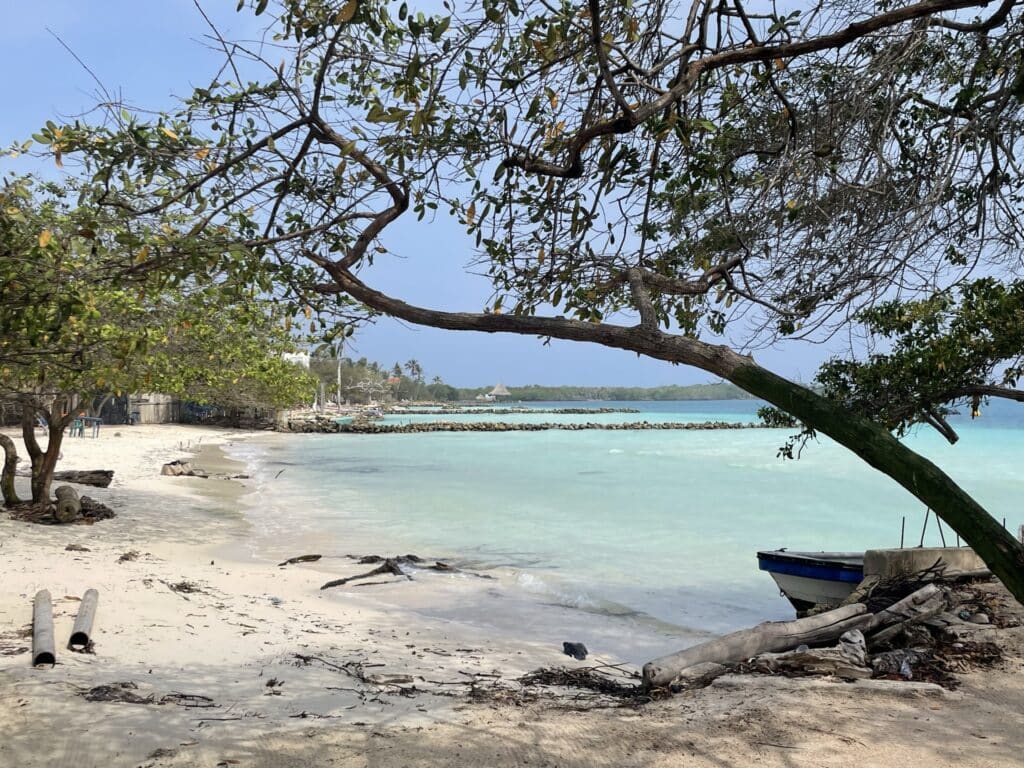
    Paradise beach situated in the Archipelago San Bernardo, Colombia

    My brief moment of rest was coming to an end—slowly but surely—and the journey had to continue. The plan for the day was ambitious: visit Santa Cruz del Islote, the most densely populated island in the world, then have lunch and a swim in the turquoise waters of a private island.

    Now, when you hear “private island,” your mind probably goes straight to billionaires and royals, champagne on the beach, and helicopters waiting nearby. I’ll admit, that idea made me a little uneasy at first—it didn’t exactly sound like my scene. But after my stop on Isla Palma, I started to get a better sense of the kind of “luxury” this trip had to offer. And funnily enough, it turned out to be exactly my scene.

    The speedboat that had delivered us to this point—while not exactly new or graceful—had one big thing going for it: a tarp roof that offered at least some protection from the merciless sun. And when I say merciless, I mean it. The day I went, even locals were sweating like it was a punishment. Around 42°C at noon, with over 80% humidity. Think sauna, but outdoors, and with no escape.

    I quickly realized the speedboat wasn’t coming back. And so we greeted our next mode of transport with a mix of enthusiasm and mild panic: a tiny fishing boat, the kind that looks like it’s more used to hauling nets than carrying tourists. There were six of us, crammed in tight. The captain—an actual fisherman who had just wrapped up his morning catch—pulled up to the pier and began clearing out buckets, fish, and equipment to make space for us.

    Once his cargo was safely dropped off at the resort, he motioned us aboard. We were headed—slowly, humbly, and a little too closely—to one of the most surreal destinations in the Caribbean: Santa Cruz del Islote, the most densely populated island in the world.
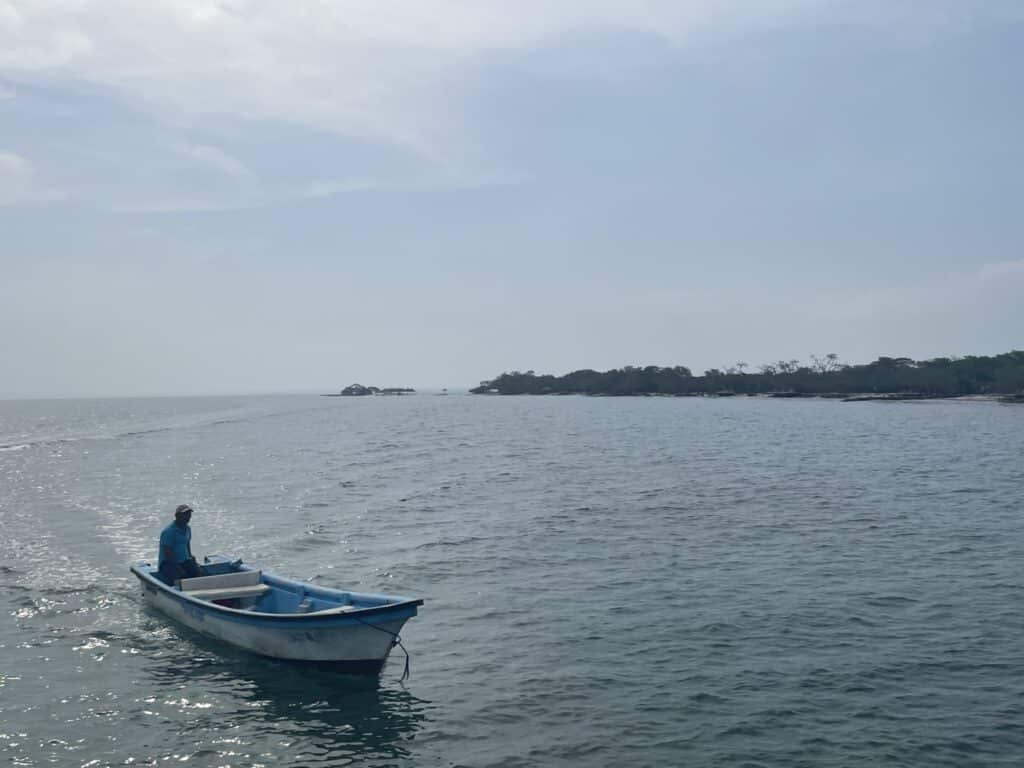
    Fisherman from Archipelago San Bernardo, Colombia

    The Most Densely Populated Island in the World: Santa Cruz del Islote

    We’d been drifting for about 15 minutes in that tiny fishing boat, winding our way between the tiny Colombian islands scattered across the sea. It was midday, and the sun was—no exaggeration—unbearable. The last weather check had shown over 41°C, and it felt every degree of it. There was no land in sight anymore—just endless blue—and ironically, though I was in the middle of the ocean, a strange, claustrophobic panic started to creep in.

    All I could think about was: What happens if this little boat gives up on us right here? It didn’t exactly scream “open-sea-worthy.” We were bobbing in open water, in over 40-degree heat, no cell signal, no shade, no drinking water. I was already mentally preparing for survival mode. And then, as if summoned by the Laws of Murphy, the engine gave out. I didn’t panic. I didn’t even flinch. I’d already lived this moment in my head. My palms had toughened into imaginary oars. I was ready to row if needed.

    Luckily, the fisherman was a professional. He tinkered with the motor for less than ten minutes—cool, calm, and entirely unbothered—then gave us the nod. We were back in motion. About twenty minutes later, something odd began to appear on the horizon: a strange shape, like a smudge on the sea. A tiny scrap of land, seemingly tossed carelessly into the middle of the Caribbean. It looked like an anomaly, a glitch in the landscape—a sliver of concrete and tin, rising out of nowhere, ringed by what looked like a shield of floating debris.

    We were almost there: Santa Cruz del Islote, the most densely populated island in the world. It was surreal. Like someone had taken a favela from Rio de Janeiro, shrunk it down, and dropped it smack in the middle of the ocean.

    We approached the small wooden dock, gently bobbing with the waves, and stepped off the boat beside a tiny, welcoming bar. Built from uneven planks and topped with a roof of dried palm leaves, it had a handmade charm—simple, but full of character. Locals gathered under its shade, sharing music and conversation in a calm, friendly atmosphere that immediately set the tone of the island: community-first, warm, and unhurried.

    But what I noticed first wasn’t the bar—it was the strong smell that hung in the air. With so many people living in such a small space, and the midday sun pressing down at over 40°C, the scent of life—waste, sea, heat—was hard to ignore. It was intense, and it stayed with you. I’m not sure if this is always the case, but at that moment, it felt like a challenge to the senses.

    Our group was welcomed right away by a smiling man who radiated friendliness. He introduced himself as Señor Gusto, the island’s guide. Shorter in height, solidly built, and with a few visible physical disabilities, he carried himself with quiet confidence and pride. He seemed genuinely happy to share his home with visitors.
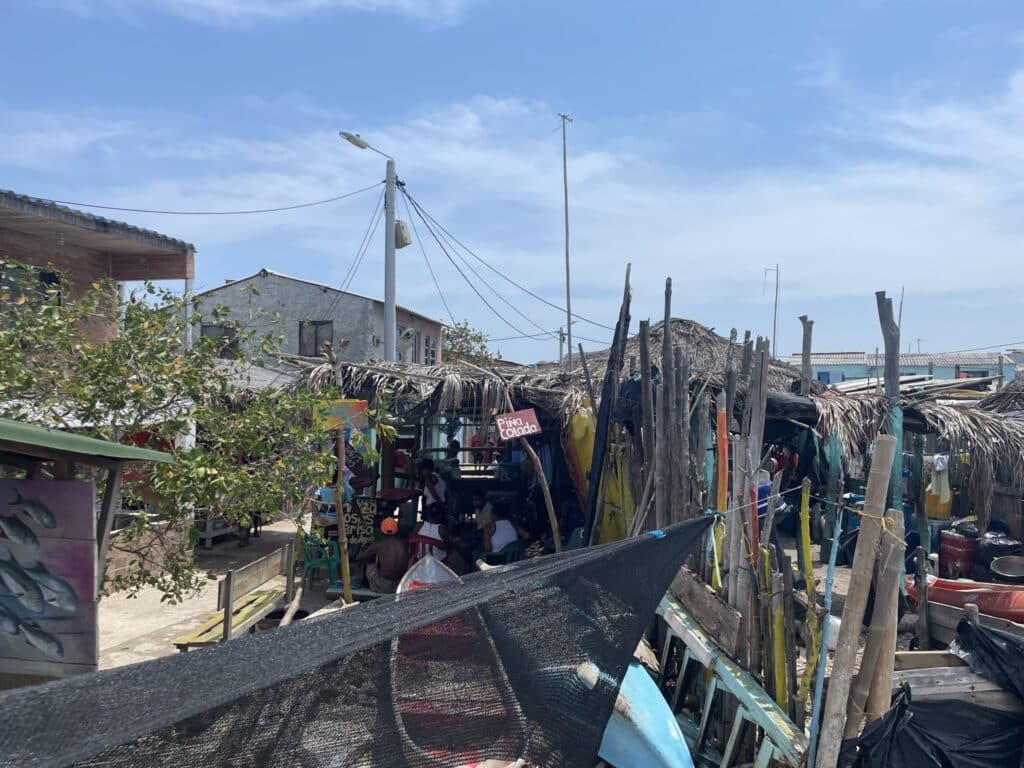
    Arriving on Santa Cruz del Islote, the most densely populated island in the World

    He first brought us to the island’s aquarium—a small, handmade pool where a few species of local marine life are kept: stingrays, small sharks, and colorful fish. Visitors can even swim with them for a small fee. I chose not to join in—not out of fear, but because I wasn’t sure about the cleanliness of the water. Maybe I was being cautious, but the heat and scent had made me more sensitive to these things.

    From there, we began our walking tour of the island, which measures around 200 meters in length and 100 in width. And yet, those few square meters are home to a thriving, tightly knit community.

    The narrow pathways were alive with energy. Children played soccer in every open space. Women chatted or did laundry near their homes. In one corner, a group of men shared a bottle of rum and laughed over music playing from a speaker. Despite the crowded conditions and the challenging climate, life here moved with rhythm and resilience.

    Santa Cruz del Islote isn’t a place filled with typical tourist attractions. It’s home. You’ll find colorful murals, a small church, a school, a shop, and a large water tank—crucial, because freshwater must be delivered by boat from nearby Isla Tintipán. There’s not a lot of space, but there’s a whole world of daily life unfolding here, rich with dignity, creativity, and community spirit.

    Tales from the tiny Caribbean islands

    Mr. Gusto had more than a few stories to tell. As we wandered the narrow paths of Santa Cruz del Islote, the most densely populated island in the world, he began painting a broader picture of the Archipelago of San Bernardo—a constellation of tiny Caribbean islands, some inhabited, others left to the birds and the sea. Located among the Colombian islands near Cartagena, this archipelago has long depended on one thing for survival: fishing.

    That’s when he told us how he lost his hands—not in a shark accident, as my imagination first jumped to, but in a fishing mishap. When he was just ten years old, he went out to sea with his father. They were fishing with dynamite, and it exploded in his hands. Yes, dynamite. At ten years old. As surreal as that sounds, it’s not the only adrenaline-fueled activity on the island. He also mentioned the controversial, and technically illegal, cockfighting matches held here. With few alternatives for entertainment, this tradition has persisted, though it’s not without its critics.

    But what truly stayed with me was the story of the island itself. Santa Cruz del Islote didn’t exist in its current form until the 1860s. Originally, it was just a sliver of land—a safe haven where fishermen from nearby tiny Caribbean islands could take shelter during storms, protected by a coral reef. Over time, they began to expand the island, adding everything they could find: coconut husks, logs, seashells, debris, and yes, even garbage. It’s a partially artificial island, born of necessity and persistence.

    Back then, it didn’t even have a name. But legend has it that a wooden cross washed ashore one day, and from that moment, it became known as Santa Cruz del Islote. Over the decades, some residents moved to nearby islands like Tintipán and Múcura, while others stayed, slowly building a tight-knit, overgrown village on the sea. Today, the island has a school (which even children from other Colombian islands near Cartagena attend), a local council formed in 2013, and since 2020, access to the internet.

    I wouldn’t call it the most beautiful place I’ve ever visited. But it’s certainly one of the most extraordinary, a place with a soul, a history, and a rhythm all its own.

    I, too, once fished with dynamite…


    Every time I longed for something,
    I wanted more, wanted it easier, faster.
    Instead of being a better fisherman.
    I dreamed of blowing the sea wide open.
    One day, the thought came to me—
    “Why not fish with dynamite?”
    Lucky me, it blew up in my hands—
    before it could shatter the reef,
    that silent wall holding back the deadly waves,
    the only thing standing between me and disaster.

    Luxury through simplicity in Archipelago of San Bernardo

    We left Santa Cruz del Islote the same way we came—rocking gently in the small fisherman’s boat, its wooden frame creaking as it cut through the water. As the island faded behind us, I turned for one last look. From a distance, it looked like a floating village stitched together from stories and cement, clinging to the sea like it refused to be forgotten.

    Just as we drifted away, I noticed the fisherman pull something from a net with practiced ease: a large, bright-red lobster, still writhing. I asked how much. “50 000 pesos” he said, with a shrug. Around 12 dollars for the freshest seafood imaginable—less a transaction, more a passing of good fortune between strangers.

    We weren’t headed back to the mainland just yet. Our next stop was what the locals called a “private island”—a phrase that sounds like luxury, but here simply means quieter, emptier, untouched. On the way, we passed a scatter of floating houses and makeshift bars resting gently on the water. They looked like dreams suspended between sky and sea—shacks on stilts painted in faded blues and yellows, pulsing with slow music and slow life. I couldn’t stop staring. It was all so simple, so barebones—and so beautiful.

    When we docked, the island revealed itself for what it was: a quiet stretch of sand, hammocks swinging lazily between palms, and a small outdoor kitchen tucked under a thatched roof. It wasn’t much, but it didn’t need to be. The sea did the rest.

    The fishermen got to work right away. In that humble kitchen, they grilled the lobster over open flames, serving it with rice and crispy patacones—slices of fried plantain, golden and salty. I ate with my hands, sitting barefoot at a plastic table in the shade, the ocean breeze cutting through the midday heat.

    That meal wasn’t fancy, but it was unforgettable. The lobster was smoky and sweet, the rice fluffy, the patacones crunchy and perfect. Everything tasted like the day itself—wild, warm, and generous in ways I didn’t expect.
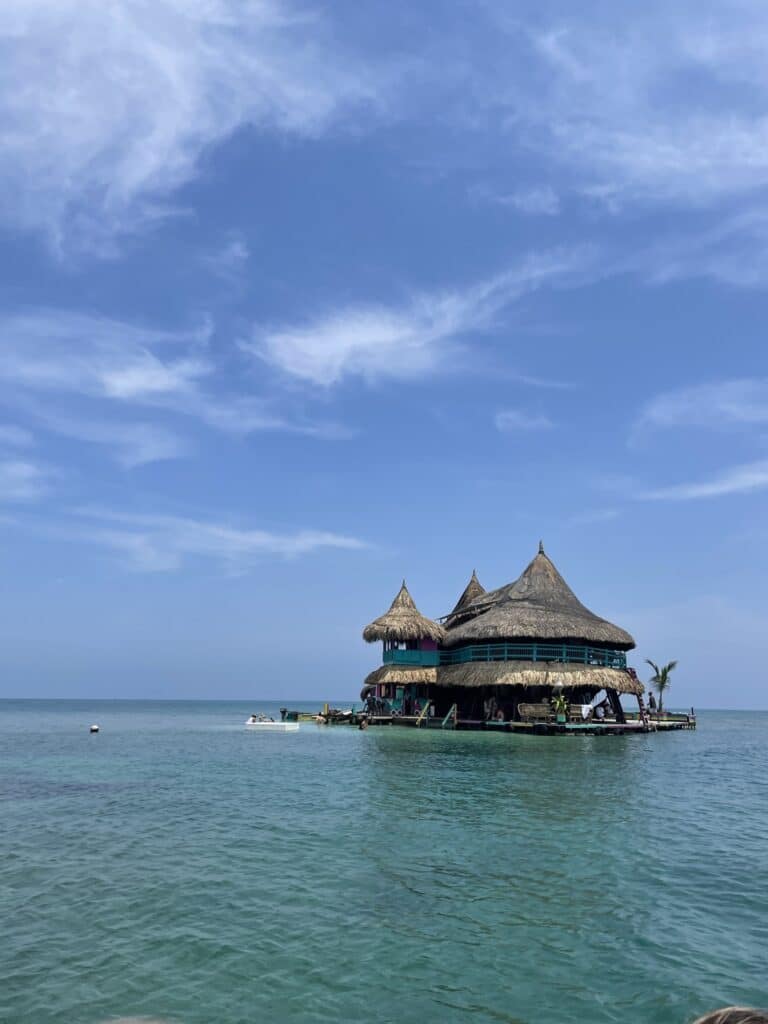
    Party house on the Caribbean, in Archipelago San Bernardo Colombia

    The Long Ride Home (and a Bit of Salt in the Wounds)

    The return to Cartagena was… something else. If the way out had been rough, the way back was a battle. This time, we were riding against the wavesthree solid hours of white-knuckle grip, trying not to be tossed into the Caribbean. The sea, once playful and warm, had turned into a relentless force, slapping the boat with every surge like it had something personal against us.

    By the time we reached the coast, my arms felt like they’d wrestled Poseidon himself. Two days later, I still had muscular fever. It hurt to lift my backpack, to hold a cup of coffee—hell, it hurt to breathe too deeply. My body had taken the brunt of the ocean’s mood, and it wasn’t shy about reminding me.

    As if the ride wasn’t enough of an experience, there was also the Venezuelan guy on board. You know the type—shirt unbuttoned, sunglasses even in the shade, and a deep need to be heard. “Déjame que te lo explico, papi,” he kept saying, trying to lecture the rest of us on how to relax so we wouldn’t feel the pain. Then he promptly lost his balance on a wave and nearly flew overboard. The irony didn’t go unnoticed, though we all pretended to care deeply for a moment or two. Still, the chaos and discomfort of the journey didn’t erase what came before.

    The Archipelago of San Bernardo, the tiny Caribbean islands near Cartagena, the strange wonder of Santa Cruz del Islote—the most densely populated island in the world—they left a mark. Not just on my skin, sunburned and salted, but deeper.

    Conclusion

    If you’ve made it this far through my story, thank you. And if this place sparked something in you—curiosity, a craving, a question—know that I’m happy to help. You can check out more of my travel articles, reach out if you’re planning a similar trip yourself, or just follow along on Instagram for more stories, scenes, and surprises from places like this.

    Sometimes the best parts of the world are the hardest to reach. But trust me—they’re always worth the ride.
  • LOST IN the Highest Mountains in Europe: Surviving 130 km TO MESTIA

    LOST IN the Highest Mountains in Europe: Surviving 130 km TO MESTIA

    It’s quite strange how, in a world obsessed with “the biggest,” “the most beautiful,” “the most expensive,” and basically “the most everything,” there’s still a place of immense significance that remains almost untouched by most people. I’m talking, of course, about the highest mountains in Europe—the mighty Caucasus.

    In the winter of 2024, during my trip to Georgia, I decided to timidly dip my toes into exploring these colossal peaks. I started with a short visit to Kazbegi, where I got a glimpse of their sheer grandeur. But what truly captured my imagination was Svaneti—a land far more remote, far less known. One of the hidden gems in Europe, fiercely guarded by the Caucasus Mountains, where time itself seems to slow down, protecting a small but extraordinary ethnic group—the Svans. With their own language, traditions, and way of life, they have remained remarkably untouched by the outside world.

    My curiosity burned like a winter fire, but getting there—especially in January—was no smooth ride. The journey was an adventure in itself, filled with unexpected twists, turns, and a fair share of challenges. In this article, I’ll share my brief but unforgettable experience in Mestia, the heart of Svaneti, and the wild road that led me there. Buckle up—it’s going to be a bumpy ride!

    LOST IN the Highest Mountains in Europe: A good story starts with a good pie and a rifle

    I had been driving on Georgia’s far-from-perfect roads for quite some time, leaving behind me the last villages and the last soviet remains, being fully aware that the real challenge was about to begin—a grueling 130-kilometer stretch through the highest mountains in Europe to reach Mestia, the heart of Svaneti. I was in a bit of a hurry, knowing the road would be tough, daylight was short, and driving at night was absolutely out of the question.

    Still, my stomach had its own plans. I needed a break—some rest, a quick bite—so I stopped at what the map claimed was the last roadside stop (and indeed, it was the last one). A tiny wooden hut, standing precariously on the edge of a curve, nestled deep in the mountains. There, they sold Georgia’s legendary khachapuri, a pastry overflowing with rich, local cheese—the kind that melts your worries away.

    Behind the counter stood a young woman, probably in her early twenties, dressed simply but with an expression that quickly shifted from neutral to deeply confused as she realized I spoke neither Svan nor Georgian. For a brief moment, we just stared at each other—me, hungry; her, puzzled. Then, like a lightbulb flickering on, she figured it out: if I had stopped there, of course, I wanted exactly what everyone else did—a hot drink and a warm, cheesy pie. With the help of some dramatic hand gestures and an intense game of charades, I finally got my hands on the much-desired khachapuri. And it was divine.

    the-highest-mountains-in-europe-soviet

    As I sat inside the tiny cabin, savoring every bite, something outside caught my eye—something equal parts hilarious and mildly alarming. A group of men, clearly locals, were gathered right in the middle of the icy road, playing with a shotgun. Their flushed faces and swaying movements gave away their intoxication, but what truly sealed the deal was their choice of entertainment: making snowballs, tossing them into the air, and trying to shoot them mid-flight. There they were—wobbling, tipsy, waving around a loaded shotgun—on a frozen mountain road, right in a curve. What could possibly go wrong?

    From my experience, people engage in dangerous activities for one of two reasons:

    1. They are completely unaware of the risk (which seemed unlikely, as no one from the roadside stop was running out to stop them).
    2. They live with constant danger, to the point where things that seem insane to the rest of us feel perfectly normal to them.

    That last thought sat uneasily with me as I got back in my car, ready to continue my journey.

    I knew driving through the highest mountains in Europe in January would be tough—but I hadn’t expected it to turn into an extreme driving experience.

    the-highest-mountains-in-europe-locals

    LOST IN the Highest Mountains in Europe: A portal to a mystical land

    I have to admit, the road to Mestia, Georgia can be summed up in just two words: exhausting and nerve-wracking. Over 100 kilometers of endless switchbacks, winding through dark valleys and towering mountains, on a road that looked like it had survived a bombing raid. And in a way, it had—only the bombardment here was entirely natural, caused by landslides and avalanches. These are the obstacles that putting out of sight one of the hidden gems in Europe.

    In many places, the remnants of what once was asphalt were more of a hindrance than a help—more craters than road, really. Luckily, my high-clearance 4×4 allowed me to crawl along at a daring 20, sometimes even 30 km/h. For about three, maybe three and a half hours, I drove through the same haunting scenery—a sheer rock face on the left, a dizzying abyss on the right, endless switchbacks, and a game of “choose the smallest crater” to keep things interesting. So far, not such an extreme winter driving experience.

    But what made the drive truly unsettling was the mountain itself, which—with infuriating consistency—sent down hundreds, sometimes thousands, of small rocks tumbling onto the road. Sometimes they were harmless little pebbles, but other times, they grew into ominously large stones, dropping just 5–10 meters in front of me, forcing me to exhale in relief every single time they didn’t land on my car.

    Every now and then, the road would tease me with a stretch of “good asphalt” (a term that, after this journey, had become extremely relative). Just as I’d allow myself to speed up a little, I’d be slammed back into reality—forced to brake hard as yet another crater field appeared, as if the aftermath of a meteor shower had just materialized in front of me.

    And then, the real surprise. On one of these rare “clean” sections, I pressed the gas a bit more confidently. Coming out of a curve, I suddenly discovered my lane was gone. No signs, no warnings—just a void where the road should have been. A massive chunk had simply collapsed into nothingness, forcing me to yank the steering wheel hard to the left. Luck was on my side—no one was coming from the opposite direction.

    This delightful near-death experience happened just past the halfway point. And weirdly enough, it was exactly the adrenaline injection I needed to power through the rest of the journey.

    the-highest-mountains-in-europe-mestia-road

    Then, suddenly, it felt like I had emerged from an endless tunnel of cliffs, abyss, and despair into a world that finally opened up. A small clearing appeared, and with it—the first house I had seen in what felt like an eternity. The first sign of human life after 100 kilometers of untamed wilderness.

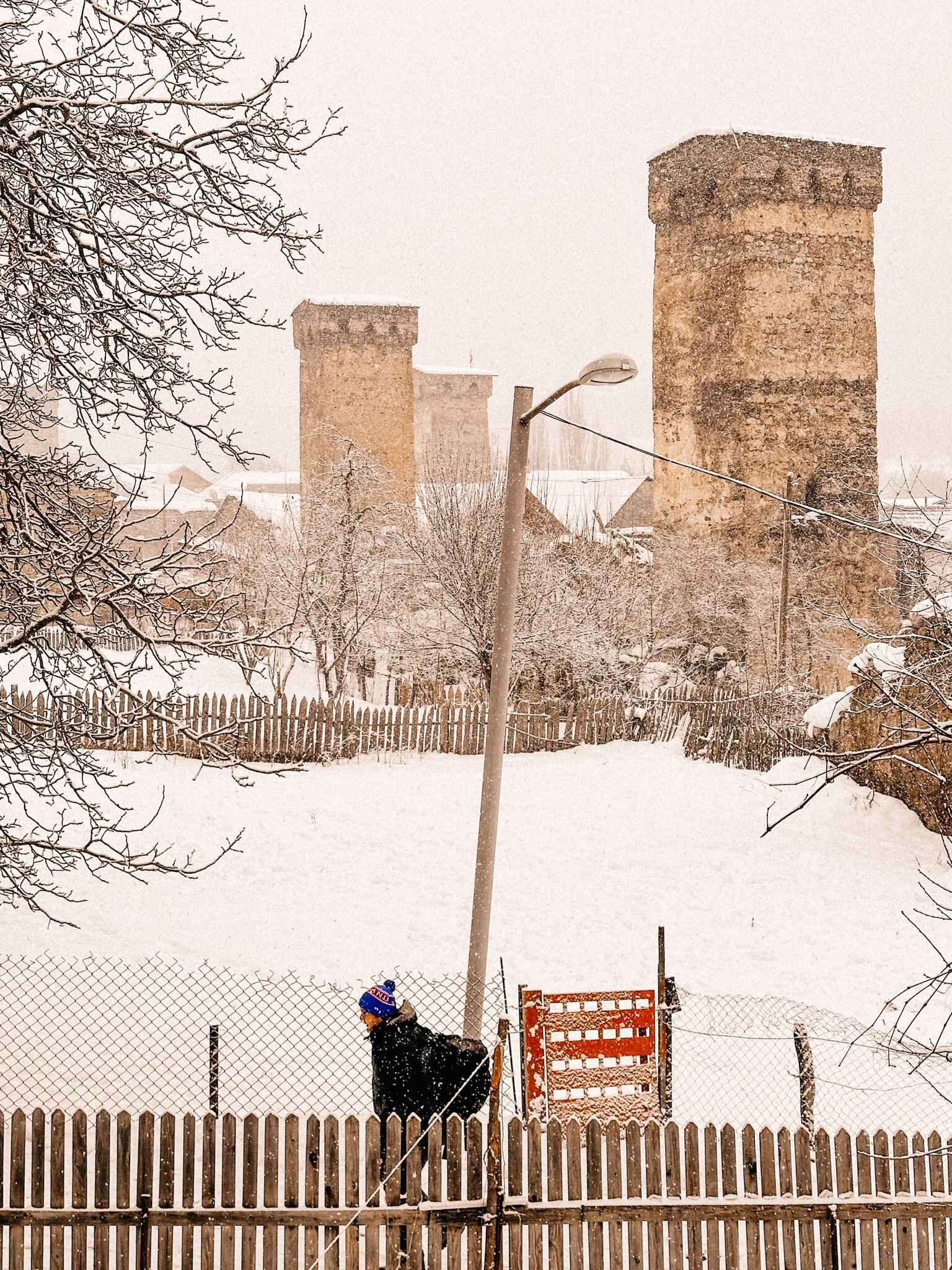
    And then, as if on cue, the snow began to fall. Not a blizzard, not a violent storm—just a soft, gentle snowfall. Large, lazy flakes drifted down, almost like a holy water blessing, washing away my tension, my stress, my anxiety. It felt like a divine sign whispering, You made it. You’re safe now. At that moment, in the distance, I saw them—dozens of ancient stone towers rising against the snowy landscape, announcing my arrival in Mestia Georgia. The majestic Svan Towers.

    That moment—the peaceful snowfall wrapping around the legendary Svan towers—is forever burned into my memory. I felt as light as the falling snowflakes, as happy as a child on Christmas Eve, and as proud as a mountaineer reaching the summit. I had conquered this monstrous road. I had passed through a twisted, merciless portal of stress, chaos, and anxiety. I had suffered enough, and in return, I had been transported into a breathtaking winter painting, straight out of Monet’s imagination.

    I had endured. And now, I could finally enjoy my reward. Or at least, that’s what I thought…

    They say heaven hides in the skies,
    But it’s more hidden where our feet lie.
    One heaven shines in joy and grace,
    Another’s cloaked in dark disgrace.
    One heaven lives within me, too,
    And another’s found in the heart of you.

    Yet from one heaven to another, a tunnel we must tread,
    A tunnel through the moon, the sun, and Saturn’s thread.
    A tunnel built from Mars to skies so vast,
    A purifying road to cleanse the past.

    Wherever, whenever, heaven may be,
    It greets you at the door, and sets you free.
    It washes your feet, your hands, your mind,
    Your thoughts, your dreams, leaving none behind
    .

    LOST IN the Highest Mountains in Europe: The Svan Towers of Mestia Georgia

    Arriving in Mestia during the winter felt like stepping into a dream. The snow fell gently, blanketing the town in a soft, ethereal glow, creating a landscape that seemed pulled from a fairytale.

    I stayed in a cozy guesthouse run by a warm and welcoming family, and the memory of the elderly grandmother remains etched in my mind. I can still see her, with practiced hands, adding logs to the old Soviet wood stove, battling the bitter cold as the fire crackled to life. As I set out to explore the town, the atmosphere was nothing short of magical. The snow, the iconic Svan towers rising proudly against the white landscape, and the only sound breaking the stillness was the distant bells of cows echoing through the crisp air.

    Talking a bit about this place, Mestia is the heart of Svaneti, a remote and ancient region nestled in the towering Caucasus Mountains, known for its rugged beauty and unique culture. The Svan people, a subgroup of Georgians, have lived here for centuries, preserving their distinct language, customs, and traditions.

    The Svaneti region is also home to the Svan towers, striking defensive structures that date back to the 9th century. These towers were once used by families to protect themselves from invaders and the harsh mountain elements. Made of stone and towering above the landscape, they have stood as silent witnesses to centuries of history, from medieval wars to more recent challenges of isolation. Entering one of these ancient towers, I could feel the weight of the past in every creaking floorboard and weathered stone.

    the-highest-mountains-in-europe-cows


    The Svan people lived in near total isolation for centuries, nestled in the remote valleys of the Caucasus Mountains. Surrounded by towering peaks, their lives remained untouched by the outside world until the last century. This natural barrier kept them safe and allowed their unique language, customs, and traditions to thrive without external interference.

    However, while they may have lived in solitude, their lives weren’t exactly the peaceful, idyllic existence you might imagine. The famous Svan towers, which still stand proudly today, were not just for show—they were designed as fortifications to protect families during the numerous vendettas that often flared up between them. So, even though the Svan people lived in their own little world, it wasn’t exactly a “happy, peaceful paradise.”

    Rather than sipping tea and singing around the fire, they were more likely to be defending their honor or family name, with a few heated arguments thrown in. It turns out that even when you live without outside interference, you still find ways to keep things interesting—just ask any of the Svan families with a tower!

    the-highest-mountains-in-europe-svan-towers

    Going forward in our current days, being a town in the highest mountains in Europe has its own perks. Mestia is highly appreciated by the locals as a prime destination for skiing, especially during the winter months. The region’s mountainous terrain offers excellent slopes, attracting both beginners and experienced skiers alike.

    However, when summer arrives, the focus shifts to hiking, as the region becomes a paradise for outdoor enthusiasts. With its breathtaking views, lush greenery, and well-marked trails, Mestia is an ideal location for trekking and exploring the stunning natural beauty of the Caucasus mountains. The locals take pride in the diversity of activities their town offers throughout the year. In any case, if you are interested to read more about this place from a touristic perspective you can check this travel guide or this CNN article.

    The sense of history and timelessness was overwhelming as I walked through the snow-covered streets. However, as I explored, the weather began to shift. What had started as a gentle snowfall soon escalated into a full-blown snowstorm. The wind howled, and the snow swirled around us, transforming the town into a white-out. The road to Mestia, already a challenge with its narrow and winding paths, became nearly invisible beneath the relentless storm.

    Would the road even be passable when I left? The thought lingered, unanswered, as the blizzard raged on, and I realized that the mountains were not just a backdrop to this place—they were its fierce protector, and I was at their mercy.

    the-highest-mountains-in-europe-svan-towers

    LOST IN the Highest Mountains in Europe: Extreme driving experience

    The morning had come, and the snowstorm had been raging nonstop for over 24 hours. I drove to the city center, where I patiently waited in a parking lot for the weather to improve so I could continue my journey. I enjoyed a Georgian pie, this time filled with meat, followed by one more coffee, and then another.

    I moved to a different parking spot to check the car. I had something that was supposed to act as snow chains—12 plastic beads, which, placed around each tire, were supposed to increase traction. While I was checking the car, a mysterious local approached with curiosity. A tall, skinny man with a rugged face and a missing eye tried to warn me in Russian that it wasn’t safe to travel in such weather. I knew that, of course, but I had to reach Zugdidi (a town at the foot of the highest mountains in Europe) that evening. Realizing we couldn’t communicate effectively because of the language barrier, he finally left me alone.

    With my “chains” on the tires, I waited for a moment when the snowfall seemed to calm down, and off I went leaving slowly the Svan towers behind. The road—absolute horror.

    The journey alternated between light snow and fierce blizzards with zero visibility. The road was completely covered in snow, and I knew that parts of it had collapsed. I drove as close as I could to the rocky cliffs, where boulders and chunks of snow and ice were falling. At first, the plastic beads gave me a bit of traction, but within 30 minutes, I had lost them all. Why? Well, the soft snow had covered all the craters in the road, making them undetectable. I hit them all, and slowly, the plastic chains broke. With the loss of the chains, I also lost traction.

    the-highest-mountains-in-europe-winter-driving

    The road was just as bad as on the way there, but now I was the only car on it. Visibility was almost zero, the craters were invisible, and with every turn, I was losing control of the car in a horrible drift. For over 100 kilometers, it felt like I was on a sled, barely in control, with no visibility, and rocks falling from the slopes of the highest mountains in Europe. I tried to control the skids as best as I could, but honestly, I think fate and luck were the only things keeping me going. It was terrifying. By the time I reached each curve, I was laughing neurotically. It was bad. Really bad.

    Just when I thought I had made it through this nightmarish road, after 3-4 hours of torture, what I had feared from the start happened—there was a giant boulder blocking the road. In front of it, the authorities were waiting for me, probably expecting me. When I saw the boulder, I slammed my head against the wheel, thinking, “What if I have to turn back to Mestia now?” Yet, by some miracle, I squeezed past it and continued forward. After passing that obstacle, I saw the authorities had closed the road. Police crews were turning all the cars around that were heading toward Mestia.

    Then, the road improved slightly, becoming a little gentler, and I could see traces of asphalt again. The extreme driving experience, in January, through the Caucasus mountains was over. All that was on my mind was the magnificent pie from the famous stop I had visited on my way there.

    I have also taken some shorts videos of this road, captures that you can explore on my Instagram page.

    the-highest-mountains-in-europe-rock-on-the-road

    Conclusion: An Epic Georgian Finale

    At the famous stop by the side of the road, there was a lively party going on. A man, along with his family, was enjoying Georgian music, dancing, and drinking. As soon as I entered, I was greeted with a glass of whiskey (which I politely declined, as I still had to drive) and invited to join the dance. The atmosphere was warm and full of joy, like a break from the harsh road outside.

    But the highlight of the moment was the man at the center of the celebration. He was quite tipsy, swaying to the rhythm with an uncoordinated but enthusiastic energy. His face was flushed with the warmth of the drink, and his smile was as wide as the mountains around us. As he danced, his movements were wild, occasionally veering into an exaggerated twirl or a misstep, which only made his family laugh louder.

    He was the kind of person who would suddenly grab anyone nearby, tugging them into the circle, trying to get them to join in, even though they had just walked in from a snowstorm and probably weren’t prepared for an impromptu Georgian dance. But his carefree spirit was contagious, and for a moment, all the exhaustion and tension of the road disappeared. This, I realized, was how this “mystical tunnel” of a journey ended—filled with good vibes, food, and laughter.

    If you enjoyed this winter adventure and want to read more about my travels, don’t forget to comment below and read my other articles! If this icy journey through the highest mountains in Europe was a bit too chilly for your taste, check out my Amazon jungle article for some much-needed warmth and tropical vibes. And if you’re into ex-Soviet adventures, don’t miss my article on the Aral Sea for a deep dive into a fascinating and surreal landscape. Stay tuned for more adventures by following my Instagram page and feel free to contact me if you need help in crafting your own adventures.