
Our method
The idea in one paragraph
Personality-based travel design is how we plan every trip. We design itineraries by hand around your personality, your pace and the places that suit you. Personality research gives us the structure, and our own travels give us the detail: the quiet town, the better route, the day you’ll want to repeat. Two people can visit the same town and have very different days. One wants the market at nine. The other wants a bench by the river at six. We use the Big Five, a widely used model of personality in research, to talk about those differences in a consistent way.
Then we match them to places, routes and rhythm. This page explains how our personality-based travel design works, and where the method stops.
The assessment
What the assessment measures
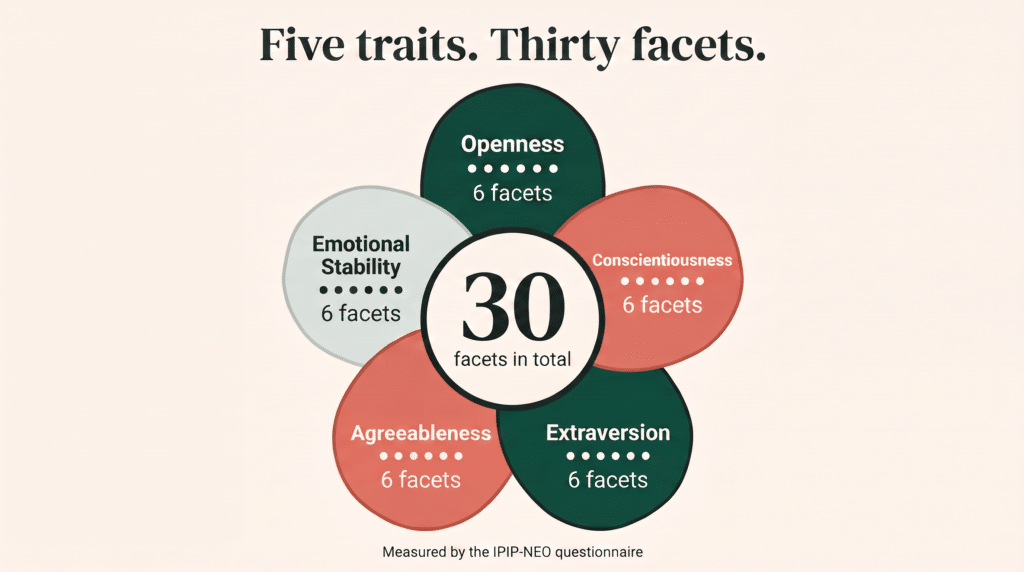
The Big Five describes personality with five broad traits: Openness, Conscientiousness, Extraversion, Agreeableness and Neuroticism. Each trait is made up of six facets, which gives 30 facets in total. A trait is the wide view. A facet is the closer one.
The difference matters for travel. Two people can both score high on Extraversion for different reasons. One likes crowds and late nights. The other likes long talks with a few people. The facets help us tell them apart. In practice, our personality-based travel design looks at how much novelty you enjoy, how much structure helps you relax, how much social energy a day costs you, and how you feel when plans change.
The questionnaire
What the IPIP-NEO is
The IPIP-NEO is a Big Five questionnaire built from the International Personality Item Pool, a public collection of personality items used in research. It measures the five broad traits and their 30 facets, and its reliability and validity have been tested in published studies.
That applies to the questionnaire. The way we match personality to places is our own method, and we explain it, limits included, on our methodology page.
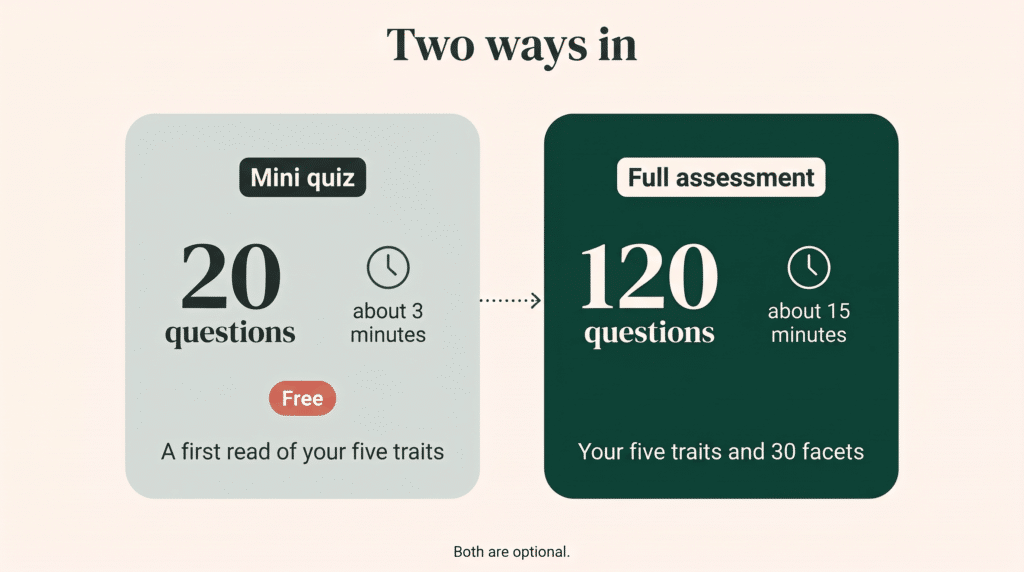
The full assessment on our quiz site takes about 15 minutes and gives you a detailed profile.
The match
How our personality-based travel design matches you to places
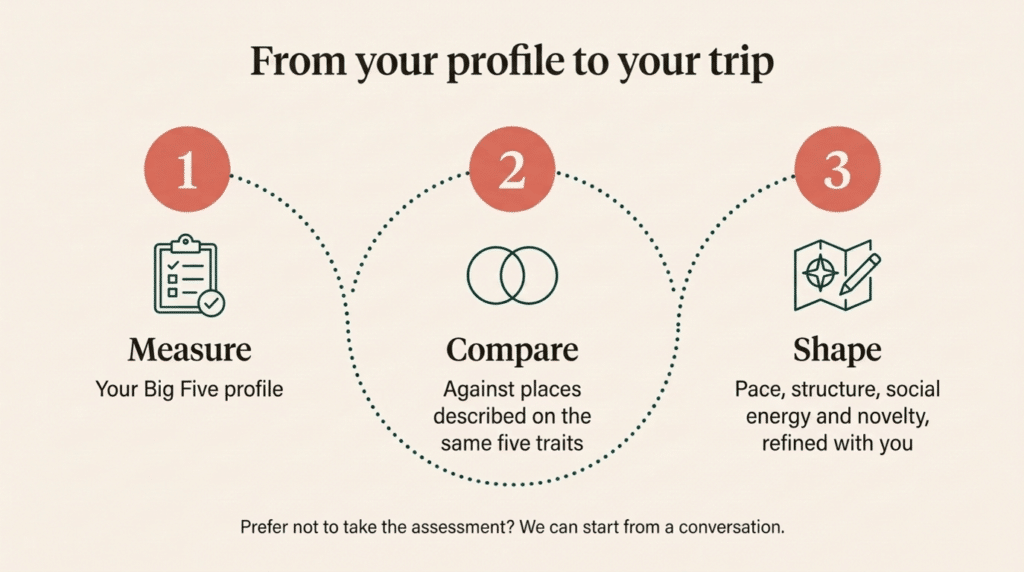
Same five traits
We describe each destination on the same five traits that we use for people. A fishing town in Galicia, a night train to Abisko and a village in Maramureș each ask something different of a traveler. They ask for a different amount of novelty, structure, company and calm. We then compare your profile with the place.
Facets before averages
When a facet and its broader trait point in different directions, we give more weight to the facet. A traveler can sit in the middle on Extraversion overall and still need a lot of time alone. That detail matters more to a plan than the average does.
Different trips, different weights
Some traits matter more for some places and trips than others. Openness counts for a lot on a trip built around culture and unfamiliar streets. Neuroticism counts for more on a route with long transfers or little predictability.
Reviewed with you
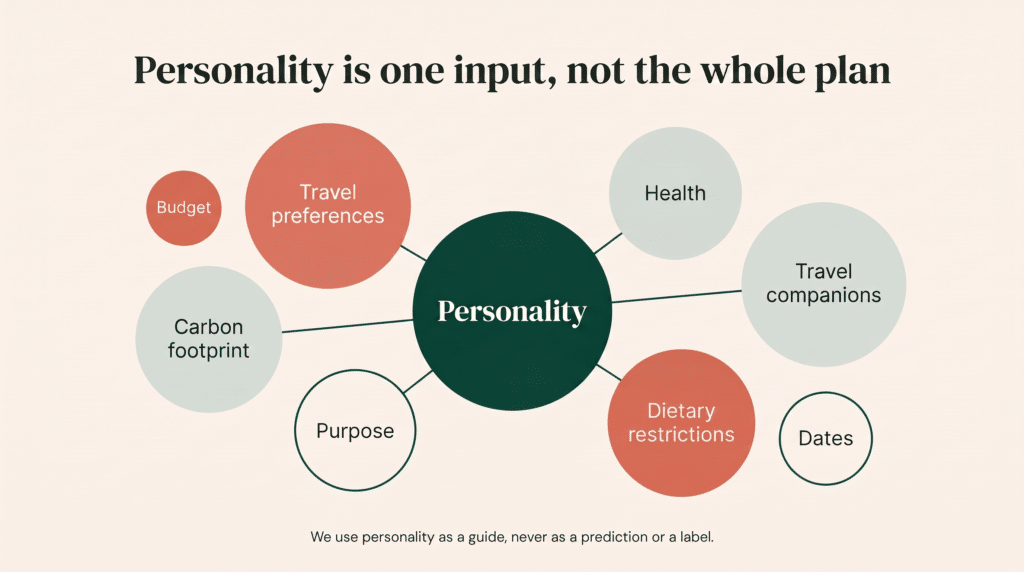
We review the result with you on the discovery call. You tell us what feels right and what doesn’t, and we adjust. The plan also takes your budget, your dates, your companions and your health into account. Personality is where we start. It is never the only input.
The evidence
The research behind it
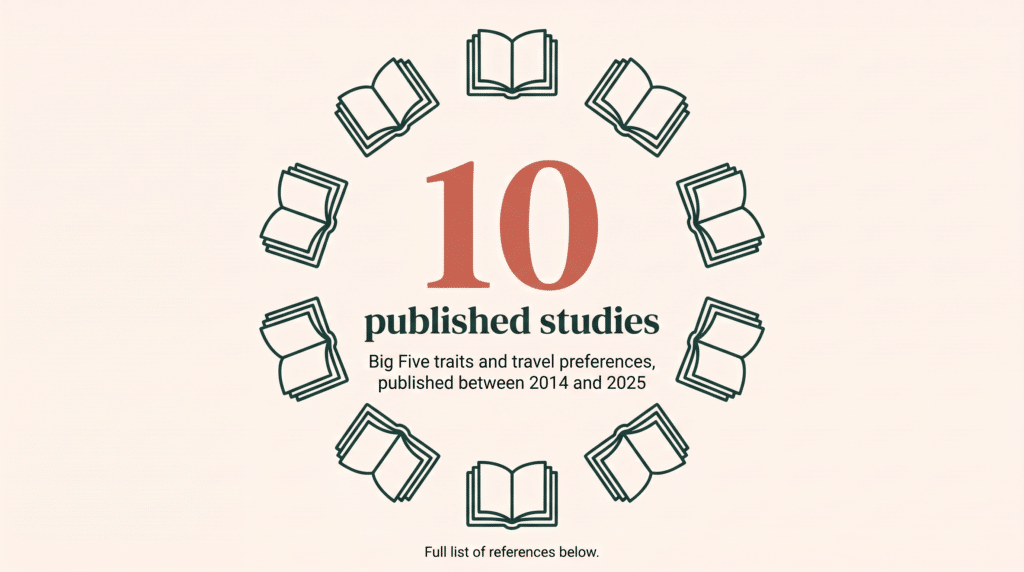
Our personality-based travel design starts from published research that links Big Five traits to travel preferences and destination choices. We drew on these ten studies:
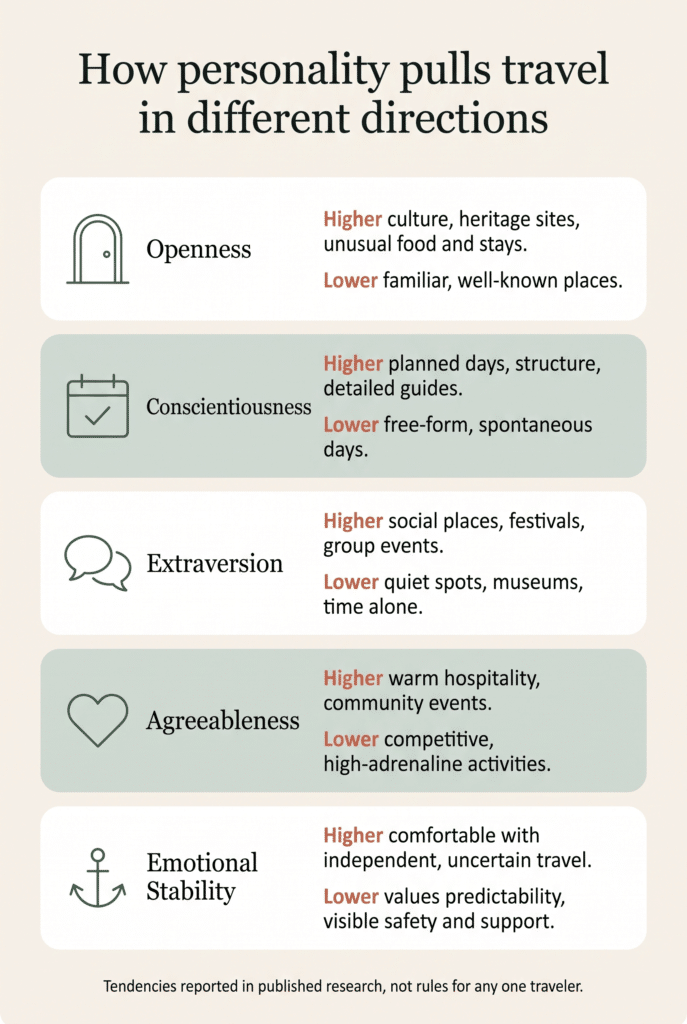
Findings in this field are mixed. Effects tend to be small to moderate, and some studies find few significant links. We treat the research as a guide to patterns, not as a rule for any one person.
Read the ten studies in full
- Alves, P., et al. (2020). Modeling Tourists’ Personality in Recommender Systems. UMAP’20: 28th ACM Conference on User Modeling, Adaptation and Personalization, 46-56.
- Kovačić, S., et al. (2022). What Shapes Activity Preferences? The Role of Tourist Personality, Destination Personality and Destination Image. Sustainability, 14(3), 1803.
- Verma, P., et al. (2023). The influence of personality traits on the decision making process and destination choice for travel planning. International Journal of Indian Culture and Business Management, 27(1), 23-44.
- Tran, X., et al. (2015). Effects of the Big Five Personality Traits on Recreation Types – The Case of Vietnam Tourism. University of Massachusetts ScholarWorks.
- Coudounaris, D., et al. (2025). ‘Big-5’ personality traits and revisit intentions: the mediating effect of memorable tourism experiences. Journal of Tourism, Heritage & Services Marketing, 11(1), 46-60.
- Akhrani, L.A., et al. (2020). Examining the Role of Big Five Personality in Soft-Adventure Traveling Type. GeoJournal of Tourism and Geosites, 32(4), 1303-1308.
- Bilim, Y. and Bilim, M.B. (2014). Does a Destination have Personality? Personality and Image Issues of a Destination. Athens Journal of Tourism, 1(2), 121-134.
- Cavusoglu, F. (2021). The Relationship between Personal Traits, Travel Motivation, Perceived Value and Behavioural Intention of Tourists Participating in Adventure Activities. International Journal of Contemporary Economics and Administrative Sciences, 11(2), 391-415.
- Kwon, B. and Park, E. (2015). The Relationship Between People’s Personality Types by the MBTI and Tourist Behaviors. International Journal of Management, Business, and Economics.
- Salazar Duque, D. and Osorio Espín, M.A. (2024). The influence of personality and desires on motivation for selecting tourist destinations. Mercados y Negocios, 25(53), 51-80.
The limits
What it cannot do
A guide, not a prediction
Personality is a guide, not a prediction. It can’t tell us what you will enjoy on a given Tuesday. It is one input among several, next to your budget, your dates, your companions and your health. It is not a clinical or diagnostic tool, and we don’t use it that way.
A profile is not a label
A profile also isn’t a label. It describes tendencies, and plenty of travelers want a trip that is unlike their usual self. A good plan can make room for that.
Our method is our own
The way we match personality to places is our own method. It builds on the research above.
Using it is optional
Personality is where we start when you want it to be. You can take the assessment, or we can work from a conversation on the discovery call. Either way, the plan is built around you.
Next step
Take the quiz or talk to us
Personality-based travel design can start with a quiz or with a conversation, whichever you prefer. The mini quiz is free and takes about 3 minutes. It is a brief Big Five check that gives you a first read. If you would rather talk first, write to us on the contact page.
Last reviewed: October 2026